The Mechanics of Kinetic Escalation
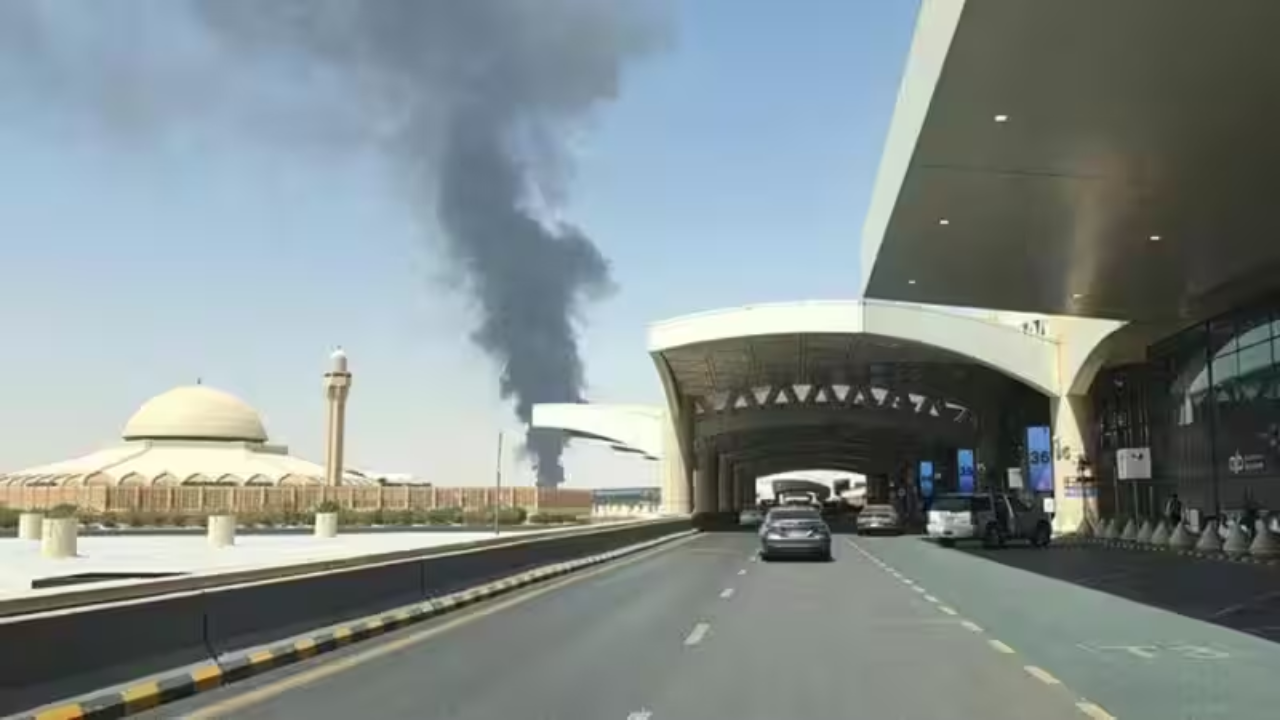
When critical civil aviation hubs experience repeated kinetic targeting within compressed operational windows, the incident ceases to be viewed as a tactical anomaly and must be reevaluated through the lens of systemic defense economics. The series of events involving Riyadh's primary international aviation gateway reveals critical vulnerabilities not merely in point defense capabilities, but in the broader architectural resilience of urban-adjacent transportation infrastructure.
Analyzing these events requires stripping away sensationalized narratives and examining the underlying operational parameters: projectile trajectory characteristics, early-warning sensor integration latency, air defense battery saturation thresholds, and the cascading economic costs of airspace closures. Critical infrastructure protection relies on a balance between interception probability and economic continuity. When repeated engagements strain this balance, the strategic objective of the attacking vector shifts from physical asset destruction to the systemic degradation of commercial throughput and investor confidence.
To understand why secondary strikes succeed or create compounding disruption, we must deconstruct the operational architecture of modern capital airports. These facilities are sprawling, highly visible economic nodes characterized by vast perimeter footprints, predictable flight corridors, and high concentrations of civilian populations. Defending such a zone involves maintaining a persistent kinetic shield against asymmetrical threats, which introduces severe logistical constraints on both military and municipal operators.
The Triad of Airport Vulnerability
The susceptibility of a major international transit hub to aerial threats is governed by three intersecting variables: geographical proximity to regional conflict vectors, the limitations of point-defense interceptor economics, and the high-density footprint of terminal operations.
Geographical Exposure and Vector Trajectories
Riyadh sits within range of various long-range unmanned aerial systems and ballistic vectors launched from protracted regional conflict zones. The flight time of these projectiles affords limited detection windows for traditional radar arrays, particularly when payloads utilize low-altitude terrain masking or autonomous guidance adjustments. Because a capital airport cannot be relocated, its stationary coordinates form a fixed target set. The absence of geographical buffers between the surrounding airspace and the central terminal infrastructure means that any successful penetration of the outer defense perimeter yields immediate operational impact.
The Interceptor Cost Asymmetry
A fundamental economic constraint governing modern defense architecture is the cost asymmetry between incoming projectiles and defensive interceptors. Deploying sophisticated surface-to-air missile batteries against low-cost, mass-produced aerial threats introduces severe budgetary friction over extended operational campaigns. This dynamic forces resource rationing, creating intervals where secondary or tertiary vectors can exploit gaps in coverage. The defender must achieve near-perfect interception rates, whereas the aggressor requires only a single high-profile penetration to achieve a strategic disruption narrative.
Infrastructure Density and Concentration
Unlike dispersed military installations, international airports concentrate high-value assets—fuel farms, passenger terminals, aircraft fleets, and control towers—within a tightly defined geographic zone. This centralization creates systemic fragility. A kinetic impact or even the near-miss debris field of an interception can compromise multiple redundant systems simultaneously, triggering mandatory ground stops, passenger evacuations, and prolonged regulatory investigations that freeze commercial operations across the entire national carrier network.
The Economic Cascades of Airspace Interruption
When flight operations are suspended following a security event, the financial and operational fallout propagates outward through a predictable sequence of bottlenecks. Understanding this propagation requires mapping the direct, indirect, and systemic costs imposed on the aviation ecosystem.
The immediate phase involves terminal lockdown and aircraft diversion. Incoming wide-body aircraft airborne at the time of closure must divert to secondary regional fields, many of which lack the ground-handling infrastructure, fuel capacity, or gate availability to service high volumes of diverted long-haul traffic. This creates immediate schedule fragmentation, stranding thousands of passengers and stranding high-value cargo inventories.
[Security Event Trigger]
       │
       ▼
[Mandatory Airspace Closure]
       │
       ├─► [Aircraft Diversion & Fuel Logistics Strain]
       ├─► [Ground Stop & Gate Gridlock at Primary Hub]
       └─► [Crew Duty-Time Expirations & Network Ripple Effects]
       │
       ▼
[Systemic Schedule Degradation & Insurance Premium Adjustments]
The secondary phase involves crew duty-time limitations and maintenance scheduling. Commercial aviation operates on tightly synchronized asset utilization curves. When an aircraft is grounded out of position in a secondary airport, subsequent rotations are canceled. Crew members trapped away from their base hubs quickly exceed legal flight-time limitations, necessitating mandatory rest periods that paralyze multi-leg routes for days after the physical airspace reopens.
The tertiary phase manifests in insurance markets and risk pricing. Repeated attacks on civil infrastructure alter the risk assessment profiles maintained by hull and liability underwriters. War-risk insurance premiums for carriers operating through the region adjust upward, directly increasing operating costs and compressing airline margins. Concurrently, business travel volume to the affected financial center experiences a temporary contraction as corporate risk committees implement travel moratoriums pending security audits.
Mitigating Asymmetrical Threats to Civil Aviation
Securing high-profile civil aviation infrastructure against persistent aerial threats demands a multi-layered operational pivot away from reactive interception alone toward proactive, integrated risk mitigation.
First, air traffic management systems require deep integration with military command-and-control networks to compress decision-making cycles. Reducing the latency between radar track identification and interception authorization is vital when dealing with high-speed or low-radar-cross-section vectors.
Second, civil aviation authorities must invest in hardened ground infrastructure. Decentralizing fuel storage depots, constructing subterranean or reinforced passenger concourses, and establishing rapid-repair protocols for runway surfaces minimize the operational downtime associated with debris impacts.
Finally, the redundancy of the national aviation network must be structurally enhanced. Relying on a single primary mega-hub concentrates systemic risk. Developing secondary domestic hubs with full customs and long-haul servicing capabilities ensures that if the primary capital gateway experiences a disruption, passenger and cargo traffic can be dynamically rerouted without collapsing national connectivity.
Strategic Forecast
The recurrence of targeting against primary regional aviation nodes indicates that physical security at the terminal perimeter is no longer sufficient to guarantee operational continuity. Future resilience will depend less on the absolute impenetrability of airspace and more on the systemic agility of the broader transportation network. Authorities that successfully transition from static defense models to distributed, highly redundant operational frameworks will minimize the strategic leverage gained by hostile actors through repeated kinetic provocations.