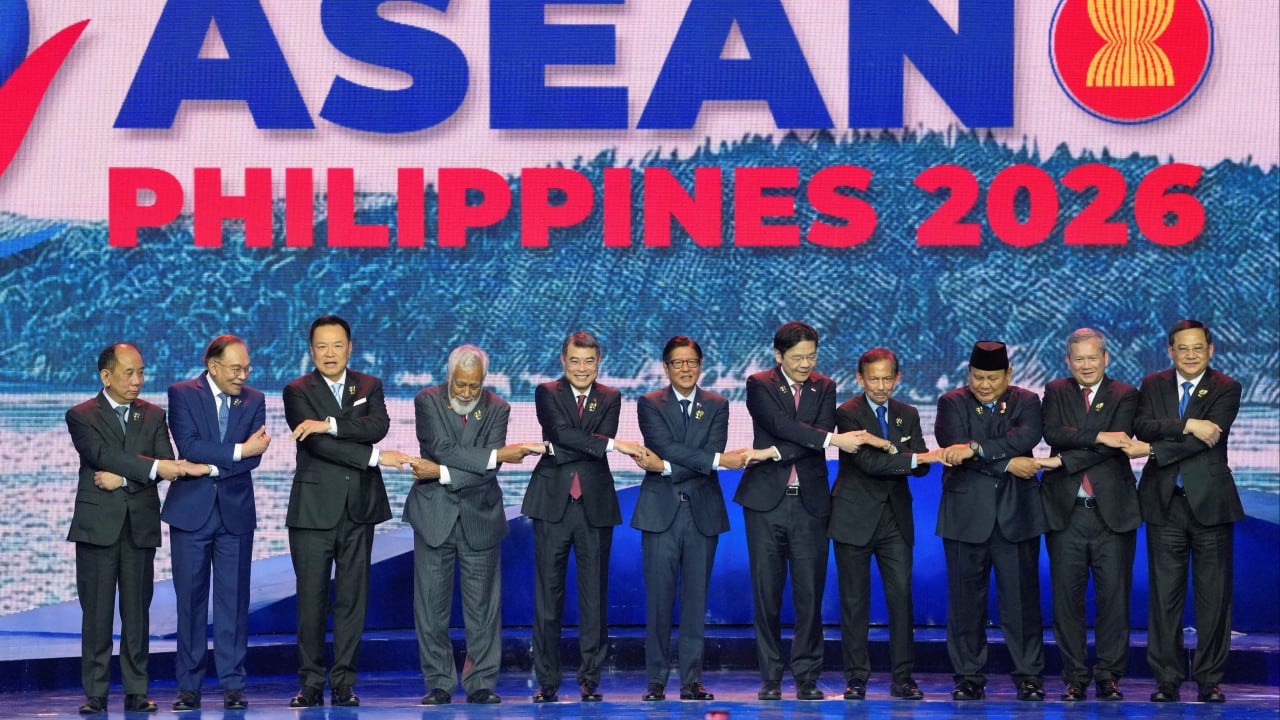
International bodies navigating superpower competition face a recurring structural challenge: how to maintain operational autonomy when economic dependency pulls in one direction and security architecture pulls in another. The Association of Southeast Asian Nations operates under a foundational principle of consensus and centrality, yet structural frictions among major economies constantly test this institutional design. When regional summits host competing global delegations, the diplomatic friction exposes the limits of non-alignment as a passive posture.
The Trilemma of Regional Alignment
To understand the mechanics of neutral diplomacy in Southeast Asia, one must model the diplomatic posture as a balancing act among three competing vectors: security guarantees, trade integration, and sovereign autonomy.
           [Security Architecture]
                     /\
                    /  \
                   /    \
                  /      \
                 /        \
[Trade Integration] ------ [Sovereign Autonomy]
A state attempting to maximize all three vectors simultaneously faces diminishing returns. Deeper integration with one major security provider often induces friction with the primary economic partner. Conversely, relying on regional diplomatic forums to mediate bilateral flashpoints requires institutional cohesion that the member states rarely possess in equal measure.
The Philippines presents a distinct analytical case study within this framework. As a treaty ally of the United States while simultaneously operating within a tightly integrated regional trade ecosystem anchored by Asian manufacturing supply chains, Manila experiences acute vector tension.
The Cost Function of Strategic Ambiguity
Maintaining neutrality is not a cost-free equilibrium; it requires active expenditure of diplomatic capital and economic hedging. When external powers apply pressure to conform to specific geopolitical blocs, the targeted state incurs direct administrative and opportunity costs.
- Diplomatic Overhead: Negotiating multilateral communiques that satisfy divergent member-state interests consumes significant bureaucratic bandwidth.
- Economic Diversification Friction: Hedging supply chain exposure to avoid single-point-of-failure dependencies demands redundant investments in infrastructure and regulatory alignment.
- Deterrence Deficit: Relying on collective diplomatic norms rather than hard power balancing can invite unilateral gray-zone coercion in contested maritime domains.
These variables establish that neutrality functions effectively only when the collective bargaining power of the regional bloc exceeds the bilateral leverage exerted by any single external actor. When intra-bloc alignment fractures, individual member states default to bilateral hedging strategies, weakening the collective framework.
Institutional Mechanics and Decision-Making Bottlenecks
The structural reliance on consensus decision-making within regional multilateralism creates inherent vulnerabilities. While consensus prevents any single member from being marginalized, it simultaneously grants veto power to states with divergent strategic priorities.
This dynamic manifests clearly during high-level diplomatic engagements where global superpowers seek explicit endorsements or joint communiques regarding territorial disputes or economic corridors. The institutional architecture lacks an enforcement mechanism, meaning compliance relies entirely on voluntary adherence. Consequently, external actors bypass regional forums when pursuing immediate strategic objectives, opting instead for minilateral partnerships or bilateral agreements.
Strategic Recalibration for Middle Powers
To sustain relevance in an increasingly bipolar or multipolar distribution of power, middle powers must transition from passive non-alignment to active multi-alignment. This requires decoupling economic partnerships from security dependencies.
Diplomatic resources should be reallocated toward strengthening sub-regional minilateral coalitions—groups of states sharing hyper-specific geographic or economic vulnerabilities that can act with greater agility than a consensus-bound regional body. By diversifying diplomatic touchpoints and locking in rules-based maritime and digital trade frameworks, states can raise the cost of coercion for external powers without requiring formal security guarantees from competing blocs.
The long-term viability of regional neutrality depends on institutional adaptation. Unless structural mechanisms are introduced to manage divergent external pressures without paralyzing collective action, multilateral forums risk devolving into mere dialogue venues devoid of strategic weight.