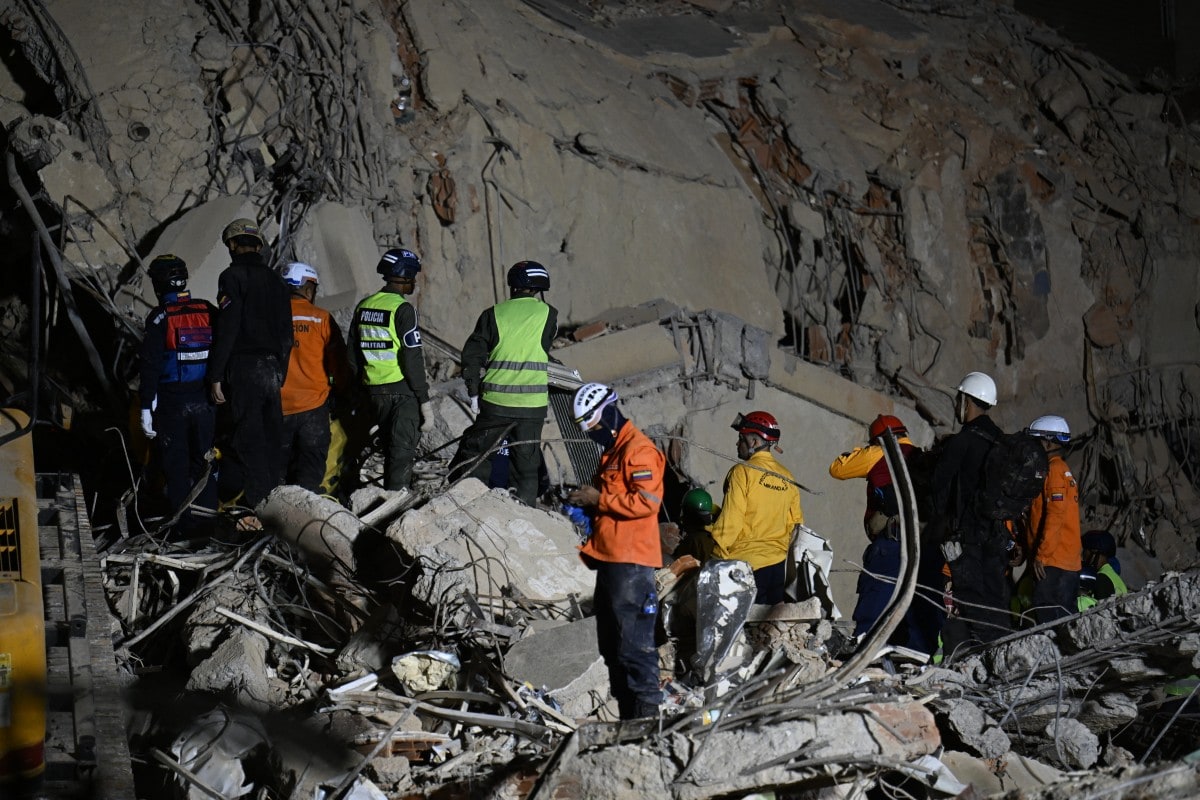
Mechanics of a Seismic Doublet
A rare seismic doublet struck Venezuela's northern coast, releasing kinetic energy via two distinct mainshocks measuring 7.2 and 7.5 in magnitude. The events occurred a mere 39 seconds apart along the San Sebastian fault zone. This temporal proximity transformed the second shock from an independent event into a force multiplier, acting directly upon structural systems already compromised by the initial wavefront.
Standard seismic models calculate damage based on isolated peak ground acceleration. In a doublet scenario, the structural demand changes fundamentally. The first 7.2 magnitude shock initiated elastic deformation and widespread fracturing in masonry and non-reinforced concrete across La Guaira and Yaracuy states. Before the building materials could settle or undergo emergency stabilization, the secondary 7.5 magnitude shock struck.
The physical reality of this back-to-back shock sequence is defined by three distinct mechanics:
- Resonance Accumulation: Structures that survived the first vibration had their natural oscillation periods altered due to micro-cracking. The second wavefront matched these newly elongated periods, accelerating harmonic resonance and causing catastrophic structural failures.
- Progressive Shear Failure: Beam-column joints subjected to cyclic loading in the first phase experienced irreversible shear degradation. The immediate second phase pushed these joints past their ultimate strain capacity.
- Soil Liquefaction in Coastal Zones: The coastal lowlands of La Guaira experienced prolonged ground shaking. This sustained cyclic stress increased pore water pressure within saturated alluvial soils, eliminating soil shear strength and causing foundations to sink or tilt uniformly.
The official death toll stands at 920 individuals, with 3,360 documented injuries. Unofficial data registries list tens of thousands missing. These metrics are a direct output of specific structural and logistical variables rather than simple geographical misfortune.
Structural Vulnerability and Building Code Deficits
The severity of the collapse footprint—notably the complete destruction of 383 major buildings and damage to hundreds more—stems from a prolonged failure in structural maintenance and regulatory oversight. The performance of a building under seismic load depends on its ductility and structural redundancy. In the worst-hit zones of Catia La Mar and Caraballeda, the built environment failed along predictable engineering fault lines.
Non-Ductile Concrete Framing
Much of the multi-story infrastructure along the northern coast utilizes non-ductile concrete frames. These systems lack the dense transverse steel reinforcement required to confine concrete cores during lateral displacement. When lateral seismic forces acted on these structures, the unconfined concrete crushed rapidly, leading to instantaneous column failure and classic "pancake" collapses.
The Soft-Story Deficit
Commercial and residential structures in urban Venezuela frequently feature open ground floors intended for parking or retail, while upper floors contain dense masonry partition walls. This configuration creates a soft-story bottleneck. The upper floors remain highly rigid, while the flexible ground floor absorbs the bulk of the lateral seismic displacement. The structural capacity of the ground-floor columns was overrun within the first seconds of the 7.5 magnitude event, causing upper floors to drop vertically.
Material Degradation and Supply-Chain Substitution
A decade of economic constraints altered the chemical integrity of building materials used for repairs and informal expansions. Sand containing high salt content from coastal areas was frequently used in concrete mixing, accelerating internal rebar corrosion over time. This internal oxidation reduces the cross-sectional area of steel reinforcement, stripping the concrete of its tension capacity long before seismic activation.
Logistics Bottlenecks and Infrastructure Interdiction
Survival rates in the wake of a structural collapse follow a strict decay curve, with the probability of live extraction dropping sharply after the 48-hour threshold. In this event, the transition from rescue to recovery was accelerated by three systemic infrastructure failures that blocked external intervention.
[Seismic Event]
       │
       ▼
[Airport Structural Damage] ──► [Airfield Interdiction] ──► [Zero International Air Insertion]
       │
       ▼
[Highway Landslips] ─────────► [Terrestrial Bottleneck] ──► [Delayed Heavy Machinery Access]
       │
       ▼
[Power Grid Cascade Failure] ─► [Telemetry Blackout] ────► [Asymmetric Resource Deployment]
The primary transit bottleneck formed at Simon Bolivar International Airport in Maiquetía. Terminal damage and runway fractures forced an immediate airfield interdiction. This closure cut off the primary vector for international Urban Search and Rescue teams, requiring heavy gear to be rerouted through distant maritime ports or secondary airfields, delaying deployment by crucial windows.
The second disruption occurred across the highway network cutting through the Cordillera de la Costa. The steep typography, saturated by seasonal rains and destabilized by ground acceleration, produced mass landslips along the Caracas–La Guaira highway. This land movement blocked heavy earth-moving machinery, cranes, and specialized concrete cutters from entering the disaster zone from central depots. Initial rescue operations were restricted to manual labor using hand tools, which cannot lift heavy concrete slabs.
The final logistical failure was the immediate cascade failure of regional electrical grids and cellular telemetry. The loss of substation functionality isolated local response units. Without centralized communication, emergency deployments were distributed based on visual proximity rather than real-time triage data, leaving highly populated collapse sites without support while minor incidents received redundant resources.
Public Health Capacity Limits
The 3,360 injured individuals entered a regional medical system already running at critically depleted base capacities. Public health management in a disaster requires immediate surge capacity—specifically in trauma surgery, blood supplies, and intensive care beds.
The José María Vargas Hospital in La Guaira illustrates the operational limits of local medical infrastructure. Structural damage forced the immediate evacuation of internal wards into open-air parking lots and field tents. This displacement compromised sterile environments, elevating the risk of post-operative infections among trauma patients.
Medical response efficiency was restricted by specific material and human resource shortages:
- Surgical Consumables Exhaustion: Universal trauma supplies, including orthopedic pins, intravenous fluids, and anesthetic agents, were exhausted within six hours of the initial influx of casualties.
- The Specialist Deficit: Sustained migration over the past decade left a deficit of specialized medical professionals. The shortage of neurosurgeons, thoracic specialists, and trauma nurses limited the number of simultaneous complex surgeries to a fraction of what the casualty volume demanded.
- Crush Syndrome Pathophysiology: Patients trapped under rubble for extended periods require complex fluid resuscitation protocols to counter crush syndrome. The sudden release of myoglobin into the bloodstream causes acute kidney injury. Without operational hemodialysis units due to water supply disruptions and power outages, the mortality rate for extracted survivors increased markedly in the 36 hours post-event.
Strategic Resource Deployment Strategy
Minimizing further loss of life requires shifting from uncoordinated civilian triage to structured, high-yield logistical management. The following protocol outlines the operational track required to stabilize the affected sectors.
[Establish Local Air Bridges via Military Heliports]
                       │
                       ▼
[Deploy Heavy Equipment to Clear the Caracas-La Guaira Highway]
                       │
                       ▼
[Sectorize Urban Zones Using GPS Grid Mapping Protocols]
                       │
                       ▼
[Concentrate Medical Assets at High-Capacity Field Hubs]
The immediate requirement is the establishment of local air bridges utilizing heavy-lift military helicopters capable of bypassing landslips. These assets must prioritize the insertion of acoustic listening devices, thermal imaging sensors, and structural shoring equipment directly to prioritized urban search nodes.
Simultaneously, engineering corps must deploy tracked excavators to clear the Caracas–La Guaira highway, establishing a single, high-priority lane reserved strictly for inbound heavy machinery and outbound critical care transports. Private transport along this corridor must be restricted by military checkpoints to prevent traffic lockups.
Urban zones must be sectorized using strict grid mapping protocols. Rather than responding to unverified digital missing-person databases, resources must be allocated based on pre-event population density maps overlaid with structural collapse assessments derived from satellite imagery. This data ensures that heavy extraction assets are placed where the mathematical probability of high-density survival is greatest.
Finally, medical triage must be centralized into high-capacity field hubs established outside the impact zone, ensuring that damaged urban hospitals are used only for initial stabilization before patients are moved to fully operational facilities inland.