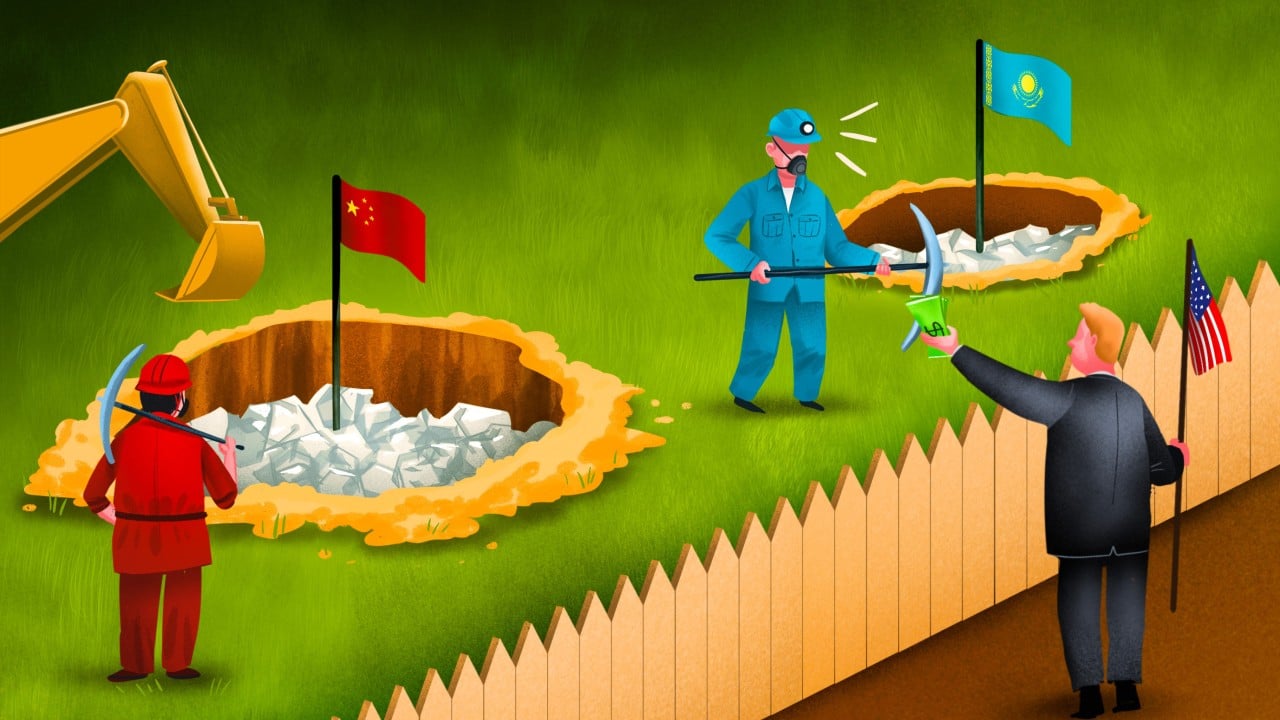
Global industrial capacity rests on a fragile foundation of geopolitical concentration. China commands an overwhelming share of both global tungsten mining and downstream processing, controlling the physical flow of a metal critical for kinetic energy penetrators, high-speed machining, and aerospace superalloys. Western industrial policy has increasingly targeted Central Asia as a counterweight to this dependency, framing the region's vast ore reserves as an immediate alternative.
Yet, converting geological endowment into functional supply chain security requires navigating severe structural, financial, and logistical bottlenecks that capital alone cannot instantly dissolve.
The Economic Mechanics of Tungsten Dominance
Tungsten, or wolfram, possesses the highest melting point of all elemental metals and extreme density, making it virtually irreplaceable in high-stress industrial and defense applications. China’s market power is not merely a function of raw extraction; it stems from a vertically integrated monopoly that spans mining, chemical refining, ammonium paratungstate (APT) production, and carbide manufacturing.
When a single nation controls the mid-stream refining capacity, it dictates global price elasticity and supply stability. Western defense contractors and industrial consumers face a structural vulnerability: even if raw ore is mined outside of China, the lack of localized refining capacity historically meant that material often looped back through Chinese processing hubs. Breaking this loop requires establishing an end-to-end supply chain that bypasses Beijing at every node, from the open pit to the final powder metallurgy.
The Central Asian Proposition and Its Capital Constraints
Kazakhstan holds some of the largest undeveloped tungsten deposits in the world, notably assets such as Severny Katpar and Boguty, which account for a massive share of the country's tungsten trioxide resources. These deposits offer the scale required to alter global market dynamics if brought to full production.
However, realizing this potential exposes the stark gap between strategic ambition and project finance realities. Proposed multi-million dollar developments backed by international capital face rigorous underwriting standards. State-backed developmental financing institutions, including the Export-Import Bank of the United States and the U.S. International Development Finance Corporation, issue non-binding letters of interest that must clear exhaustive multi-stage project reviews before capital is formally deployed.
When macroeconomic risk, volatile commodity pricing cycles, and complex governance structures intersect, institutional lenders frequently pause. The assumption that sovereign backing guarantees rapid construction ignores the rigorous debt-servicing thresholds and feasibility milestones required to move a massive mining project from concept to commercial extraction.
Logistical Friction Along the Middle Corridor
Geography imposes a permanent tax on Central Asian mineral extraction. Landlocked between major powers, export routes from Kazakhstan and neighboring states must transit immense distances to reach Western markets.
The primary alternative to Russian transit networks is the Trans-Caspian International Transport Route, commonly known as the Middle Corridor. While policy initiatives and capital commitments aim to modernize this pathway, the corridor suffers from systemic capacity limits. Multimodal transit involving rail, Caspian Sea shipping ports, and onward rail through the Caucasus introduces high freight costs, customs delays, and chronic bottlenecks.
A mineral supply chain is only as reliable as its weakest transit link. Moving thousands of tons of heavy tungsten concentrates or refined products westward requires robust infrastructure investments in port expansions, rolling stock, and digital tracking systems that remain underfunded relative to the scale of the challenge.
The Processing Deficit
Extracting tungsten ore and producing marketable concentrate represents only the primary stage of value creation. The high-value segments of the supply chain—converting ore into APT, tungsten carbide, and precision components—demand advanced chemical infrastructure, strict environmental controls, and specialized technical expertise.
Central Asian economies have historically functioned as resource exporters rather than advanced refiners. While newer development models emphasize domestic processing to capture higher margins, building these facilities requires stable inputs of chemical reagents, reliable electrical power grids, and advanced environmental waste management systems. Without concurrent investments in mid-stream refining capacity within the region or trusted partner nations, raw materials will continue to flow wherever processing capacity is cheapest and most established—risking indirect capture by existing dominant market players.
Strategic Execution Framework
To convert Central Asian mineral wealth into genuine supply chain resilience, policymakers and private consortia must shift focus from speculative announcements to execution mechanics.
First, project financing must be structured with realistic risk-sharing mechanisms that account for long construction timelines and regional transit hurdles, avoiding over-reliance on non-binding letters of credit.
Second, investment must be explicitly tied to mid-stream processing infrastructure rather than primary extraction alone, ensuring that value addition occurs locally.
Third, international partners must synchronize diplomatic and financial frameworks to systematically upgrade the logistical capacity of the Middle Corridor, transforming it into a high-throughput commercial artery rather than a fragmented series of regional transit routes.