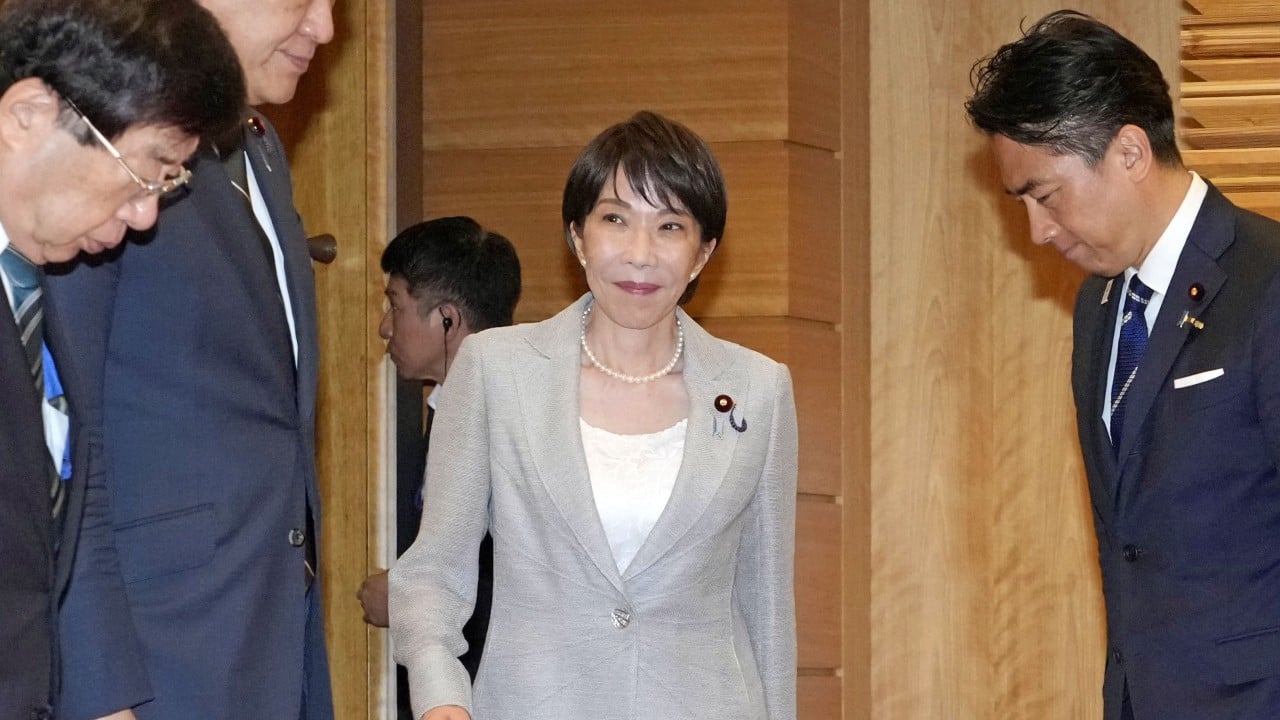
Political consolidation in parliamentary systems operates on an uncompromising cost-benefit curve. When Prime Minister Sanae Takaichi executed her cabinet and party leadership reshuffle, conventional commentators diagnosed the maneuver through the lens of ordinary political caution. That diagnosis mistakes symptom for mechanism. A thorough inspection of the personnel retained, the rivals absorbed, and the coalition boundaries expanded reveals a targeted institutional fortification designed to preempt legislative gridlock and neutralize intra-party factional attrition.
The Risk Architecture of Cabinet Retention
The decision to keep senior ministers in place—including Chief Cabinet Secretary Minoru Kihara, Finance Minister Satsuki Katayama, Foreign Minister Toshimitsu Motegi, and Defense Minister Shinjirō Koizumi—is frequently mischaracterized as a sign of uninspired predictability. In structural terms, this retention represents a deliberate minimization of administrative friction.
In a system recovering from institutional volatility and navigating intense geopolitical pressures across the Indo-Pacific, executive continuity functions as a risk mitigation asset. Ministries such as Finance and Foreign Affairs require prolonged institutional memory to manage sovereign debt dynamics, foreign exchange fluctuations, and continuous diplomatic signaling with Washington and Beijing. Replacing seasoned operators with untested loyalists would introduce operational latency into state machinery at a moment when external shocks demand rapid response loops.
Takaichi structured her retention strategy around the principle of containment. By keeping former leadership rivals within the formal apparatus of government—such as Motegi at Foreign Affairs and Koizumi at Defense—she binds their individual political trajectories to the collective performance of the administration. They cannot dissociate their personal brands from executive outcomes while simultaneously drawing the institutional authority of their portfolios. This dynamic transforms potential internal saboteurs into co-accountable stakeholders.
The Calculus of Intra-Party Neutralization
To understand why certain figures were moved while others remained stationary, one must evaluate the internal distribution of influence within the Liberal Democratic Party. The party has historically functioned as a federation of competing factions, where stability depends on the continuous redistribution of patronage and portfolio distribution.
The removal of Yoshimasa Hayashi from the Ministry of Internal Affairs and Communications and his replacement by Hisayuki Fujii illustrates the fine-tuning of internal power weights. Hayashi, a seasoned centrist and former leadership contender, represents a different ideological lineage from Takaichi’s hardline conservative base. Adjusting his position alters the internal negotiating capacity inside the party apparatus.
Simultaneously, the retention of figures like Yasutoshi Nishimura as the LDP election committee chair establishes a clear operational bridge toward upcoming electoral cycles. The institutional machinery of candidate vetting and resource allocation requires an operator who understands the granular mechanics of district-level mobilization. Takaichi avoids the mistake of purging competent administrative technicians in favor of ideological purists, prioritizing electoral survival over doctrinal uniformity.
Coalition Engineering and the Ishin Integration
The most consequential structural alteration in the reshuffle is not found among veteran LDP heavyweights, but in the incorporation of Nippon Ishin no Kai into the ministerial framework. Appointing Hiroshi Nakatsuka as minister for regulatory reform marks the formalization of structural cooperation with an external political force known for administrative decentralization and economic deregulation doctrines.
This integration reflects a shift in legislative arithmetic. Governing with slim majorities or fragile coalitions creates a permanent legislative bottleneck. By offering a cabinet seat to an Ishin representative, the administration binds the party's parliamentary votes directly to executive policy outputs. This reduces transactional friction during Diet votes on complex fiscal measures, tax reforms, and administrative restructuring.
The cost function of this coalition expansion involves managing ideological friction within the LDP's traditional conservative base, which historically resists radical decentralization or aggressive deregulation of entrenched domestic markets. Takaichi calculates that the legislative certainty gained through Ishin's cooperation outweighs the risk of internal dissent from protectionist elements within her own party.
The Economic Policy Transmission Mechanism
Personnel shifts in Tokyo carry immediate implications for the transmission channels of fiscal and monetary policy. The retention of Satsuki Katayama at the Ministry of Finance preserves continuity in handling the fragile equilibrium between currency depreciation, bond market yields, and inflationary pressures.
Takaichi’s political identity has long been associated with expansive fiscal measures and targeted industrial support, particularly in advanced technology sectors such as semiconductors, artificial intelligence, and robotics. The institutional apparatus supporting these initiatives—including the growth strategy portfolios and economic security offices—remains anchored by loyalists who understand the intersection of industrial policy and national security.
When the state directs capital toward technological resilience, the administrative capacity of ministries determines whether funds translate into productive output or bureaucratic delay. Retaining ministers who have already navigated the inter-ministerial coordination hurdles ensures that capital deployment does not stall amid turf wars. The reshuffle protects the speed of policy execution against the drag of administrative inertia.
Strategic Outlook and Institutional Vulnerabilities
Despite the veneer of consolidated authority, the structural framework engineered by this reshuffle carries latent vulnerabilities. Takaichi’s historical reputation within the LDP has been characterized by a degree of ideological isolation—operating as a conviction politician rather than a master of traditional factional patronage networks.
By tying her political fate to a high-stakes legislative agenda and a streamlined executive team, she leaves little margin for operational error. If economic indicators soften, or if inflation outpaces wage growth, public discontent will rapidly target the executive center. Because the reshuffle concentrated responsibility at the top rather than diffusing blame across a wide coalition of rival faction leaders, the political downside of any policy failure is borne disproportionately by the prime minister herself.
The resilience of the administration depends entirely on the velocity of tangible results. If the newly expanded coalition delivers measurable economic stabilization and stringent defense posture reinforcement, the reshuffle will be recorded as a masterclass in executive consolidation. If structural reforms stall in the Diet, the very stability engineered by retaining familiar faces will ossify into political stagnation. The institutional machinery is set; the speed of execution will determine the outcome.