Economic output is rarely a direct function of external market demand alone; it is heavily dictated by domestic structural inputs and institutional design. The prevailing narrative attributes modern trade imbalances primarily to currency manipulation or direct state subsidies. This perspective misses the underlying mechanics. China export performance is an endogenous by-product of aggressive industrial self-reliance policies implemented over the past two decades. When external supply chains fracture or trade barriers rise, the systemic response within China has historically been to internalize production loops, drive down marginal costs through local supply chain density, and convert import substitution into export capacity.
Analyzing this dynamic requires moving past generalized assertions about state capitalism. We must deconstruct the operational architecture that transforms inward-looking resilience into outward-looking market saturation.
The Three Pillars of Industrial Localization
Industrial self-reliance functions as a deliberate engineering problem rather than a political slogan. To understand how internal substitution generates external market power, the architecture must be split into distinct operational layers: upstream material security, midstream component integration, and downstream logistics density.
Upstream Material Security and Capital Allocation
The initial layer involves securing primary inputs and chemical precursors. Import dependency on critical minerals, advanced semiconductors, and specialized polymers creates structural vulnerabilities that external actors can exploit through sanctions or export controls.
State-backed capital deployment targets these specific bottlenecks. Rather than distributing stimulus broadly across consumer markets, financial allocation flows into targeted credit facilities for domestic equipment manufacturers, rare earth processing facilities, and foundational material science labs. This creates an enforced captive market for domestic producers during their high-cost development phase.
The mechanism relies on sequential import substitution. When a domestic sector achieves a baseline threshold of technological parity, regulatory friction increases for equivalent foreign inputs. Local manufacturers are incentivized or mandated to source domestically, shifting the demand curve inward. This guarantees volume for unproven local suppliers, allowing them to ride down the experience curve and achieve cost parity without relying on foreign purchasers.
Midstream Component Integration and Cluster Density
Geographic clustering accelerates the feedback loop between design, manufacturing, and iteration. Industrial zones along the eastern seaboard do not merely house factories; they house complete manufacturing ecosystems where component suppliers, assembly plants, and testing facilities operate within a narrow geographic radius.
This spatial compression reduces logistical friction and working capital requirements. Inventory turnover rates accelerate because component suppliers can deliver just-in-time inputs multiple times per day. When a design modification is required, the iteration cycle takes hours rather than weeks.
Foreign multinational corporations operating within these clusters initially brought advanced process engineering. Over time, local competitors reverse-engineered these processes, absorbed the tacit knowledge, and redeployed it using lower-cost domestic capital equipment. The result is a midstream sector capable of absorbing supply shocks and scaling production velocity faster than competitors scattered across fragmented global supply chains.
Downstream Logistics and Infrastructure Syndication
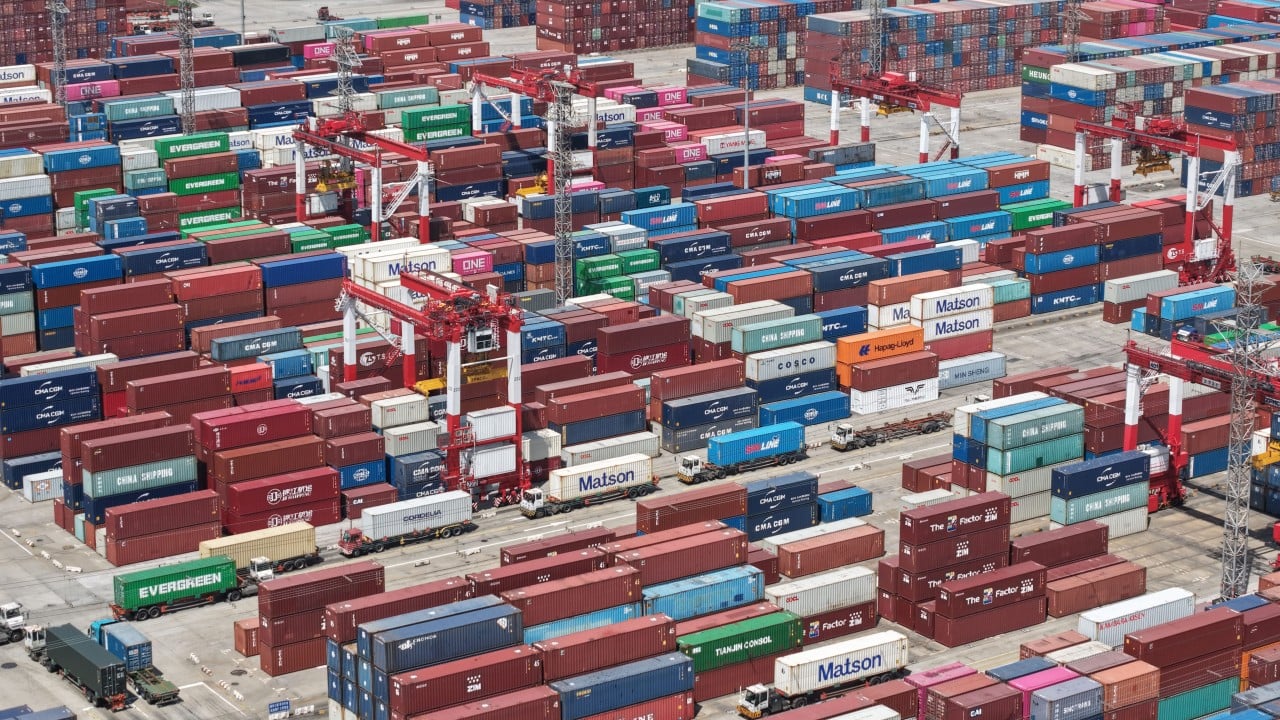
Production capacity remains economically inert without high-throughput distribution networks. The expansion of port infrastructure, high-speed rail freight corridors, and digital customs clearance platforms forms the third pillar of this architecture.
State-directed infrastructure investment treats logistics not as a profit-maximizing commercial venture, but as a systemic cost-reduction subsidy for the entire manufacturing base. By lowering the marginal cost of moving intermediate and finished goods from inland manufacturing hubs to deep-water ports, the system offsets rising domestic labor costs.
Digital integration of customs processing further compresses transit times. Real-time data sharing between manufacturing plants, freight forwarders, and maritime authorities eliminates administrative bottlenecks that typically plague developing export economies.
The Cost Function of Domestic Substitution
The transition from import dependency to export dominance involves specific economic trade-offs. The strategy is not frictionless; it generates distinct internal costs that are often obscured by headline trade surplus figures.
External Shock -> Import Restriction -> State-Backed Substitution -> Local Overcapacity -> Export Dumping
This sequence illustrates the conversion of defensive economic policy into offensive trade aggression. When domestic demand fails to absorb the output of newly localized industries—often due to suppressed domestic consumption and high savings rates—the surplus must find an outlet abroad.
Capital Misallocation and Debt Accumulation
Forcing self-reliance requires massive upfront capital expenditure. Because private capital markets naturally price risk based on immediate commercial viability, the state must underwrite investments in sectors with long payback periods and high failure rates.
This creates structural overcapacity. When dozens of regional state-owned enterprises or subsidized private firms simultaneously enter a targeted sector—such as photovoltaic cells, electric vehicles, or legacy semiconductors—aggregate supply quickly outstrips domestic clearing capacity. The resulting price wars squeeze profit margins across the entire sector. While this benefits foreign consumers through lower prices, it forces weaker domestic firms into insolvency unless structural state lifelines are continuously extended.
The Innovation Trade-Off
A system optimized for rapid scaling and cost reduction through process engineering often struggles with foundational, high-risk scientific breakthroughs. The institutional framework rewards incremental efficiency gains and rapid commercialization of established technologies rather than blue-sky research.
While China has achieved global leadership in applied manufacturing and scaling clean-tech hardware, foundational breakthroughs in areas like advanced logic chip architectures or novel pharmaceutical compounds still rely heavily on basic research generated outside its borders. The focus on self-reliance creates a paradox: by aggressively closing loops to protect domestic industries, the system risks insularity, potentially cutting itself off from the chaotic, cross-border intellectual collisions that drive paradigm-shifting scientific discoveries.
Systemic Vulnerabilities and Strategic Limitations
Evaluating the long-term viability of this export engine requires identifying its operational boundaries. Self-reliance is a powerful shield against external disruption, but it introduces distinct systemic fragilities.
Demographic Shifts and Labor Cost Pressures
The foundational assumption of low-cost manufacturing elasticity is eroding. Shrinking working-age cohorts and an aging population are shifting the labor supply curve upward.
While automation and robotics help offset rising wage rates, capital expenditure on factory floor automation cannot entirely replace human labor in complex, high-mix, low-volume assembly processes. As the domestic demographic profile mirrors those of advanced Western economies, the domestic consumption engine must expand to absorb manufacturing output. If domestic consumption remains suppressed due to structural wealth distribution patterns, the economy becomes dangerously reliant on external markets that are increasingly hostile to unconstrained import surges.
Global Retaliation and Market Fragmentation
The ultimate limitation of export-led self-reliance is foreign political pushback. When a single nation accounts for a dominant share of global production in critical industrial sectors, trading partners view this concentration not as a market outcome, but as an existential national security threat.
Tariffs, non-tariff barriers, localized content requirements, and sweeping industrial policies in the United States, Europe, and major emerging economies are systematically dismantling the frictionless global trade architecture that enabled China's initial rise.
As destination markets erect regulatory walls, the marginal cost of exporting rises. Factories built for global scale face utilization rate drops, eroding the unit-cost advantages that made them competitive in the first place.
Strategic Trajectory
The interaction between industrial self-reliance and export performance demonstrates that protectionist domestic policies can successfully generate formidable industrial powerhouses, provided they are backed by disciplined capital allocation, spatial clustering, and infrastructure syndication. However, this model operates on diminishing returns once domestic capacity vastly exceeds internal absorption limits.
The strategic challenge for policymakers navigating this environment is not merely countering export surges with defensive tariffs, but recognizing that structural overcapacity is a built-in feature of state-directed industrial policy. Long-term market equilibrium will depend on whether domestic economic rebalancing can successfully shift capital away from investment-heavy manufacturing and toward household income growth, thereby internalizing demand before global trade fragmentation forces a painful operational contraction.