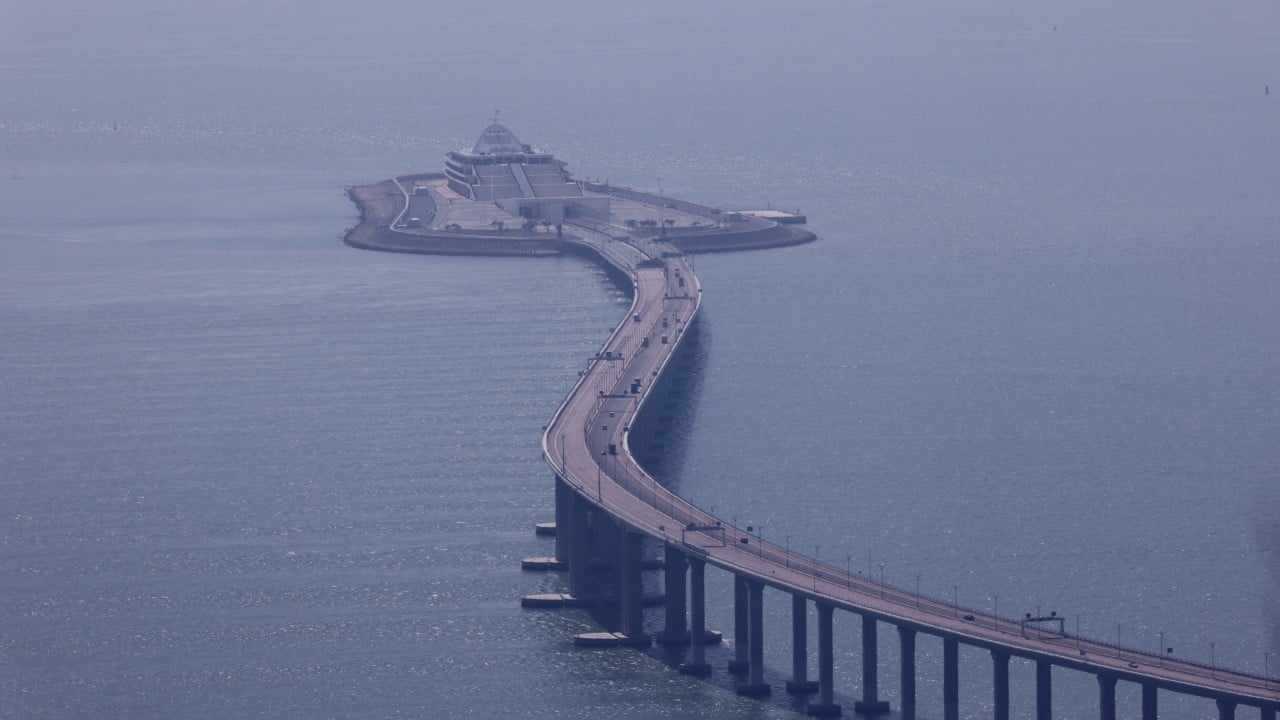
Massive fixed-link infrastructure projects do not merely alter transport routes; they systematically dismantle the unit economics of legacy carriers operating in parallel vectors. The structural contraction of scheduled cross-border helicopter services and maritime ferry frequencies between Hong Kong, Macau, and the Pearl River Delta illustrates how high-capacity terrestrial networks redefine regional mobility costs. When state-backed mega-projects achieve critical operational mass, adjacent high-cost, low-volume transport modes face terminal margin compression unless they undergo fundamental corporate restructuring.
Evaluating this transport shift requires moving past superficial observations about changing consumer preferences to examine the underlying microeconomics of cross-border transit. The displacement operates through three distinct structural mechanisms: door-to-door time elasticity, the erosion of time-sensitive yield premiums, and the fixed-cost dilution capacity of high-occupancy vehicular networks. For a more detailed analysis into this area, we suggest: this related article.
The Cost Function Shift in Regional Mobility
Legacy premium transport models, exemplified by scheduled cross-border helicopter flights and high-speed ferries, relied on a specific consumer willingness-to-pay threshold. Corporate executives and high-net-worth travelers absorbed steep tariffs in exchange for absolute terminal-to-terminal velocity. However, the introduction of the 55-kilometer bridge-tunnel system fundamentally altered the spatial-temporal equation.
Terrestrial alternatives eliminated the multi-node friction inherent in marine and aviation transport. Traditional maritime and aviation routes demand multi-stage transit configurations: ground transport to a terminal, pre-departure customs clearance cutoffs, marine or air transit, and secondary ground distribution upon arrival. The mega-bridge introduced direct point-to-point vehicular access via private hire vehicles and cross-border coach networks. This capability compresses the total journey friction for a vast segment of travelers who previously found air or sea transport indispensable. For further context on this topic, comprehensive analysis is available on Financial Times.
As vehicle throughput on the bridge scaled significantly—surpassing pre-pandemic baselines and registering millions of annual vehicle crossings—the addressable market for high-cost scheduled aviation contracted past the minimum viable operating threshold. When fixed-wing and rotary operators face structural volume loss, their unit cost per passenger seat-kilometer rises exponentially. This dynamic forced operators such as the primary cross-border helicopter service provider to suspend scheduled passenger routes entirely and pivot toward an exclusive charter and niche sightseeing model.
The Substitution Effect on Maritime Fleets
While premium aviation absorbed the blow at the top of the pricing pyramid, high-speed maritime passenger ferries experienced volume erosion across the mid-tier market segment. Ferry economics depend heavily on high load factors to offset capital-intensive vessel maintenance, fuel volatility, and high port terminal fees.
The substitution effect unfolded through two distinct phases following the stabilization of the regional bridge network:
- Baseline Volume Bleed: Scheduled coach buses and private car schemes captured price-sensitive and time-tolerant travelers by offering predictable scheduling without maritime weather cancellations.
- Off-Peak Yield Collapse: As core commuter pools migrated to 24-hour terrestrial options, ferry operators lost the high-margin business traveler segment during peak hours, forcing aggressive fare discounting that failed to cover fixed operational overhead.
Consequently, marine transport providers faced structural overcapacity. Without state intervention or deep structural consolidation, frequency reductions became the only mathematically viable option to prevent catastrophic cash burn. The market response demonstrates a zero-sum reallocation of regional passenger volume where terrestrial capacity expansion directly crowds out marine frequency density.
Regulatory Bottlenecks and Quota Economics
The velocity of this modal displacement is heavily mediated by regulatory frameworks rather than pure market competition alone. Government-administered vehicle quotas, restricted driver licensing schemes, and multi-jurisdictional customs protocols initially suppressed the bridge's traffic potential during its early operational years.
As administrative friction was progressively dismantled—exemplified by expanded private vehicle schemes and streamlined port clearance procedures—the true substitution velocity materialized. Lawmakers and transport analysts tracking the decline of legacy services frequently misdiagnose the root cause as a temporary cyclical downturn. In reality, the compression of ferry and helicopter routes represents a permanent structural realignment. Once terrestrial infrastructure achieves institutional integration and administrative red tape is reduced, legacy point-to-point carriers cannot compete on generalized operating expenditure or schedule flexibility.
To maintain economic viability under these market conditions, remaining regional transport operators must decouple their asset utilization from rigid scheduled timetables. The strategic transition of rotary-wing operators from scheduled intercity transit to customized charter frameworks and specialized aviation services is a textbook exercise in asset preservation. By shrinking the active fleet deployment and targeting high-margin corporate events, localized aerial tourism, and private charters, operators convert fixed operational liabilities into variable-cost service offerings.
Future infrastructure planning across dense economic clusters must account for this cannibalization vector. Planners can no longer evaluate transport modes in isolation; every major fixed-link investment acts as an economic sponge, absorbing baseline demand and forcing adjacent high-overhead legacy systems into mandatory contraction or specialized market repositioning.