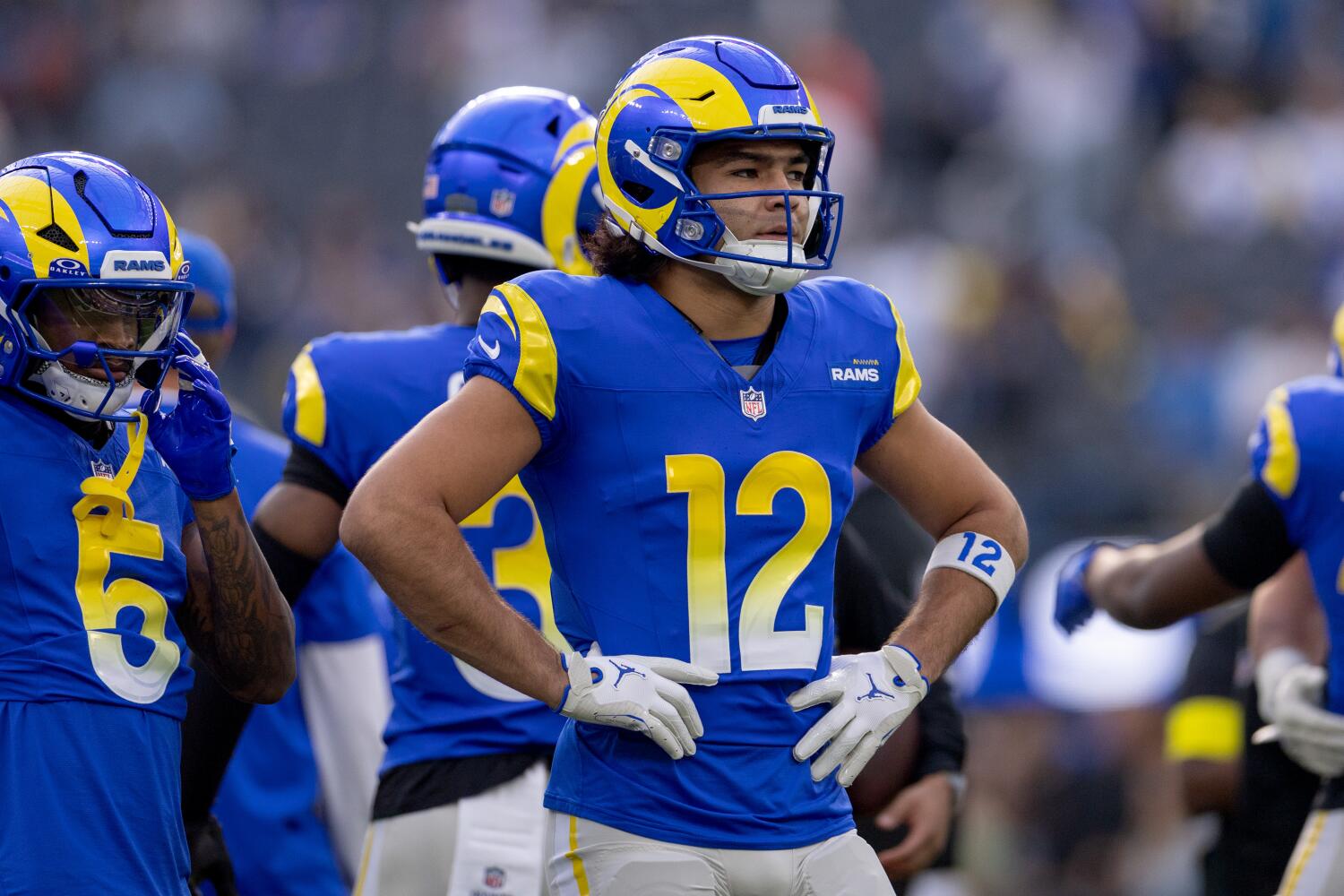
The Los Angeles Rams currently face a classic asset valuation paradox where the market value of a high-yield performer is being systematically eroded by escalating operational risks and legal liabilities. Puka Nacua, who transitioned from a fifth-round statistical anomaly to a foundational offensive pillar, now represents a concentrated risk profile that necessitates a cold-blooded reassessment of the team’s long-term roster architecture. The intersection of chronic physical attrition and off-field litigation creates a compounding "risk-premium" that the Rams front office must calculate before committing to a market-setting extension.
The Kinematic Cost of Usage Rates
Nacua’s value proposition in 2023 was built on a high-volume, high-contact role that is fundamentally unsustainable for long-term physiological durability. His rookie season metrics revealed a specific tactical dependency: he was used as a primary "dirty work" receiver, frequently operating in the high-traffic middle of the field where collision velocity is maximized. You might also find this related article useful: Shadows on the Pitch.
The physical toll of this role is measurable through the lens of Force Management. When a receiver of Nacua’s build (approximately 212 lbs) consistently engages in contested catches and run-blocking assignments against linebackers, the cumulative micro-trauma to the musculoskeletal system accelerates the "wear-out" phase of the athlete's career. The current knee rehabilitation is not a singular event; it is a lagging indicator of a usage-rate-to-recovery-ratio that has fallen out of equilibrium.
The Fragility of the Skill-Set Transition
The Rams’ offensive scheme relies on precise timing and physical leverage. If Nacua’s lower-body explosiveness is diminished by 5% due to chronic inflammation or structural instability, his ability to create separation at the break point of his routes vanishes. Unlike "speed" receivers who can lose a step and remain viable as deep threats, "physicality" receivers like Nacua operate on thin margins. Once the physical dominance is neutralized by injury, the player often experiences a rapid decline in utility because their secondary skills (straight-line speed) are insufficient to compensate for the loss of their primary skill (leverage and contested catch wins). As extensively documented in latest reports by ESPN, the results are worth noting.
The Liability Variable and Brand Equity
Beyond the training room, the legal complications surrounding Nacua introduce a non-football risk that impacts the franchise's Cap-Adjusted Asset Value. In the modern NFL, a player’s contract is an investment in both on-field production and off-field brand alignment. Legal proceedings create a "distraction tax" that consumes administrative bandwidth and creates potential for league-mandated disciplinary action.
Contractual Protection Mechanisms
From a front-office perspective, legal trouble triggers specific "Conduct Detrimental" clauses that allow a team to void guaranteed money. However, relying on these clauses is a reactive strategy. A proactive strategy involves the De-Risking of the Second Contract. The Rams must decide if Nacua’s off-field profile warrants a "locked-in" long-term deal or a structure heavy on incentives and per-game active bonuses.
The risk of a suspension under the Personal Conduct Policy creates a vacancy that cannot be easily filled mid-season. This "replacement cost" is high for a player who recorded 105 receptions in a single season. The organization isn't just weighing the player’s character; they are weighing the cost of a catastrophic roster hole during a Super Bowl window.
The Opportunity Cost of the Nacua Centric Offense
Sean McVay’s system is often praised for its "illusion of complexity," but at its core, it requires high-level execution from specific chess pieces. Nacua was the perfect piece for 2023, but the 2025-2026 outlook changes the math. If Nacua’s reliability drops below the 80% threshold (meaning he is projected to miss 3 or more games per season or play at 75% health), he becomes a bottleneck.
The Portfolio Diversification Requirement
Modern roster construction follows the principle of Anti-Fragility. Relying too heavily on a player with a high injury profile makes the entire system fragile. The Rams have historically been aggressive with "Stars and Scrubs" roster building, but that strategy requires the stars to be durable (e.g., Aaron Donald). Nacua’s current trajectory suggests he may be a "High-Beta" asset—capable of massive returns but prone to extreme volatility.
To mitigate this, the Rams must:
- Re-index the Target Share: Shift the offensive focus back toward a more balanced distribution to reduce Nacua’s per-game contact exposure.
- Hedge via the Draft: Invest high-capital picks in receivers with similar "big slot" profiles to ensure the scheme doesn't collapse if Nacua is sidelined.
- Restructure the Contract Horizon: Avoid a 5-year commitment in favor of a 3-year "front-loaded" deal that aligns with Nacua’s peak physical window before the "Physicality Wall" is hit.
The Legal-Medical Correlation
There is a documented, though often ignored, correlation between prolonged injury rehabilitation and off-field instability. The psychological strain of "rehab-loops"—where a player is isolated from the team environment while focusing on recovery—often leads to increased risk-taking behavior or lapses in judgment. For the Rams, Nacua’s legal issues during a period of injury rehab are a "Red Flag Cluster."
This cluster suggests that the player's support system or personal discipline may be struggling under the pressure of professional expectations. In any other industry, a $20M+ per year asset showing signs of structural failure and regulatory non-compliance would be put under intense audit. The NFL should be no different.
The Cap Space Efficiency Frontier
The Rams are approaching a critical junction regarding the Salary Cap. With aging veterans and a need to replenish the defense, every dollar allocated to Nacua is a dollar not spent on a secondary pass rusher or offensive line depth.
The Marginal Utility of the Elite Receiver is diminishing in an era where mid-tier receivers are producing at 85% of the elite level for 30% of the cost. If Nacua demands a contract exceeding $28M AAV (Annual Average Value), the Rams must evaluate if a "healthy-but-lesser" replacement provides a better ROI (Return on Investment) when the $15M in savings is applied to the defensive front.
Quantitative Projections of Value Decay
If we apply a standard decay model to Nacua’s current trajectory, we see a disturbing trend line.
- Year 1 (2023): 1,486 Yards (100% Efficiency / 0% Risk)
- Year 2 (2024): Projected 30% reduction in snaps due to injury/legal (70% Efficiency / 40% Risk)
- Year 3 (2025): The "Pivot Point."
The Pivot Point is where the team must decide to either sell high (trade for draft capital) or double down. Trading a player of Nacua's caliber is seen as heresy by fans, but for a data-driven front office, it is an exercise in Arriving Early to the Decline. Stefon Diggs, Davante Adams, and Tyreek Hill were all moved when their teams calculated that the "Price to Keep" exceeded the "Probability of Continued Peak Production."
Strategic Imperatives for the Front Office
The Rams must move away from the emotional narrative of the "undiscovered star" and treat Nacua as a distressed asset that requires stabilization. The following tactical steps are non-negotiable for maintaining franchise health:
- Implement a Biomechanical Usage Cap: Dictate a maximum number of "high-impact" blocks and middle-of-field targets per game. Preserving the asset is more important than regular-season statistical totals.
- Contingency Contractual Architecture: Any extension must include "Total Guarantee" offsets linked to both games played and specific conduct triggers. This protects the team from a "dead money" apocalypse if the legal situation or the knee health worsens.
- Aggressive Talent Inflow: The Rams cannot afford to wait for Nacua to fail. They must draft his replacement now to gain leverage in contract negotiations. If Nacua knows the team can function at 90% capacity without him, his bargaining power—and his incentive to comply with team protocols—increases.
The future of the Los Angeles Rams offense depends not on Nacua’s talent, which is undeniable, but on the organization's ability to manage his mounting volatility. Talent wins games, but asset management wins championships. The Rams must prioritize the latter by treating Nacua's current situation as a systemic risk to be mitigated, rather than a temporary hurdle to be ignored.