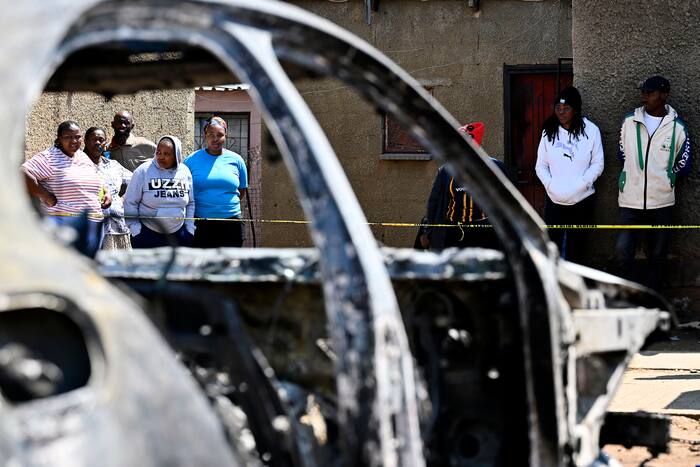
The convergence of two distinct mass casualty events resulting in at least 27 fatalities across the Gauteng and Western Cape provinces exposes structural failures within South Africa's security architecture. Rather than viewing incidents in Wedela and Lwandle as isolated criminal anomalies, systemic analysis reveals an environment where illegal resource extraction networks, porous small arms supply chains, and overextended policing capabilities intersect to produce predictable peaks of organized violence.
The Economics of Illicit Resource Contestation
The primary driver behind high-casualty events in industrial and mining townships is the financial optimization of illicit syndicates. In regions such as Gauteng, the proliferation of informal or illegal gold mining has created an underground war economy. When underground syndicates compete for control over abandoned shafts, processing sites, and extortion territories, lethal force becomes a rationalized business expense used to secure monopoly rents.
The mechanics of these conflicts follow a predictable economic logic:
- Capital accumulation through unregulated commodity extraction yields high liquidity for purchasing military-grade or smuggled weaponry.
- Territorial disputes lack institutional dispute-resolution mechanisms, forcing syndicates to rely on preemptive kinetic strikes to deter rival groups.
- Commercial hubs, taverns, and informal gathering spaces function as soft targets where rival operatives congregate, raising the strategic value of mass-casualty assaults designed to eliminate leadership and intimidate local informants simultaneously.
The Small Arms Proliferation Vector
South Africa's domestic firearm registry operates under strict legal frameworks, yet the domestic market is saturated with unregistered ordnance. Estimates from criminological assessments and private security analysts place the number of illegal firearms in circulation between two million and six million units.
This abundance stems from three structural supply vectors:
- Historical leakage from state armories and corrupt law enforcement custody chains.
- Cross-border trafficking routes utilizing porous boundaries with neighboring states, inherited from regional historical conflicts.
- The recycling of weapons seized or abandoned during previous syndicate wars.
Because the marginal cost of acquiring an unregistered automatic or semi-automatic weapon in informal settlements is relatively low, tactical parity among criminal groups is easily achieved. This renders traditional community policing strategies obsolete, as local patrol units are outgunned by squads utilizing military tactics and high-capacity magazines.
The Operational Bottlenecks of State Security
The deployment of national defense assets alongside metropolitan police units highlights an ongoing strategic dilemma: reactive saturation versus proactive intelligence. When the state relies on high-visibility military deployments after a massacre occurs, it treats the symptom rather than the systemic operational deficit.
The operational response suffers from distinct structural friction points:
- Intelligence lag prevents preemptive disruption. State agencies frequently lack informants embedded deep enough within mining cartels and taxi federations to map attacks before execution.
- Geographic isolation and infrastructural deficits in townships hinder rapid tactical response times, allowing perpetrators ample window to execute exfiltration maneuvers.
- Investigative capacity remains bottlenecked by high caseloads per detective, leading to low conviction rates for organized crime syndicates and reinforcing a culture of impunity.
Strategic Forecasting
Without a fundamental restructuring of intelligence-gathering operations targeting the financial accounts and supply chains of illegal mining cartels, mass casualty events will remain a baseline feature of South Africa's security landscape. Tactical saturation of townships post-incident provides temporary deterrence but fails to alter the cost-benefit matrix of criminal syndicates. True institutional stabilization requires cutting off the capital flows funding illicit arms procurement and dismantling the protected distribution networks that keep illegal firearms in circulation.