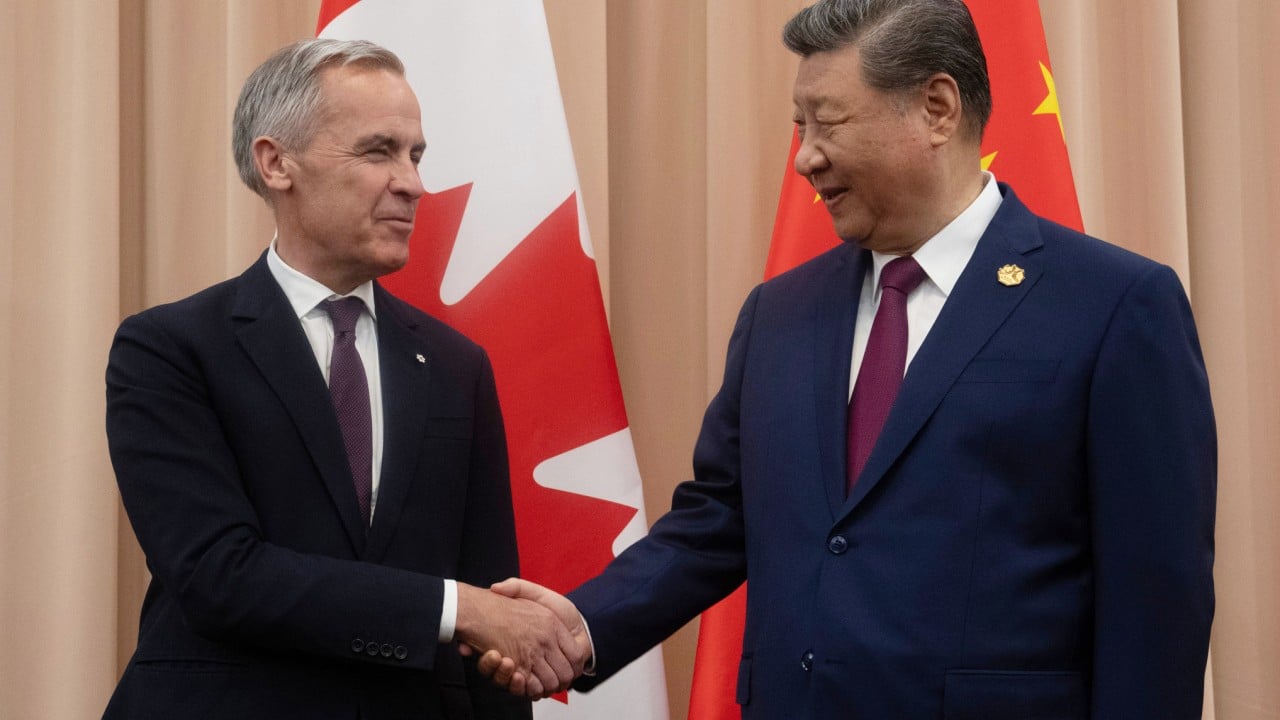
When Canadian leadership prepares to confront Chinese President Xi Jinping over election interference, the interaction represents a calculated trade-off between domestic democratic legitimacy and bilateral economic stability. Standard media coverage frames these encounters as binary moral confrontations—a Western leader demanding accountability from an authoritarian counterpart. That framing misses the operational reality of statecraft. Raising foreign interference at the executive level is not an attempt to extract a confession or secure an immediate behavioral reversal; it is a signaling mechanism designed to establish deterrence thresholds, manage domestic political risk, and ring-fence economic cooperation from national security friction.
The Structural Asymmetry of the Dialogue
Bilateral talks between a middle power like Canada and a superpower like China operate under severe structural asymmetry. Understanding the mechanics of these discussions requires mapping the divergent incentive structures of both executives before they enter the room.
For Ottawa, the primary driver is domestic institutional defense and coalition maintenance. Public inquiries, intelligence leaks, and legislative scrutiny have transformed foreign interference from a covert intelligence problem into an acute domestic political liability. Failing to raise the issue directly with Beijing signals institutional weakness to domestic voters and allies within the Five Eyes intelligence alliance. Raising it directly establishes an official diplomatic baseline: interference is no longer an unacknowledged shadow activity but an explicit variable in the bilateral ledger.
For Beijing, the objective is narrative control and economic compartmentalization. Chinese diplomatic doctrine treats accusations of interference as fabrications driven by Western domestic politics or containment strategies. Xi Jinping will not validate the premise of the accusation. Instead, Beijing’s strategic goal is to decouple security grievances from trade flows, ensuring that diplomatic friction over governance does not disrupt access to Canadian agricultural commodities, critical minerals, or energy markets.
This creates a predictable diplomatic stalemate on the core issue while opening space for tactical negotiation on the margins. Neither side expects resolution; both sides are managing the boundaries of conflict.
The Three Mechanisms of Executive Signaling
When a Canadian Prime Minister—such as Mark Carney stepping into a high-stakes bilateral engagement—places election meddling on the formal agenda, the action executes three distinct operational functions.
1. Attribution Elevation
Intelligence agencies routinely attribute interference operations internally, and diplomatic staff lodge protests through mid-level channels. Those protests carry low political cost for the target state because they remain invisible to the public and insulated from top-level decision-makers. Elevating the issue to a head-of-state meeting removes plausible deniability at the highest tier of the Chinese state apparatus. In centralized authoritarian systems, lower-level bureaucracy often operates aggressively to meet perceived ideological targets. Direct executive-level confrontation forces the central leadership to weigh the tactical gains of diaspora coercion and disinformation against the strategic cost of stalled bilateral relations.
2. Deterrence Threshold Setting
Deterrence in gray-zone operations—activities that fall below the threshold of armed conflict—relies on clear red lines. Historically, Western democracies maintained strategic ambiguity regarding what constituted an unacceptable level of political interference, fearing that explicit definitions would invite adversaries to operate just beneath the line. By formally registering election meddling in direct talks, Ottawa shifts from ambiguity to explicit boundary setting. The implicit message is that future covert operations targeting electoral districts, nomination contests, or diaspora communities will trigger pre-calibrated retaliatory measures, ranging from diplomatic expulsions to targeted economic sanctions and foreign agent registry enforcement.
3. Allied Synchronization
Canada does not engage China in a vacuum. Washington, London, Canberra, and Brussels closely monitor Ottawa’s posture toward Beijing. Historically, allies have scrutinized Canada for perceived vulnerabilities in its intelligence-sharing and counter-interference frameworks. Concurrently raising interference concerns aligns Canadian diplomatic posture with broader G7 and Five Eyes consensus, reinforcing Canada’s credibility as a reliable security partner while demonstrating that economic pragmatism will not override collective security norms.
The Cost Function of Confrontation
Every diplomatic confrontation carries a measurable cost function. In Sino-Canadian relations, the transmission belt between diplomatic friction and economic retaliation is well-documented. Beijing routinely utilizes non-tariff barriers, phytosanitary inspections, and state-directed procurement shifts to penalize political defiance without formally violating World Trade Organization rules.
- Agricultural Vulnerability: Canadian exports of canola, pork, and seafood remain highly sensitive to sudden regulatory delays at Chinese ports. Past diplomatic disputes demonstrated how rapidly technical inspections can halt billions of dollars in trade.
- Critical Mineral Friction: Canada’s push to secure domestic supply chains and restrict state-owned enterprise investment in critical minerals already strains bilateral commercial ties. Escalating security rhetoric risks accelerating Chinese divestment or retaliatory export controls on processed materials essential for Canadian manufacturing.
- Diplomatic Freeze: Direct confrontation often results in the suspension of working-level dialogues on climate, finance, and consular affairs, leaving zero institutional shock absorbers when an unforeseen crisis occurs.
To manage this cost function, Canadian negotiators must practice strict compartmentalization. The operational objective is to isolate the security file from the commercial file—delivering a firm, unambiguous warning on electoral integrity while simultaneously signaling openness to predictable, rules-based trade in non-sensitive sectors. Whether Beijing accepts that compartmentalization depends entirely on China’s own domestic economic pressures. When Chinese domestic growth slows and property markets contract, Beijing exhibits a markedly higher tolerance for Western diplomatic criticism in order to preserve stable external trade relationships.
The Limitations of Bilateral Diplomacy
Relying on executive-level talks to curb foreign interference carries severe structural limitations. Diplomatic warnings do not dismantle covert infrastructure.
First, gray-zone interference is inherently deniable. Covert funding networks, proxy community organizations, and coordinated social media amplification operate through layers of intermediaries. Beijing can truthfully claim within a diplomatic setting that the state apparatus did not directly execute a specific local action, even when the activity aligns with the directives of the United Front Work Department.
Second, verbal deterrence fails without domestic hardening. A warning delivered to Xi Jinping holds zero weight if Canada’s domestic legal and institutional architecture remains porous. If political party nomination processes lack security vetting, if foreign influence transparency registries suffer from delayed implementation, and if intelligence agencies cannot rapidly declassify actionable threats for local law enforcement, external diplomatic pressure will not alter adversary behavior. Adversaries exploit structural vulnerabilities regardless of diplomatic rhetoric.
Third, leadership transitions introduce policy discontinuity. Beijing operates on multi-decade strategic timelines, whereas democratic governments operate on four-year electoral cycles. Chinese strategists routinely absorb short-term diplomatic friction while waiting for domestic political shifts in Ottawa to produce a more accommodating administration.
The Operational Mandate
Treating a bilateral meeting with Xi Jinping as the centerpiece of a counter-interference strategy is a category error. The diplomatic engagement is merely the external signaling layer of a broader national security posture. To convert executive-level confrontation into actual deterrence, Ottawa must pair the diplomatic message with immediate, unilateral domestic execution:
- Enforce Mandatory Transparency: Fully operationalize the Foreign Influence Transparency Registry with strict criminal penalties for non-disclosure, shifting the burden of compliance onto domestic proxies and consultants acting on behalf of foreign principals.
- Harden Party Governance: Bring federal and provincial political party nomination contests under the formal regulatory oversight of Elections Canada, eliminating the unregulated gray zone where foreign interference concentrates most effectively.
- Institutionalize Threat Disclosure: Establish a statutory protocol requiring intelligence agencies to notify targeted candidates and diaspora community leaders of specific, credible interference threats within 48 hours of verification, removing political discretion from the disclosure process.
Diplomacy defines the boundary, but domestic institutional resilience enforces it. Without structural hardening at home, raising election meddling in bilateral talks remains an exercise in domestic political theater rather than an instrument of statecraft.