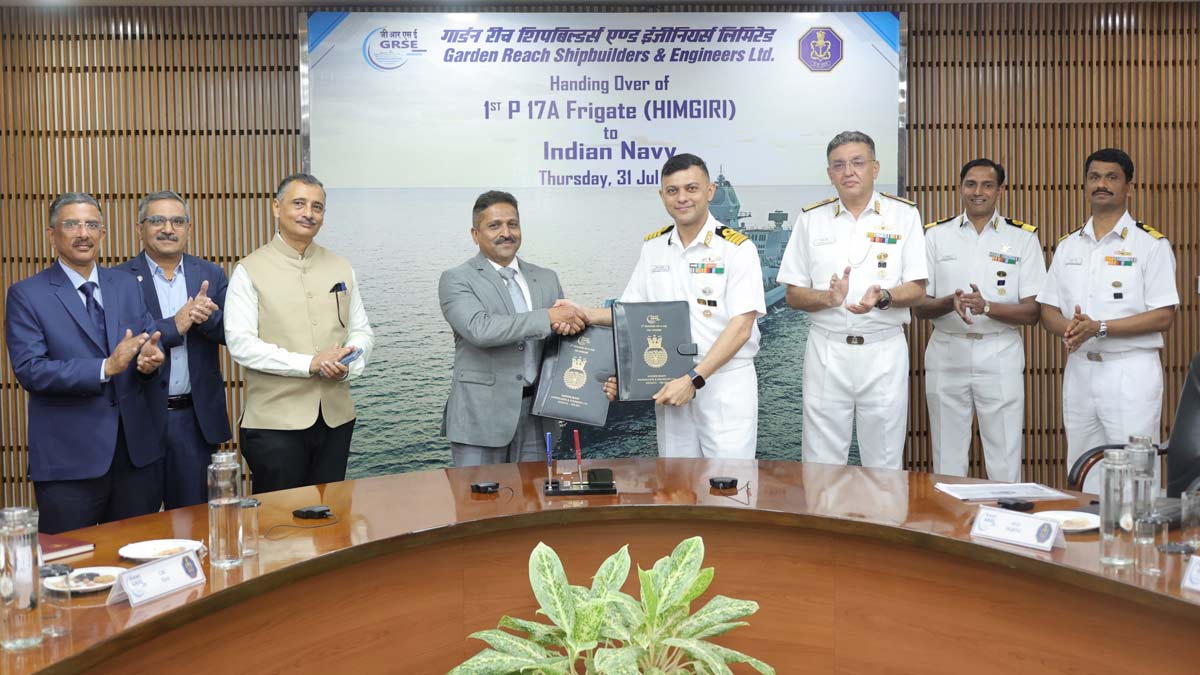
The deployment of the INS Himgiri—the second hull of the Nilgiri-class (Project 17A) guided-missile frigates—marks a shift from legacy territorial coastal defense to blue-water power projection in the Indian Ocean Region (IOR). Naval procurement is often evaluated using surface-level metrics such as tonnage or raw missile counts. A structural analysis reveals that the Nilgiri-class functions as a highly integrated node designed to solve a specific operational vulnerability: the Indian Navy's historic deficit in multi-domain area denial against dual-threat environments featuring quiet conventional submarines and high-density anti-ship cruise missile (ASCM) salvos.
The Project 17A platform is not merely an incremental upgrade over the preceding Shivalik-class (Project 17). It represents a fundamental redesign of hull geometry, sensor integration, and radar cross-section (RCS) management, engineered to withstand the modern high-leverage maritime threats present in the Malacca Strait and the wider Indo-Pacific choke points.
The Structural Architecture of Project 17A
To evaluate the operational efficacy of the INS Himgiri, the platform must be deconstructed into three foundational technical pillars: signature attenuation, sensor-weapon integration latency, and propulsion efficiency profiles.
Signature Attenuation and Survivability Mechanics
The hull of the Nilgiri-class utilizes advanced radar cross-section reduction techniques that depart sharply from legacy Indian surface combatants.
- Geometric Faceting: The superstructure incorporates sloped surfaces that deflect incident radar energy away from the transmitting source's return path.
- Enclosed Deck Configurations: Flush-deck architecture encloses traditional deck machinery, mooring stations, and weapon storage areas, eliminating corner reflectors that increase radar returns.
- Infrared and Acoustic Suppression: Exhaust gases from the propulsion system are mixed with ambient air through active cooling ducts prior to discharge, shifting the thermal signature outside the peak detection bands of passive infrared homing anti-ship missiles. Acoustic signature management relies on raft-mounted machinery to isolate structural vibrations from transmission into the water column, degrading the detection capabilities of opposing passive sonar arrays.
Sensor-Weapon Integration and Target Engagement Latency
The primary sensor suite revolves around the EL/M-2248 MF-STAR (Multi-Function Surveillance, Track and Guidance Radar), an active electronically scanned array (AESA) operating in the S-band. Mounted at the highest point of the integrated mast, this system replaces multiple legacy single-function radars.
[Target Detection: MF-STAR AESA] ──> [CMS-17A: Threat Evaluation & Prioritization] ──> [Barak-8 Vertical Launch System]
This configuration alters the engagement calculus. Legacy systems suffered from handover latency, where a search radar passes a target track to a dedicated tracking and illumination radar. The MF-STAR eliminates this bottleneck by executing simultaneous high-accuracy tracking and mid-course guidance updates for surface-to-air missiles within a single solid-state architecture.
The sensor feeds directly into the CMS-17A Combat Management System, a localized data processing network that automates threat evaluation and weapon assignment. The system reduces the time elapsed between initial sensor detection and weapon release to fractions of the previous operational baseline, a prerequisite for intercepting supersonic sea-skimming cruise missiles.
Propulsion Dynamics: CODLAG Efficiency Profiles
The Nilgiri-class utilizes a Combined Diesel and Gas (CODOG) configuration, integrating two General Electric LM2500 gas turbines with two MAN 12V28/33D STC diesel engines. This propulsion architecture balances two competing operational requirements: long-range economical transit and high-speed tactical maneuvering.
- Cruising Phase: The diesel engines provide high fuel efficiency at lower velocities (typically up to 18 knots), extending the unrefueled operational radius of the vessel during protracted anti-submarine patrols.
- Dash Phase: The LM2500 gas turbines engage to rapidly accelerate the vessel to speeds exceeding 28 knots, allowing the frigate to assume optimal tactical positioning, evade incoming torpedo tracks, or sprint to reinforce a carrier strike group.
Quantifying the Combat Envelope
The tactical utility of the INS Himgiri is determined by its offensive and defensive loadouts, which establish defined zones of denial across three distinct spatial vectors.
| Combat Vector | System Designation | Operational Range | Functional Mechanism |
|---|---|---|---|
| Long-Range Offensive | BrahMos Cruise Missile | ~290 km to 450+ km | Supersonic (Mach 2.8) sea-skimming kinetic penetration |
| Area Air Defense | Barak-8 (LRSAM) | ~70 km to 100 km | Active radar homing with dual-pulse rocket motor |
| Sub-Surface Denial | Varunastra Heavyweight Torpedo / RBU-6000 | Variable / 6,000 m | Active/passive acoustic homing / Rocket-assisted depth charge |
The Surface Strike Vector
The offensive capability of the vessel is anchored by an 8-cell Vertical Launch System (VLS) configured for the BrahMos supersonic cruise missile. Operating at speeds of Mach 2.8, the BrahMos compresses the target vessel's defensive reaction window.
The kinetic energy transfer upon impact, combined with a 200-to-300-kilogram warhead, ensures that a single successful strike can neutralize cruiser- or destroyer-sized combatants. The integration of this system allows Project 17A to execute precision stand-off strikes against high-value maritime or littoral land targets well outside the engagement envelope of shore-based coastal defense batteries.
The Aerial Interception Vector
Defensive sovereignty is maintained via a 32-cell VLS loading the Barak-8 Long-Range Surface-to-Air Missile (LRSAM). The Barak-8 is designed to counter saturating aerial assaults, including cruise missiles, manned aircraft, and unmanned aerial vehicles (UAVs).
The system relies on a dual-pulse rocket motor. The first pulse drives the missile toward the predicted intercept point, while the second pulse ignites during the terminal phase. This provides a surge in maneuverability (high-G capability) at maximum range, neutralizing the evasive flight profiles of agile anti-ship missiles.
The Sub-Surface Vector
Anti-submarine warfare (ASW) relies on a dual-tiered detection suite: a hull-mounted sonar array paired with an advanced towed array sonar system (TASS). The TASS bypasses the acoustic interference generated by the frigate's own propulsion system, operating below the thermal layers of the ocean where submarines traditionally conceal themselves.
Target neutralization is achieved via twin triple-tube torpedo launchers deploying Varunastra heavyweight torpedoes, complemented by RBU-6000 anti-submarine rocket launchers configured for terminal torpedo defense and shallow-water engagement.
Strategic Integration within the Indo-Pacific Theater
The deployment of Project 17A frigates directly alters the maritime security architecture of the IOR, specifically addressing the geopolitical frictions arising from expanded extra-regional naval deployments.
          [ Choke Point Monitoring: Malacca / Sunda / Lombok Straits ]
                                        │
                                        ▼
               [ INS Himgiri / Project 17A Forward Deployment ]
                                        │
           ┌────────────────────────────┴────────────────────────────┐
           ▼                                                         ▼
[Carrier Strike Group Escort]                              [Independent Action Groups]
 - Area Air Defense Vector (Barak-8)                        - Stand-off Surface Strike (BrahMos)
 - Outer-Zone ASW Screen                                    - Persistent Maritime Domain Awareness
Carrier Strike Group Architecture
The Indian Navy’s doctrine emphasizes the utilization of Carrier Battle Groups (CBGs) centered around the INS Vikramaditya and INS Vikrant. A carrier is inherently vulnerable to subsurface penetration and saturated missile strikes.
The INS Himgiri acts as an escort capable of managing the outer air-defense screen and mid-zone anti-submarine defense perimeter. By absorbing the tracking and interception responsibilities for local threats, the Project 17A platform allows the carrier's airborne assets to focus exclusively on long-range offensive operations.
Strategic Choke Point Interdiction
The geographic configuration of the Indian Ocean forces commercial and military maritime traffic through narrow choke points: the Strait of Malacca, the Sunda Strait, the Lombok Strait, and the Bab-el-Mandeb. In a period of heightened geopolitical friction, the INS Himgiri can operate within independent Surface Action Groups (SAGs) tasked with monitoring or sealing these avenues of approach. The vessel's endurance profiles enable extended continuous deployment, establishing a persistent persistent maritime domain awareness posture.
Supply Chain Realities and Industrial Constraints
An objective analysis of Project 17A requires decoupling nominal capabilities from industrial throughput realities. The construction of the INS Himgiri by Garden Reach Shipbuilders & Engineers (GRSE) showcases major advancements in Indian naval manufacturing while highlighting systemic supply chain dependencies.
Modular Construction Frameworks
The Nilgiri-class is built utilizing integrated modular construction techniques. This methodology involves fabricating distinct sections of the hull and superstructure in isolated workshops, fully outfitting them with piping, electrical trunking, and foundational machinery before shifting them to the building berth for final assembly.
This approach compresses construction timelines relative to traditional slipway assembly methods and improves structural weld integrity under climate-controlled conditions.
The Indigenization Paradox
While India claims an indigenization level of approximately 75% for the Project 17A class, a granular examination reveals that this metric is weighted by structural mass rather than high-value component complexity.
- Domestic Assets: The warship-grade steel (DMR-249), the main hull structure, the localized auxiliary systems, and the sonar enclosures are manufactured entirely within domestic facilities.
- External Dependencies: The high-technology core remains bound to international joint ventures and direct imports. The EL/M-2248 MF-STAR radar is an Israeli design; the critical internal components of the Barak-8 missile rely on foreign supply chains; the LM2500 gas turbines originate from United States designs, even when assembled locally.
This creates a strategic vulnerability: any disruption in global technology corridors or geopolitical alignments can stall the maintenance, mid-life upgrades, or emergency scaling of this combat fleet.
Operational Limitations and Vulnerabilities
No single naval platform can achieve absolute supremacy across all operational variables. The Project 17A class exhibits specific engineering and doctrinal compromises that limit its deployment versatility.
Magazine Capacity Deficits
The 8-cell VLS configuration for the BrahMos missile restricts the vessel's independent offensive endurance. In a high-intensity engagement against a peer-level navy employing swarm tactics or structured surface action groups, an eight-missile payload can be depleted in a single tactical encounter.
Once these cells are emptied, the vessel must withdraw to a specialized naval facility for vertical replenishment, rendering it incapable of sustained offensive power projection during prolonged campaigns without secondary fleet support.
The Absence of Long-Range Land Attack Cruise Missiles
While the BrahMos can execute land-attack profiles, its current variants are optimized for tactical anti-ship roles or fixed littoral coordinates. The Nilgiri-class lacks a dedicated, long-range strategic land-attack cruise missile (LACM) comparable to Western or peer-adversary systems capable of striking deep inland targets from over-the-horizon stand-off distances of 1,500+ kilometers. This restricts the platform's utility in multi-theater escalation scenarios where destroying deep inland command nodes is required.
Tactical Directive for Regional Force Composition
To maximize the return on the Project 17A investment, naval planners must resist using these platforms for routine low-intensity maritime security or anti-piracy tasks. The INS Himgiri and its sister ships must be managed as high-end deterrence assets.
The optimal operational deployment requires pairing every Project 17A frigate with a minimum of two Project 28 Kamorta-class ASW corvettes to form localized Hunter-Killer groups. This pairing allows the Nilgiri-class to delegate the granular, power-intensive task of active sonar pinging and localized tracking to the corvettes.
The frigate remains under emission control (EMCON), hiding its precise location until its high-altitude sensor suite detects an airborne threat or its long-range weapon systems are required for a definitive strike. This operational posture preserves the platform's survivability, maximizes weapon efficiency, and counters the asymmetric advantages sought by opposing forces within the Indo-Pacific maritime domain.