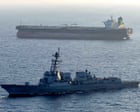
The prevailing narrative regarding the Strait of Hormuz is a masterclass in recycled anxiety. Pundits and "defense analysts" love to paint a picture of a binary ticking clock: a scenario where either the United States or Iran eventually snaps because the economic or political pressure becomes "unsustainable."
They are wrong. They are missing the fundamental mechanics of modern shadow warfare.
The standoff isn't a crisis looking for a resolution. It is a stabilized, high-margin ecosystem. Both Washington and Tehran have realized that a permanent state of "impending doom" provides more strategic leverage, domestic control, and budget justification than actual peace or actual war ever could. The "unsustainability" argument is the lazy consensus of people who still think geopolitics is about winning. In the 21st century, geopolitics is about maintaining the tension at a profitable frequency.
The Myth of the Global Economic Meltdown
The first pillar of the "unsustainability" myth is the belief that a total blockage of the Strait would instantly trigger a global Great Depression, forcing both sides to the table. This assumes we live in the energy market of 1973. We don't.
While 20-21 million barrels of oil flow through that 21-mile-wide passage daily, the world has spent forty years building redundancies that the doom-scrollers ignore. Saudi Arabia’s East-West Pipeline and the UAE’s Habshan-Fujairah line can already bypass the Strait for millions of barrels. More importantly, the rise of US shale and the strategic petroleum reserves (SPR) of OECD nations provide a buffer that didn't exist during the Tanker War of the 1980s.
When Iran threatens to close the Strait, they aren't threatening a knockout blow. They are performing a price-discovery exercise.
Every time a limpet mine attaches to a hull or a drone gets splashed, risk premiums on insurance jump. Crude prices spike. For a regime under heavy sanctions, those spikes are a lifeline. For a US administration, the "Iranian threat" is the ultimate lubricant for arms sales to the Gulf. We are witnessing a choreographed dance where the music is the sound of wire transfers.
Why Iran Prefers the Siege
The "consensus" says Iran is desperate for sanctions relief. This ignores the internal logic of the Islamic Revolutionary Guard Corps (IRGC). The IRGC doesn't just defend the country; it owns the country. It controls the black markets, the smuggling routes, and the "resistance economy."
A normalized Iran with open borders and transparent trade would strip the IRGC of its monopoly on the gray market. By keeping the Strait in a state of perpetual friction, they justify their grip on the port of Bandar Abbas and the intricate networks used to bypass Western banking.
If the standoff were truly unsustainable for Tehran, they would have made a move years ago. Instead, they’ve mastered the art of "Strategic Patience"—a fancy term for staying just below the threshold of a Tomahawk missile strike while keeping the threat of a $200 barrel of oil alive.
The American Addiction to the Choke Point
On the flip side, we’re told the US Navy is "stretched thin" and the American public has no appetite for another Middle Eastern entanglement. This is a fundamental misunderstanding of how the Pentagon views the world.
The Strait of Hormuz is the "Forever Project" that justifies the carrier strike group.
Without a persistent threat to the "freedom of navigation" in the Persian Gulf, the argument for a 350-ship navy collapses. The threat is the product. The standoff allows the US to:
- Maintain a forward presence that monitors not just Iran, but China’s growing energy interests.
- Lock in Gulf partners into decades-long maintenance contracts for American hardware.
- Test electronic warfare suites in a live environment against a peer-adjacent adversary without the body count of a hot war.
I’ve seen defense contractors pitch systems specifically designed for "asymmetric littoral threats." They don't want those threats to disappear. They want them managed. The "standoff" is the R&D lab of the military-industrial complex.
The Logistics of a Failed Blockade
Let’s run a thought experiment. Imagine Iran actually tries to "close" the Strait.
They don't have the conventional naval power to hold it. They have thousands of fast-attack craft, sea mines, and shore-to-ship missiles like the Noor or Ghadir.
In a vacuum, they could sink a few tankers. But the moment they do, they lose their only shield: the international community’s hesitation. The instant the flow of oil stops, China—Iran's biggest customer—becomes their biggest enemy.
The Strait of Hormuz is roughly $2.5 billion in trade moving every single day. If Iran stops that flow, they aren't just fighting the Great Satan; they are bankrupting the Dragon. Tehran knows this. Their "threats" are aimed at Western voters' gas prices, not at actually stopping the ships.
The standoff is sustainable because it is a bluff that neither side wants to call.
The Technology of Controlled Chaos
We are no longer in an era where "closing a strait" means a line of battleships. It’s now about cyber-attacks on port infrastructure, spoofing GPS coordinates to lure tankers into territorial waters, and using "ghost fleets" to move sanctioned oil under the very noses of the Fifth Fleet.
The "standoff" has moved to the digital and legal realms. This is much cheaper to maintain than a fleet of cruisers.
- AIS Spoofing: Tankers regularly "go dark" or broadcast false locations to hide their origin.
- Shadow Insurance: New entities in non-aligned jurisdictions are providing coverage that circumvents Western P&I clubs.
- Drone Swarms: Low-cost attrition warfare that forces the US to fire $2 million interceptors at $20,000 flying lawnmowers.
This asymmetry makes the standoff more sustainable, not less. It’s a low-boil conflict that can be dialed up or down depending on the news cycle.
You Are Asking the Wrong Question
People ask: "When will it end?"
The honest answer is: "Why would anyone involved want it to?"
The standoff is a functional tool for domestic stability in both countries. In the US, it’s a bipartisan bogeyman. In Iran, it’s the "external enemy" required to suppress internal dissent.
If you are a business leader or an investor waiting for "resolution" in the Persian Gulf before making a move, you are a dinosaur. The friction is the resolution. The volatility is the baseline.
The only "unsustainable" part of this situation is the belief that we are heading toward a climax. We aren't. We are living in the new normal of permanent, managed instability.
The Real Risk Nobody Talks About
The danger isn't a planned escalation. It's a technical glitch.
In a theater crowded with nervous twenty-something-year-old sonar operators and automated defense systems, the "incidental spark" is the only thing that can break the stalemate.
If an autonomous drone misidentifies a target or a cyber-attack on a refinery goes too far and kills hundreds, the "managed" part of the standoff evaporates. Both leaderships would be forced into a war they don't actually want and can't afford.
That is the paradox: the standoff is perfectly sustainable until a computer error makes it impossible.
Stop looking for a diplomatic breakthrough or a military victory. They are both bad for business. The players on the board have already decided that the current state of "almost-war" is the most efficient way to run their respective empires.
The Strait of Hormuz isn't a bridge to be crossed; it's a toll booth where the currency is fear. As long as the world is willing to pay, the standoff will continue.
Bet on the tension. It’s the only thing in the Gulf that’s guaranteed.