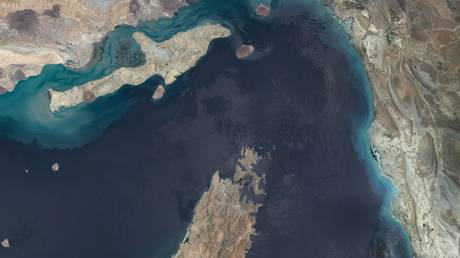
The foreign policy establishment is currently taking a victory lap over what they call an embarrassing retreat.
On Monday, the White House threatened a 20% "reimbursement fee" on all commercial cargo transiting the Strait of Hormuz. Shipping executives screamed about international law. European diplomats muttered about madness. By Tuesday, the toll was gone, replaced by vague promises of Gulf state investments and a standard naval blockade of Iranian ports.
The mainstream consensus is clear: a chaotic, illegal threat was made, the world balked, and the administration backed down.
They are completely misreading the board.
This was not a policy failure. It was a classic, aggressive monetization of American hegemony. By anchoring the conversation with an absurdly high, legally questionable 20% toll, the White House established a brand-new geopolitical reality: maritime security is no longer a free public good provided by the American taxpayer.
If you want the U.S. Navy to keep the world’s most volatile chokepoint open, you are going to pay for it. And the Gulf states just agreed to pay.
The Math of the Anchor
Let's look at the raw numbers that panicked the global shipping market.
At Brent crude prices hovering around $86 a barrel, a fully laden Very Large Crude Carrier (VLCC) carrying 2 million barrels of oil holds a cargo worth roughly $172 million. A 20% fee on that single transit amounts to more than $34 million. For a fully laden liquefied natural gas (LNG) carrier, the toll would have cleared $17 million.
Roughly 20 million barrels of oil pass through the Strait of Hormuz every single day. If the U.S. had actually enforced a 20% fee on all transit, it would have extracted upwards of $340 million per day from the global energy supply chain. That is more than $120 billion a year.
To put that in perspective, the entire annual budget of the U.S. Navy is roughly $250 billion. The White House threatened to fund half of the entire American naval apparatus on the backs of Gulf energy exporters and Asian buyers.
Naturally, the shipping industry cried foul. Industry groups like BIMCO and shipping giants like Hapag-Lloyd quickly pointed out that under Article 26 of the United Nations Convention on the Law of the Sea (UNCLOS), no charges may be levied upon foreign ships by reason only of their passage through territorial seas or international straits.
But international law is a polite fiction. It only exists as long as there is a dominant military power willing to enforce it. The U.S. has spent eighty years acting as the unpaid security guard of the global commons.
The 20% toll threat was designed to smash that status quo. It was a deliberate, extreme negotiating anchor.
When you want to extract billions from a counterparty, you do not start by politely asking for a 2% contribution. You demand 20%, threaten to shut down their entire economic pipeline, and wait for their phones to ring.
The "Walk-Back" That Wasn't
The media is calling Tuesday’s announcement a U-turn. But look at what actually happened.
Within hours of the toll announcement, the kings and emirs of the Gulf states were reportedly on the phone with the Oval Office. They did not offer legal arguments. They knew better. Instead, they offered cash.
The official statement from the administration laid it bare: the 20% fee was replaced with "Trade and Investment Deals that the various Gulf States will be making into the United States".
This is a shakedown masquerading as diplomacy, and it worked flawlessly.
[Threaten 20% Toll on Global Shipping]
               │
               ▼
[Gulf States Panic Over $30M+ Per-Ship Fees]
               │
               ▼
[Gulf Leaders Call White House to Negotiate]
               │
               ▼
[Toll Dropped in Exchange for Billions in US Investments]
The Gulf states—primarily Saudi Arabia, the UAE, Qatar, and Kuwait—rely entirely on the Strait of Hormuz to keep their economies alive. They are fully aware that without the U.S. Fifth Fleet, Iran could easily paralyze the waterway.
For decades, these nations have enjoyed a defense subsidy. They exported their oil, pocketed the profits, and let American sailors bleed and American taxpayers pay to keep their trade routes safe.
By threat-modeling a catastrophic toll, the administration forced these sovereign wealth funds to subsidize domestic American industry. The "walk-back" was actually the closing of the deal. The U.S. secured the financial upside of the toll without having to deal with the logistical and legal nightmare of actually stopping neutral ships to collect cash in the middle of a war zone.
The Blockade is the Side Show
While the business press focuses on the financial transactionalism, defense analysts are fixated on the return of the naval blockade of Iranian ports. This, too, is a misunderstanding of the current conflict.
A naval blockade is an outdated 19th-century tool being applied to a 21st-century asymmetric war.
Yes, the U.S. military can turn away commercial tankers flying foreign flags that are trying to load crude at Iran's Kharg Island terminal. We saw this during the first iteration of the blockade earlier this year, when dozens of ships complied with directions and reversed course. But blockading physical ports does not solve the actual security threat inside the Strait of Hormuz.
Iran does not need a massive blue-water navy to disrupt global trade. They have spent thirty years perfecting asymmetric swarm warfare. They use:
- Low-cost, explosive-laden fast attack craft
- Anti-ship cruise missiles hidden in coastal cliffs
- Loitering munitions and attack drones launched from inland bases
- Smart sea mines deployed from civilian dhows
A U.S. Navy destroyer sitting off the coast of Iran to enforce a blockade is actually a massive, high-value target for these exact systems.
The blockade does not deter Iranian aggression; it escalates it. Just hours after the blockade was reinstated, we saw retaliatory strikes on tankers and commercial ships associated with the UAE, Bahrain, and Jordan.
The blockade is a blunt, expensive military operation that risks American lives. The real genius of the administration’s strategy was using the threat of the toll to force the Gulf allies to pay for the very military operations that protect their own survival.
The Illusion of Free Navigation
The maritime industry is desperate to preserve the illusion of free, unmonetized navigation.
They argue that charging tolls for international straits sets a dangerous precedent. If the U.S. can charge a fee in Hormuz, what stops Egypt from raising Suez Canal fees to extortionate levels, or Malaysia and Indonesia from taxing the Malacca Strait?
Here is the hard truth: those waterways are already heavily monetized, either directly through transit fees or indirectly through soaring insurance premiums.
During crisis periods, war-risk insurance premiums for tankers transiting the Red Sea or the Persian Gulf can skyrocket to over 1% of the hull value per voyage. For a modern LNG carrier, that is over $2 million just in insurance costs for a single transit, paid directly to Western underwriters.
The shipping lines are already paying a toll. They are just paying it to Lloyd's of London instead of the Pentagon.
The administration’s proposal simply cut out the middleman. If the U.S. Navy is the entity taking the physical risk to defend the shipping lanes, why should the financial premium go entirely to private insurance syndicates?
Why the Gulf Paid Up
The Gulf Cooperation Council (GCC) states are not stupid. They recognized the leverage immediately.
If they refused to negotiate, the U.S. had two options, both of which were disastrous for Riyadh and Abu Dhabi:
- Enforce the toll: Forcing Gulf oil to become immediately 20% more expensive than Latin American, West African, or North Sea crude on the global market, destroying their market share.
- Withdraw U.S. protection: Leaving the Strait of Hormuz entirely to the mercy of Iran’s Islamic Revolutionary Guard Corps (IRGC), which has already proven it will seize or attack any vessel it pleases.
Faced with these options, pledging billions of dollars in domestic U.S. investments is a bargain. It allows the Gulf monarchs to frame the payments as strategic economic partnerships rather than tribute paid to a foreign hegemon. It keeps the U.S. military hardware stationed in Bahrain and Qatar. Most importantly, it keeps the oil flowing.
The foreign policy establishment can keep whining about the "rules-based international order." Meanwhile, the global security architecture has just been permanently restructured.
U.S. military protection is no longer a charity. It is a subscription service. And the first major invoice has just been settled.