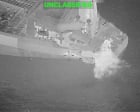
The headlines are bleeding red. A US missile strikes a commercial tanker bound for Iran. The pundit class is already hyperventilating on cable news, dusting off their "World War III" graphics and predicting $150-a-barrel oil by Friday.
They are wrong. They always are. Meanwhile, you can explore similar events here: Why the Atlantic Crossing of INS Sudarshini Matters More Than You Think.
The mainstream narrative surrounding the escalation in the Strait of Hormuz operates on a fundamentally flawed premise. The lazy consensus views this strike as a desperate, reckless push toward an uncontainable regional war. The media wants you to believe that global energy supply chains are a house of cards, and Uncle Sam just pulled the bottom card.
The reality is far more calculated, cold, and transactional. What looked like a flashpoint for global conflict was actually a highly calibrated exercise in maritime market stabilization. To understand the full picture, we recommend the excellent report by The Washington Post.
The Illumination of "Freedom of Navigation"
For decades, the naval presence in the Persian Gulf has been wrapped in the noble rhetoric of "keeping global sea lanes free." It is a beautiful sentiment designed for press briefings.
I spent years analyzing risk allocation in maritime logistics. Let me tell you how it actually works. "Freedom of navigation" is a code word for underwriting the risk management of multi-billion-dollar oil conglomerates.
When the US military fires a kinetic payload at a rogue vessel attempting to breach international sanctions, it is not an act of war. It is a margin call.
Consider the mechanics of maritime insurance. When tensions rise in the Choke Point of the World, Lloyd's of London syndicates do not panic; they reprice. War risk premiums skyrocket. If the United States sat on its hands and allowed Iran to establish a shadow-fleet monopoly through the strait, the cost of insuring every single transit would become economically untenable.
The missile strike was a brutal, necessary signal to the underwriting markets. It demonstrated that the rule of law—or at least the rule of Western economic dominance—will be enforced with high-explosive predictability. By taking out a non-compliant actor, the US actually stabilized the long-term risk profile of the strait. It proved that the cost of defiance is absolute, which, paradoxically, keeps the cost of compliant commerce stable.
The Broken Logic of the Oil Shock Myth
Let's address the inevitable "People Also Ask" panic: Will this strike cause a global energy crisis?
The short answer is no. The long answer requires looking at data, not drama.
The crowd that panics over every Gulf skirmish forgets that the energy map has fundamentally shifted. The global economy is no longer uniquely hostage to the whims of the Hormuz choke point.
| Metric | The 1970s Reality | The Modern Reality |
|---|---|---|
| US Energy Position | Net Importer (Vulnerable) | Net Exporter (Permian Basin Dominance) |
| Strategic Reserves | Nascent / Uncoordinated | Global Coordinated Release Mechanisms |
| Alternative Routes | Virtually Non-Existent | East-West Pipelines, Red Sea Bypass Options |
The Permian Basin is the ultimate geopolitical shock absorber. Every time a drone flies too close to a refinery in the Middle East, West Texas shale producers spin up rigs. Furthermore, China—the primary destination for a massive chunk of Iranian crude—has spent the last decade building a vast network of overland pipelines and strategic storage facilities.
If you think a single localized strike on a tanker halts global industry, you underestimate the redundant, hyper-engineered nature of modern supply chains. The market knows this. Look at the Brent crude futures in the wake of the strike. A temporary 3% spike, followed by a steady bleed back to baseline. The traders aren't scared. Only the journalists are.
The Dark Side of Deterrence
Admitting the counter-intuitive stability of this strike does not mean there are no casualties. The downside of this cynical geopolitical calculus is borne entirely by the global shipping labor force and merchant mariners.
While Wall Street algorithms price in the risk perfectly, the humans steering these 300,000-ton vessels are treated as acceptable collateral damage. When a state actor decides to enforce a blockade or a sanction regime via kinetic force, they are betting that the shipping industry's endless supply of cheap, third-country national labor will keep showing up to sign contracts.
I have stood on the decks of these vessels. The sailors aren't thinking about ideological supremacy or the balance of power in the Middle East. They are thinking about their families in Manila or Odessa. The contrarian truth is that global trade relies on a baseline of human terror that the corporate offices in Geneva and Houston prefer not to quantify on their balance sheets.
De-escalation Through Kinetic Calibration
The most glaring omission in the competitor's coverage is the failure to understand the concept of proportional response. They painted the picture of an out-of-control superpower firing wildly at targets of opportunity.
Nothing could be further from the truth.
Military planners do not use sledgehammers when scalpel-thin precision will suffice. The weapon system utilized was intentionally chosen to minimize broader collateral damage while maximizing psychological impact. It was a message delivered in the language of hardware: We can see you, we can touch you, and your sovereign patrons cannot protect your cargo.
Imagine a scenario where the US had chosen diplomatic posturing instead. A strongly worded UN resolution. Additional economic sanctions on a regime already drowning in them. What happens? The shadow fleet grows bolder. Iran increases its leverage. The threat to international shipping lanes becomes systemic rather than sporadic.
By executing a precise, violent intervention, the US prevented a slow-burning crisis from becoming a chronic disease. It re-established the boundaries of acceptable behavior in international waters. True deterrence requires the credible threat of violence, and a credible threat must occasionally be validated.
Stop reading the breathless commentary about an impending apocalypse. The global economic architecture is remarkably resilient, cold-blooded, and indifferent to localized chaos. The strike in the Strait of Hormuz wasn't the opening salvo of a new global conflict. It was just the cost of doing business.


