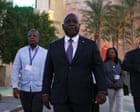
The air in Nassau doesn't just sit; it clings. It carries the scent of salt spray, diesel from the jitneys, and the faint, sweet decay of tropical flora. On election night, that air thickened with something else: the electric, jagged tension of a people who had reached their breaking point.
Philip "Brave" Davis did not just win an election. He inherited a house that had been battered by a Category 5 hurricane and then boarded up by a global pandemic. To understand why the Progressive Liberal Party (PLP) swept back into power, you have to look past the tallies and the percentages. You have to look at the hands of the people casting the ballots—hands that were tired of holding on to promises that never quite reached the dinner table.
Consider a hypothetical vendor named Elias. Elias sells conch salad under the bridge at Potter’s Cay. For decades, his rhythm was dictated by the arrival of cruise ships. When the world stopped turning in 2020, Elias’s world didn't just slow down; it evaporated. He represents the silent majority of the 400,000 souls living across the Bahamian archipelago. For Elias, the outgoing Free National Movement (FNM) government wasn't just a political entity. It was the face of a lockdown that felt like a chokehold.
The numbers tell the cold version of the story. The PLP secured 32 of the 39 seats in the House of Assembly. It was a landslide. A rout. But the heat of that victory was fueled by a simple, human desperation for a change in tone.
The Weight of the Caribbean Sun
The Bahamas is often viewed through the gauzy lens of a postcard. Turquoise water. White sand. Luxury resorts. But behind the hibiscus hedges lies a complex economy that was crushed under the weight of back-to-back catastrophes.
First came Hurricane Dorian in 2019. It wasn't just a storm; it was a generational trauma. It leveled parts of Grand Bahama and the Abacos, leaving scars on the land and the psyche that haven't even begun to fade. Then, before the rubble could be cleared, COVID-19 arrived.
The outgoing Prime Minister, Hubert Minnis, was a physician by trade. He approached the pandemic with a doctor's clinical detachment. He implemented some of the strictest lockdowns in the region. He looked at the data and saw a need for containment. The people looked at their empty cupboards and saw a need for survival.
Davis, a seasoned lawyer from a humble background, sensed this disconnect. He didn't campaign on clinical data. He campaigned on "The Blueprint for Change." He spoke about the "Brave" way forward. It was branding, yes, but it was branding that met the moment. He promised to lower the Value Added Tax (VAT) from 12% to 10%, a move that felt like oxygen to a drowning man.
A Tale of Two Realities
Politics in the islands is intimate. It’s played out in church pews and grocery store aisles. In the months leading up to the vote, the FNM argued that they had saved lives through their rigorous health protocols. They pointed to their management of the national debt and the slow reopening of the borders.
The voters weren't listening to the macro-statistics. They were feeling the micro-pressures.
The unemployment rate had ballooned. The debt-to-GDP ratio was spiraling toward 100%. When the FNM called an early election—eight months before it was legally required—they banked on a "vaccine bounce." They hoped the public would reward them for navigating the worst of the crisis.
They miscalculated the depth of the exhaustion.
When the polls opened, the lines weren't just long; they were quiet. There was a grim determination in the air. The low voter turnout—roughly 65%, compared to the usual 90%—spoke volumes. It wasn't just apathy. It was a segment of the population so disillusioned by the options that they stayed home, and a segment so energized by the hope of relief that they showed up in droves to flip the script.
The Architecture of a Comeback
Philip Davis is not a firebrand in the traditional sense. He doesn't have the booming, operatic charisma of some of his predecessors. He is steady. He is calculated. He spent years in the trenches of the PLP, serving as Deputy Prime Minister under Perry Christie.
His strategy was to pivot the conversation from "safety" to "dignity."
He spoke to the workers in the tourism sector who felt forgotten. He spoke to the families in the "over-the-hill" neighborhoods of Nassau who saw the shiny skyscrapers of Baha Mar and Atlantis from a distance but felt none of the warmth of that prosperity.
The PLP’s victory was a rejection of the "doctor knows best" approach to governance. It was a demand for a partner, not a parent. The mandate was clear: fix the economy, but don't do it on the backs of the poor.
The Invisible Stakes
Why does a small island nation's election matter to the rest of the world?
The Bahamas is a canary in the coal mine for climate change and global economic shifts. As a country that contributes almost nothing to global carbon emissions but pays the highest price in the form of intensified hurricanes, its leadership must be vocal on the world stage.
Davis entered office with the shadow of Dorian still looming. The "invisible stakes" of his premiership involve more than just tax cuts. They involve the very survival of the islands. If the government cannot secure international climate financing or diversify the economy away from its total reliance on American tourism, the cycle of boom and bust will only become more violent.
Think back to Elias at Potter’s Cay. If the next hurricane hits and the government’s response is seen as bureaucratic or cold, the cycle of political upheaval will simply repeat. The Caribbean voter is patient, until they aren't.
The transition of power was swift. In the British parliamentary tradition, Minnis conceded quickly. Davis was sworn in with a sense of urgency. The festivities were muted by the ongoing reality of the pandemic, but the sense of relief among the PLP faithful was palpable. They wore yellow—the party color—like a badge of survival.
The Morning After the Storm
The morning after the election, the sun rose over Nassau harbor just as it always does. The cruise ships were beginning to return, white giants looming over the docks. But the conversation in the barber shops and on the docks had shifted.
The "Brave" era began with a mountain of expectations.
Voters are fickle because their needs are immediate. A 2% reduction in VAT is a start, but it doesn't rebuild a roof in Marsh Harbour. It doesn't put a child through university in a country where the cost of living is one of the highest in the world.
Davis knows this. His rhetoric since taking office has been one of "we." We will recover. We will rebuild. We will thrive. It is a necessary shift from the "I" of executive mandates.
The story of the Bahamas re-electing the PLP isn't a story of political ideology. There is very little daylight between the FNM and the PLP when it comes to actual policy. Both are centrist, pro-business parties. The difference lies in the narrative of empathy.
One party looked at the people and saw patients to be managed. The other looked at them and saw partners to be empowered.
As the new administration settles into the pink buildings of Parliament Square, the ghosts of Dorian and the silence of the lockdowns still haunt the hallways. The victory was the easy part. The true test lies in the quiet Tuesday afternoons when the headlines have faded, and the people are still waiting for the "Blueprint" to become a reality.
The Bahamian people didn't just vote for a new Prime Minister. They voted for the possibility that their government might finally feel what they feel. They voted for the hope that the next time the wind picks up and the clouds darken, they won't be left to face the storm alone.
The salt air continues to cling. The water remains a shade of blue that seems impossible. And in the heart of Nassau, the people are watching, waiting to see if the "Brave" way is a path or just a promise.


