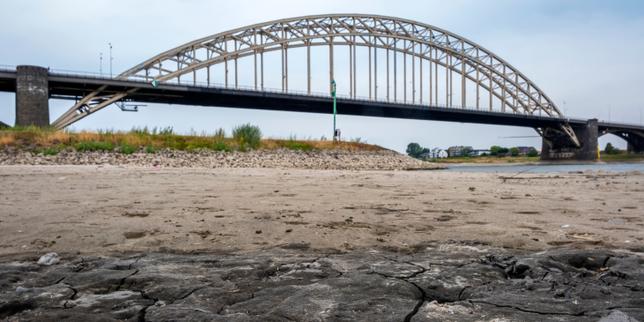
Every time the Rhine dips below a standard threshold, environmental commentators panic on schedule. Media outlets rush to publish breathless warnings about how the Netherlands, that eternal fortress of pumps and polders, is suddenly vulnerable to parching.
It is a lazy narrative built on a fundamental misunderstanding of hydrology. The conventional wisdom claims that a country famous for fighting off the sea is uniquely unequipped for a lack of water. You might also find this similar story insightful: The Economics of Maritime Destruction Why Targeting Iranian Tankers Alters Global Energy Pricing.
The lazy consensus has got it completely backwards.
The Dutch are not victims of an unexpected dry spell. They are victims of their own engineering brilliance, trapped by a century-old obsession with draining every square inch of earth to maximize agricultural output. Focusing on surface-level drought misses the catastrophic reality happening below ground. As discussed in recent coverage by Reuters, the results are worth noting.
The Polder Paradox That Everyone Ignores
To understand why standard reports on Dutch water shortages miss the mark, look at how the system actually operates. For generations, Rijkswaterstaat and local water boards (waterschappen) treated water management as a binary equation: keep the Dutch dry, push excess rain into the North Sea as fast as humanly possible, and maintain artificially low groundwater tables so heavy tractors can tear across clay and peat soils.
When it stops raining, everyone blames the clouds. Nobody blames the drainage pumps.
By artificially forcing water tables down to suit intensive dairy farming and greenhouse operations, water authorities spent decades engineering their own vulnerability. Imagine a scenario where a homeowner leaves the basement drains wide open during a dry summer while complaining that the well is running empty. That is modern Dutch water policy in a nutshell.
When dry periods hit, the problem is not a lack of moisture falling from the sky. The problem is that the sponge has been systematically removed. Decades of drainage turned sponge-like peatlands into compressed, oxidized dirt.
The Real Danger Is Land Subsidence, Not Thirsty Tulips
When mainstream journalists cover Dutch droughts, they focus on low shipping levels on the Rhine, scorched lawns, and restrictions on spraying crops. These are inconveniences, not existential threats.
The true structural crisis is land subsidence.
As peat soils dry out because groundwater levels are kept artificially low, the organic matter oxidizes and literally vanishes into the atmosphere as carbon dioxide. The ground sinks by centimeters every year. Entire neighborhoods built on wooden piles decades ago are now seeing those foundations rot as oxygen hits wood that used to be permanently submerged. Billions of euros in infrastructure damage loom, not because it didn't rain enough last month, but because the subsurface framework is collapsing under the weight of bad nineteenth-century zoning habits.
Institutions like Deltares have tracked these long-term deformations for years. Yet, public discourse remains fixated on emergency measures like shipping restrictions or temporary bans on sprinkling sports fields. This is like putting a band-aid on a structural fracture while the foundation shifts.
Why More Canals and Reservoirs Will Fail
The standard technocratic response to these dry spells is to demand more infrastructure. Politicians call for larger freshwater reservoirs, expanded storage in the IJsselmeer, and complex piping networks to shunt water inland from the wetter northern provinces.
This approach doubles down on the exact mindset that caused the vulnerability in the first place. Trying to engineer your way out of an ecological mismatch with heavier concrete and more pumps is a fool's errand.
Water retention cannot be solved by building more artificial bathtubs. It requires raising the groundwater table back up, even if that means telling dairy farmers they can no longer farm on fragile peat soils that belong underwater. It requires accepting wetter fields, adapting crop types, and letting parts of the landscape revert to a semi-amphibious state.
Stop asking how the Netherlands can secure more water to maintain an unsustainable status quo. The question you should be asking is how quickly the country can abandon the delusion that nature can be permanently subjugated by a bigger pump.
The water will return. The sunken land will not.