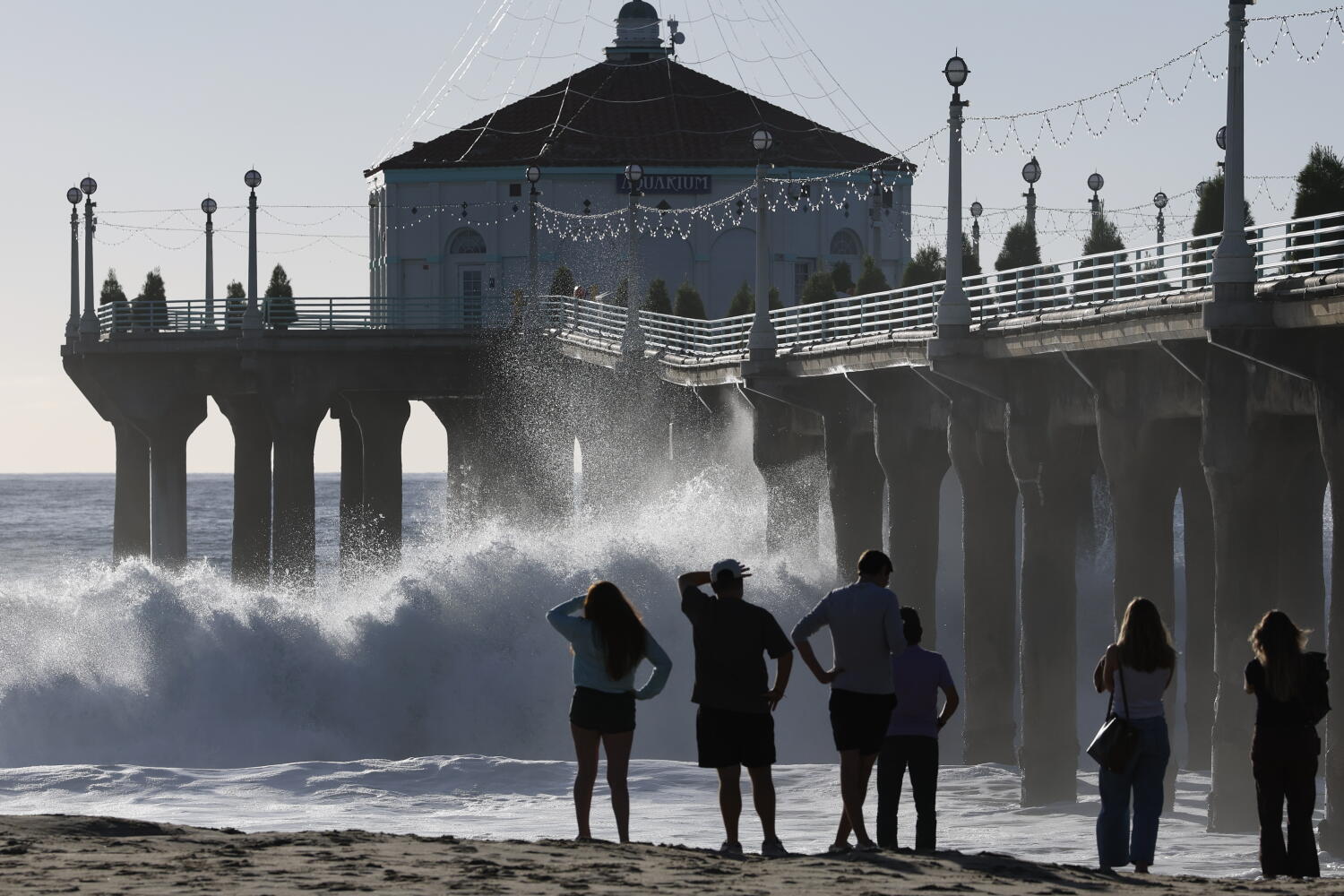
Every single winter, local news anchors dust off the exact same breathless script. They stand in front of a green screen, point at a red blob on a National Weather Service map, and tell millions of Californians to lock their doors and stay miles away from the sand because "the beach is not your friend this weekend."
It is lazy journalism. Worse, it is counterproductive public safety messaging.
When media outlets flatten a complex oceanographic event into a simplistic "ocean equals evil" warning, they fail the exact people who need help the most. Terrified landlubbers stay home anyway, while casual beachgoers—having been cried wolf to ten times every winter—ignore the blanket panic entirely. Meanwhile, the people who actually understand coastal dynamics recognize that a massive winter swell isn't a blanket apocalypse. It is a hyper-localized redistribution of kinetic energy.
If you treat the entire 840-mile California coastline as a monolithic death trap, you fundamentally misunderstand how waves work, how beaches erode, and how human beings actually interact with the Pacific Ocean.
The Myth of the Uniform Coastline
The biggest lie in mainstream surf and weather reporting is the idea that a "20-foot swell" hits every beach equally.
Open-ocean swell height, measured in feet, is a raw metric collected by offshore buoys operated by the National Data Buoy Center (NDBC). When a buoy 50 miles west of San Francisco reads 18 feet at 19 seconds, news desks immediately translate that into impending doom for every town from Eureka to Imperial Beach.
That is not how bathymetry works.
The ocean floor off California is a chaotic underwater mountain range carved by deep submarine canyons, shifting sandbars, and jutting headlands. This underwater topography acts like an optical lens, bending and focusing wave energy through a process called wave refraction.
- Submarine Canyons Amplify Energy: Places like La Jolla Canyon or Monterey Canyon allow deep-water swells to travel right up to the shoreline without losing momentum to bottom friction. When that energy finally hits a shallow reef or steep beach, it explodes. That is why Maverick’s in Half Moon Bay or Black’s Beach in San Diego can produce life-threatening walls of water while a beach three miles down the road stays relatively tame.
- Headlands and Islands Block Swells: A massive northwest groundswell—the standard winter engine in the North Pacific—gets completely shadowed by Point Conception and the Channel Islands. While Pismo Beach might be getting hammered by violent shorebreak, beaches in Ventura or Santa Barbara sitting just around the corner can remain entirely sheltered, peeling at a manageable three to four feet.
Telling someone in Santa Barbara to avoid the sand because Ocean Beach in San Francisco is closing out is like telling someone in Miami to board up their windows because a blizzard hit Boston. Blanket fear-mongering erases geography.
Why "Stay Away" Fails the People Actually in Danger
After decades of watching coastal rescues unfold from Malibu to Ocean Beach, a clear pattern emerges. The people getting swept off jetties and dragged out by rip currents aren't big-wave surfers with inflatable vests and jet-ski support. They aren't even the tourists who blindly obey a scary headline.
The victims are almost always the casual observers who walked out onto wet rocks because nobody explained why a long-period swell is deceptive.
When a news report screams about "massive waves," the average person expects a continuous, roaring wall of whitewater like a washing machine. When they drive past the coast and see five minutes of glassy, calm water, they assume the forecasters exaggerated. They walk down to the water's edge to take a photo.
They do not understand wave period—the time in seconds between consecutive wave crests.
A short-period wind swell (8 to 10 seconds) is messy, choppy, and visibly chaotic. You can see the danger immediately. A massive winter groundswell generated by a storm 2,000 miles away in the Gulf of Alaska travels with a long period—often 18 to 22 seconds.
Long-period swells travel fast, carry exponentially more water volume, and organize into distinct sets separated by long lulls. During a 15-minute lull, the ocean looks entirely benign. Then, a five-wave set arrives, pushing hundreds of thousands of gallons of water onto the beach all at once. Because the water has nowhere to go, it surges up the dry sand—a phenomenon oceanographers call wave run-up—and rushes back out in violent, localized channels.
By screaming "the beach is not your friend" instead of explaining the mechanics of a 20-minute lull, the media actively blinds the public to the actual mechanism that kills people: sneaker waves.
The Economic and Cultural Blind Spot of Coastal Panic
There is another side to this story that local news desks completely ignore while chasing clicks with dramatic B-roll of flooded parking lots.
For coastal communities, surfers, photographers, and marine researchers, a massive winter swell isn't a disaster. It is the main event of the year.
When a legitimate XXL swell hits the California coast, it triggers a massive, hyper-local economic surge. Hotel rooms in Half Moon Bay sell out overnight. Charter boats out of Pillar Point Harbor book weeks in advance. Surf shops, board shapers, wetsuits manufacturers, and local diners from Santa Cruz to San Clemente see their highest winter revenues during the exact weekends the evening news tells everyone to hide under their beds.
More importantly, these swells are essential for the physical health of the coastline itself.
Beaches are not static paved parks; they are dynamic rivers of sand. Massive winter swells perform critical geological maintenance. They strip summer sand from the dry beach and deposit it offshore into protective underwater sandbars. These winter sandbars act as natural speed bumps, absorbing energy from subsequent storms later in the season and preventing catastrophic cliff collapse. Without violent winter swells, California’s coastal geology would stagnate, accelerating long-term shoreline retreat.
Dismantling the Worst Questions About Big Winter Swells
If you search online during a high-surf advisory, you get flooded with terrified, poorly framed questions driven by sensationalist headlines. Let’s tear down the flawed premises behind them.
"Is it safe to go to the beach during a high surf advisory?"
You are asking the wrong question. "The beach" is not a single place, and "safe" depends entirely on where you stand and what you are looking at.
Is it safe to stand on a low-lying rock jetty at Moss Landing during a 20-foot swell at high tide? No. That is a coin flip with death. Is it safe to stand on an elevated coastal bluff in Palos Verdes or watch from the boardwalk in Santa Cruz? Yes. In fact, watching massive kinetic energy unload against a rocky headland from high ground is one of the greatest free spectacles in nature. Stop treating the coastline like a binary on/off switch and start reading the specific terrain.
"Are giant waves caused by climate change?"
Be careful with lazy attribution. Single winter storms and massive North Pacific swells have hammered California for millennia—long before industrial emissions existed. El Niño winters in 1982–83 and 1997–98 produced historic, devastating swells that wiped out piers up and down the coast.
What has changed is the baseline. According to data from the National Oceanic and Atmospheric Administration (NOAA) and Scripps Institution of Oceanography, global sea level rise means those exact same historic swells are now launching from a higher starting elevation. A 15-foot swell hitting a seawall at a 7-foot king tide does infinitely more structural damage than the exact same swell hitting at a 4-foot tide 50 years ago. The waves aren't necessarily bigger; the ocean floor they are standing on is higher.
"Why do surfers risk their lives during these warnings?"
Because to an outsider, a 30-foot wave looks like random chaos. To a seasoned waterman, it is a predictable, rhythmic system governed by physics.
Big-wave surfers aren't adrenaline junkies blindly throwing themselves into meat grinders. They spend days studying bathymetric charts, buoy spectral data, wind direction shifts, and tide swings. They know the exact channel where water flows back out to sea without breaking. They carry inflation vests, wear impact suits, and coordinate rescue teams on personal watercraft. Their risk is calculated, rehearsed, and respected. The person drowning in two feet of whitewater at a local beach break didn't die because the ocean was "unfriendly"—they died because they lacked basic water literacy.
How to Actually Navigate a Massive Swell (Without Hiding Indoors)
If you want to experience a historic California swell without becoming a statistic for the local fire department, throw away the generic news warnings and follow the exact rules coastal veterans use.
1. Never Turn Your Back on the Pacific
This is the oldest rule on the coast for a reason. Never walk along the wet sand line looking at your phone or facing inland. If you are on a beach during a high-surf warning, your eyes stay glued to the horizon. Period.
2. Read the Sand, Not the Headline
Look down before you step onto a beach.
- Dry, fluffy sand means water hasn't reached that spot during the current tidal cycle.
- Dark, wet, packed sand means a wave washed over that exact spot within the last 20 minutes—and another one will do it again shortly. Never set down a blanket, a camera bag, or a child on wet sand during a long-period swell.
3. Check the Tide Table Before the Buoy Report
A 15-foot swell at a negative low tide often breaks far offshore on outer sandbars, dissipating its energy before it ever reaches the beach. That exact same 15-foot swell hitting during a 6.5-foot high tide bypasses the outer bars entirely, slamming directly into coastal bluffs, seawalls, and parking lots. Tide height dictates coastal flooding far more than raw swell size.
4. Stay Off Jetties, Breakwaters, and Tide Pools
Man-made rock jetties (like the Wedge in Newport Beach or Harbor entrance walls in Santa Cruz) are death traps during big swells. Waves refract along the submerged rocks, creating unpredictable surges that wash straight over the top, knocking people into jagged boulders and sweeping them into fast-moving harbor channels. Watch from elevated cliffs or paved promenades well above the splash zone.
The Downside of Treating the Ocean Like an Adversary
There is a legitimate risk to encouraging people to engage with the coast during extreme weather: overconfidence. Some people will always misread conditions, overestimate their swimming ability, or ignore basic physics because they want a viral video. Lifeguards and Coast Guard crews already stretch their resources thin every winter pulling unprepared people out of cold, turbulent water.
Yet, infantilizing the public with melodramatic headlines does nothing to stop reckless behavior. When every 12-foot winter swell gets branded as a life-or-death catastrophe, people tune out. When a truly historic, once-in-a-decade storm system arrives—carrying 25-foot swells, hurricane-force onshore winds, and severe coastal flooding—the public treats it like just another weekend weather segment.
The ocean is not your friend, and it is not your enemy. It is an indifferent, awe-inspiring physical force moving energy across thousands of miles of open water. Respect it by learning how it works, get to high ground, and watch the show.