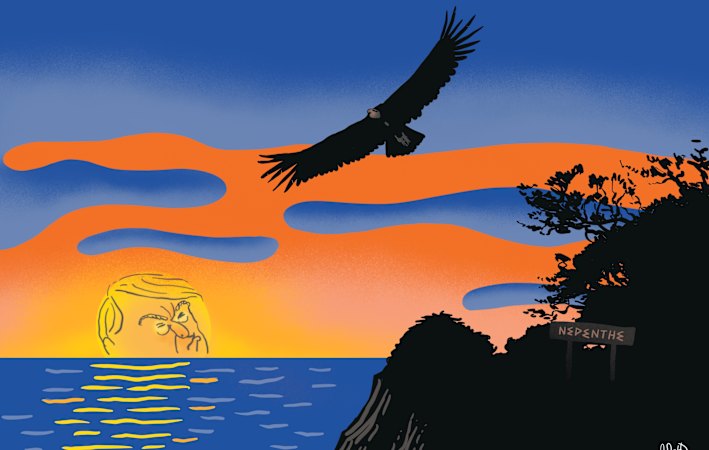
The news cycle right now feels like a heavy wool blanket dropped over your head. Turn on the television, scroll through your feed, or just listen to people at the local coffee shop, and you're trapped in it. Between the relentless political theater in Washington, the minting of literal gold coins with a president's face, and escalating global standoffs, the mental static is deafening. Modern America is loud. It's exhausting.
Sometimes the only sane response is to run away. Not permanently, of course. Just long enough to remember that the dirt, the ocean, and the sky don't care who sits in the Oval Office.
If you need that kind of escape, you need to head to the edge of the continent. Specifically, you need to get yourself onto California Highway 1, point the nose of your car south from Monterey, and lose yourself in the dramatic cliffs of Big Sur. It's a place where cell service goes to die and history feels remarkably close. People have been fleeing to these cliffs for a century to get away from the anxieties of their times. You won't be the first, and you certainly won't be the last.
The Massive Wings Above the Pacific
You're driving along a narrow ribbon of asphalt suspended between a sheer rock wall and a three-hundred-foot drop into the crashing Pacific. The air smells like salt and crushed sage. Suddenly, a shadow blocks the sun.
You pull over into a gravel turnout, step out of the car, and look up. High above the churning white foam, a massive bird glides on the thermal currents. Its wingspan is absurd, stretching nearly ten feet across. It doesn't flap. It just commands the sky, riding the wind like a silent black glider.
That's a California condor.
Seeing one in the wild feels like spotting a living dinosaur, and honestly, it kind of is. Back in the late 1980s, these birds were effectively gone. Human expansion, lead poisoning, and poaching whittled the wild population down to just over twenty individuals. Biologists had to swoop in, capture every single remaining wild condor, and bet everything on captive breeding programs at places like the San Diego Zoo and the Los Angeles Zoo.
It worked. Today, dozens of these prehistoric giants fly free over the central coast. They wear numbered tags on their wings like marathon runners, a stark reminder of how much human effort it takes to undo human damage.
Watching a condor drift effortlessly through the fog teaches you something about perspective. These birds survived the ice age. They survived the arrival of Spanish galleons. They survived the gold rush, the building of the highway, and the dawn of the internet. They don't know anything about political polling or international blockades. They just look for carrion and wait for the morning sun to warm the air currents. Standing on a cliffside watching a species cheat death makes the morning's breaking news alerts feel incredibly small.
Fleeing the Spotlight in Carmel and the Crags
Long before the current political climate made everyone want to throw their smartphones into the sea, old Hollywood treated this stretch of coast as its private sanctuary. The glamour of Los Angeles has always carried a toxic undercurrent of desperation and scrutiny. When the stars of the golden age couldn't take it anymore, they drove north.
Carmel-by-the-Sea sits just north of Big Sur proper, acting as a genteel gateway to the wild coast. It's a town famously designed to reject modernity. There are no street addresses here, no neon signs, and no streetlights. If you want to find a house, you look for its name, like "Sea Urchin" or "The Periwinkle," painted on a wooden shingle.
Clint Eastwood famously loved the place so much he became its mayor in the 1980s. He ran for office mostly because he was annoyed by local bureaucrats trying to ban people from eating ice cream cones on the public sidewalks. He won in a landslide, fixed the ice cream issue, supported local business, and then stepped back into the shadows of his ranch. He understood that Carmel wasn't a place for grand political statements. It was a place to protect a quiet way of life.
Further down the coast, deep in the rugged heart of Big Sur, the escapes became even more radical.
Consider Orson Welles and Rita Hayworth. In the 1940s, they were one of the most famous, scrutinized couples on earth. Looking for an escape from the studio bosses and the gossip columnists, they bought a rustic wooden cabin perched high on a ridge overlooking the ocean. They wanted isolation. They wanted to forget about cameras and scripts.
Though their marriage didn't last, that cabin became the foundation for Nepenthe, a legendary restaurant that still stands today. The word nepenthe comes from the ancient Greek, translating roughly to "a medicine for sorrow" or "that which chases away grief." Sitting on the restaurant’s outdoor terrace today, sipping a beer while looking down at the coastline, you can see exactly why Welles and Hayworth wanted to hide here. The view demands your full attention, leaving no room in your brain for internal anxieties.
The Geography of Direct Disconnection
The secret weapon of a Big Sur road trip is its technical difficulty. This isn't a highway where you can set the cruise control, lean back, and check your text messages.
Highway 1 is a fickle beast. It clings to the edge of the Santa Lucia Mountains. Landslides are common, sometimes shutting down entire sections of the road for months at a time. The pavement twists violently around blind corners, narrows down to single lanes over historic concrete bridges, and frequently disappears into thick banks of marine layer fog.
You have to pay attention. If your mind wanders to a tweet or a cable news headline while you're negotiating a tight turn near Hurricane Point, you're going to end up in the ocean. This forced mindfulness is exactly what makes the drive so therapeutic. Your brain simply doesn't have the bandwidth to worry about national debts or foreign policy when you're managing a steep descent on a wet road with no guardrail.
Then there is the beautiful gift of the dead zone.
About ten miles south of Carmel, your cell phone signal will flicker and die. It won't come back until you get close to San Simeon, miles to the south. At first, you might feel a phantom vibration in your pocket. You might feel a brief spike of panic. How will you know what's happening? What if something breaks?
Then, the panic fades into a profound sense of relief. You can't be reached. You can't check the news. You can't participate in the digital shouting match. You are exactly where your feet are, occupying a tiny patch of space between the redwoods and the ocean.
Spending Your Time Wisely on the Coast
If you're going to use this road trip to clear the political cobwebs out of your head, don't rush it. Too many people try to blast through Big Sur in a couple of hours, treating it like a checkbox on a tourist itinerary. That defeats the whole purpose.
Start your morning early at Point Lobos State Natural Reserve, just south of Carmel. The late artist Francis McComas called it the greatest meeting of land and water in the world, and he wasn't exaggerating. Walk the Cypress Grove Trail. The trees here are clinging to the granite cliffs, their branches covered in a bright orange moss called Trentepohlia. Listen to the bark of the sea lions out on the rocks. Watch the sea otters tangled in the kelp beds, floating on their backs without a care in the world.
When you head further south, make a stop at the Bixby Creek Bridge. It's one of the most photographed bridges in the world for a reason. The single concrete arch spans a massive canyon, looking like something built by an ancient Roman civilization rather than 1930s highway workers. Instead of just taking a quick selfie and leaving, sit on the hillside for twenty minutes. Watch how the ocean fog rolls through the arch, swallowing the structure whole before spitting it back out into the sunlight.
For lunch, get that seat on the deck at Nepenthe. Order a burger, leave your phone in the car, and just stare at the south coast. The cliffs stack up behind each other like giant green waves fading into the blue haze of the distance.
Finish your day by walking down into the redwood canyons. Places like Pfeiffer Big Sur State Park offer a completely different atmosphere from the sun-drenched ocean cliffs. Under the canopy of these ancient trees, the world becomes quiet and dark. The redwoods can live for over a thousand years. They don't care about the news cycle. They've stood through empires rising and falling, and they'll be standing long after our current political squabbles are forgotten footnotes in history books.
Pack a physical map. Buy a bottle of water. Put your phone in the glove box, turn the key, and start driving. The country will still be messy when you get back, but you'll be in a much better frame of mind to deal with it.


