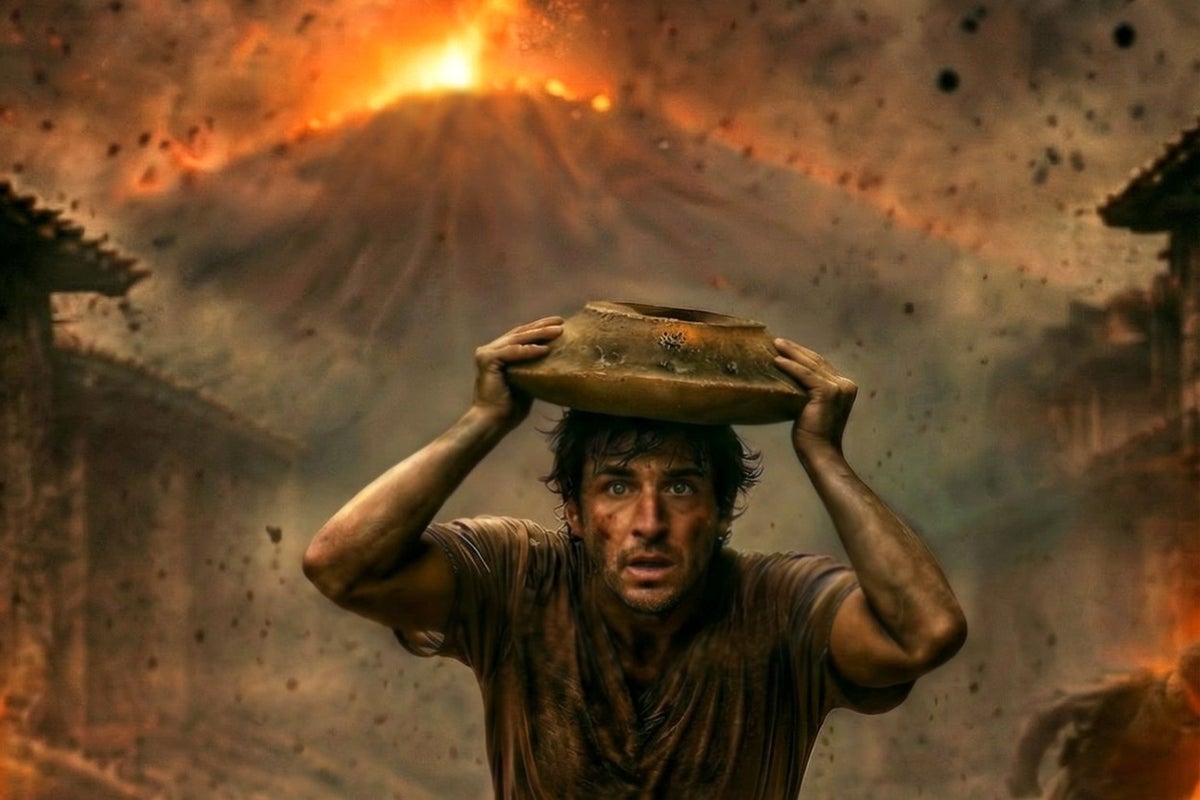
Archaeology has a voyeurism problem. We have spent centuries staring at the agony of Pompeii, but now we have handed the magnifying glass to an algorithm that doesn’t know the difference between a historical fact and a cinematic trope.
The recent surge in "AI-reconstructed" escape attempts from the AD 79 eruption of Vesuvius is being sold to the public as a breakthrough in empathy and science. It is neither. It is a high-tech Rorschach test. When we use neural networks to "reconstruct" the final moments of a victim, we aren't recovering history. We are projecting our 21st-century anxieties onto a pile of ash and calling it data.
The Hallucination of Certainty
The standard narrative claims that by feeding skeletal remains, plaster cast scans, and topographical data into a generative model, we can simulate the "most likely" path a victim took to escape. This premise is fundamentally broken.
Machine learning is a game of patterns. It looks at what exists and predicts what is missing based on the most common outcomes it has seen in its training data. If you train a model on Hollywood disaster movies and a handful of archaeological papers, the AI will prioritize a "dramatic" or "logical" path.
But humans in a crisis are rarely logical.
When Vesuvius blew, the air was thick with lapilli—small stones falling at terminal velocity—and the sky was pitch black. To suggest an AI can calculate an "attempted escape route" implies that the victim had visibility, a map, and a rational mind. In reality, people were suffocating on pyroclastic surges moving at 100 miles per hour. There was no "path." There was only chaos. By smoothing that chaos into a digital narrative, we erase the terrifying reality of the event in favor of a clean, digestible simulation.
The Data Gap Nobody Wants to Talk About
I have seen research teams spend hundreds of thousands of dollars on LiDAR scans of the Pompeian villas only to feed that precision data into a black-box model that makes "best guesses" about soft tissue and muscle response.
Here is the inconvenient truth: We do not have the input variables required for a high-fidelity simulation. To truly reconstruct a "path," you would need:
- Instantaneous Atmospheric Density: How much ash was in the lungs at minute four?
- Structural Integrity Timelines: When exactly did the roof of the House of the Faun collapse?
- Pre-existing Pathologies: Did this specific individual have a limp? A respiratory condition? An inner ear infection that affected their balance in the dark?
Without these, the AI is just playing a very expensive game of The Sims. It fills the gaps with "average" human behavior. But history isn't made of averages. It is made of the outliers.
Digital Taxidermy is Not Science
The competitor articles love to use words like "resurrection" or "bringing the past to life." This isn't science; it's digital taxidermy.
When we "reconstruct" a face using AI, we are creating a person that looks like a composite of everyone else the AI has seen. This creates a feedback loop of historical "sameness." We end up with a version of the past that looks remarkably like a modern Mediterranean tourist board advertisement.
We are obsessed with making the dead "relatable." We want to see them running, reaching, and fearing because it makes us feel connected. But true archaeology should respect the "otherness" of the past. These people lived in a world with different social structures, different physical endurances, and different worldviews. Forcing them through a modern AI processor strips away their Roman context and replaces it with a Silicon Valley veneer.
The Ethics of the Digital Ghost
There is a massive ethical void in the middle of this trend. We are currently creating "digital twins" of people who died in one of the most horrific ways imaginable. We then put these twins in simulated environments to watch them "attempt" to escape over and over again for the sake of a museum exhibit or a viral headline.
If we did this with victims of a modern disaster, there would be an outcry. Because these victims are 2,000 years old, we treat them as public domain assets for our computational experiments.
I’ve sat in rooms where developers bragged about the "physics-based skeletal stress" they simulated during a digital reconstruction of a collapsing wall. They weren't talking about a person; they were talking about a collision mesh. When we reduce human tragedy to a series of optimized nodes in a pathfinding algorithm, we lose the very empathy that these projects claim to foster.
The Better Way Forward
If we actually want to use AI for Pompeii, we should stop trying to make movies and start looking for the invisible.
AI is brilliant at identifying chemical signatures in soil that human eyes miss. It is incredible at reassembling thousands of fragmented fresco pieces that would take a human lifetime to sort. It can analyze the isotopic composition of teeth across thousands of skeletons to map migration patterns with brutal accuracy.
These are the "boring" uses of AI that actually move the needle of human knowledge. They don't make for great headlines because they don't produce a video of a digital ghost running through a CGI street.
We need to kill the "Escape Route" narrative. It is a distraction from the real work.
Stop Asking the Wrong Questions
People ask: "Where was he trying to go?"
The honest, brutal answer is: "It didn't matter."
The pyroclastic flow $T \approx 300°C$ (572°F) doesn't care about your pathing algorithm. It doesn't care about your "escape attempt." Death was instantaneous for many, a thermal shock that crystallized their position forever.
By obsessing over the "attempted escape," we are trying to find a happy ending or a "hero's journey" where there was only a sudden, violent stop. We are trying to give the victims agency that the volcano took away.
Stop looking for the "story" in the AI. The story is already there in the silence of the stone. The AI isn't showing you the past; it's showing you a mirror. And right now, we look like a culture more interested in a convincing lie than a difficult truth.
Don't trust a reconstruction that looks like a video game. If it’s clean, it’s fake. If it’s logical, it’s a hallucination. Archaeology is meant to be a gritty, uncertain, and often silent record of what was—not a playground for predictive text applied to human remains.
The dead of Pompeii don't need to be "reconstructed" by an algorithm that thinks it knows how they felt. They just need to be remembered for what they actually were: people who ran out of time in a world that didn't have any answers.
Stop clicking on the simulations. Start looking at the ash.