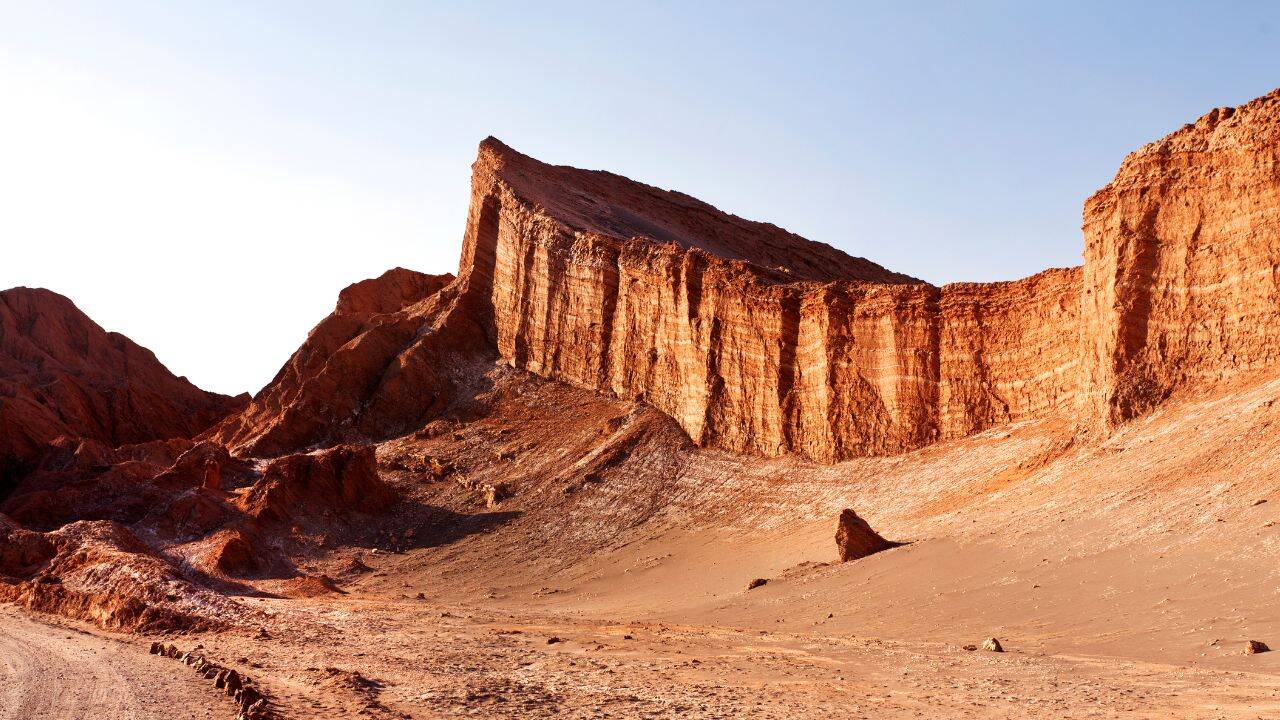
Astrobiologists and travel writers love a romantic myth. They look at the hyper-arid salt flats of northern Chile and declare them an untouched window into the dawn of terrestrial biology.
They are wrong.
Treating the Atacama Desert as a pristine mirror of primordial Earth is not just bad journalism—it is a multi-million-dollar scientific blind spot. Every year, space agencies and planetary research teams pour massive budgets into testing Mars rovers and life-detection sensors in the Yungay core, operating under the lazy consensus that "driest place on Earth" equals "Earth four billion years ago."
Here is the uncomfortable reality that rarely makes it into the glossy science features: the Atacama is not a cradle of ancient genesis. It is an evolutionary graveyard of hyper-specialized survivors.
The Primordial Soup Fallacy
To understand why the mainstream narrative fails, you have to look at basic planetary chemistry. Early Earth during the Hadean and Archean eons was hot, volcanic, anoxic, and overwhelmingly wet. Life did not spark in a bone-dry nitrate crust bathed in modern levels of atmospheric oxygen. It emerged in liquid water—likely around alkaline hydrothermal vents or warm, mineral-rich volcanic pools devoid of free oxygen.
The Atacama is the exact chemical opposite of that environment.
Today’s Atacama sits under a 21 percent oxygen atmosphere, bombarded by some of the highest levels of ultraviolet radiation on the planet due to its high elevation and thin ozone column. Its soils are loaded with perchlorates, sulfates, and nitrates—aggressive oxidizing agents that actively shred unprotected organic molecules.
When researchers dig up microbes in the Atacama, they are not looking at primitive organisms frozen in evolutionary amber. They are looking at modern, battle-hardened
Calling an Atacama cyanobacterium "ancient life" is like finding a nuclear bunker survivor in a hazmat suit and claiming you have discovered a caveman.
Why Space Agencies Keep Making the Same Mistake
I have watched instrument teams spend millions calibrating biosignature spectrometers on Atacama gypsum crusts, only to realize their sensors were completely calibrated for the wrong chemical baseline.
The industry conflates arid with primordial. Because Mars transitioned from a wet world to a hyper-arid, perchlorate-rich desert billions of years ago, the Atacama is a phenomenal analog for modern or late-stage Mars. Dr. Chris McKay at NASA Ames and Dr. Armando Azua-Bustos have spent decades proving this exact point: the Atacama shows us how life dies out when a planet dries up.
Yet pop-science outlets routinely twist those findings backward. They take research about life’s final retreat and sell it as a story about life’s first spark.
The Contamination Blind Spot
There is another problem nobody in the Atacama field-testing circuit likes to advertise: the desert is no longer isolated.
Between lithium mining operations in the Salar de Atacama, copper extraction, tourism, and decades of unsterilized rover trials, human and atmospheric contamination has altered local microbial baselines. Wind currents routinely carry marine aerosols and terrestrial spores from the Pacific coast into the hyper-arid core.
When a sensor detects a faint organic signature in the dirt, proving whether that molecule is a million-year-old native remnant or a windblown stowaway from last Tuesday requires brutal, expensive isotopic scrutiny.
Dismantling the Common Myths About the Atacama
If you search for the Atacama online, you run into the same recycled trivia. Most of it misses the real mechanics of how this ecosystem actually functions.
Is the Atacama Desert really completely devoid of life?
No, and anyone claiming parts of it are "100 percent sterile" is selling headlines, not microbiology. Even in the hyper-arid Yungay region—where rainfall averages less than a millimeter per year—microbes survive inside salt crystals (halite) and translucent gypsum rocks. They do not need rain. They rely on
Can the Atacama tell us how life started on Earth?
Almost nothing. If you want to study the origins of terrestrial life, skip the Chilean desert and go to the hydrothermal fields of Iceland, the hot springs of Rotorua in New Zealand, or the ancient
Why does NASA test Mars rovers in Chile instead of Antarctica?
Logistics and surface geology. Antarctica’s McMurdo Dry Valleys are actually a closer thermal analog to Mars, with sub-zero temperatures and permafrost layers. However, getting heavy robotic prototypes, engineering crews, and drilling rigs to Antarctica costs a fortune and restricts operations to a narrow summer window. The Atacama offers accessible roads, nearby airports in Calama and Antofagasta, and iron-oxide-rich soils that mimic Martian regolith year-round. It is a choice driven by operational convenience as much as geological fidelity.
The Real Secret Hidden in the Salt Flats
Once you drop the "ancient Earth" fairy tale, the Atacama becomes far more interesting—and far more useful for engineers, biologists, and travelers who actually want to understand planetary limits.
The true value of the Atacama lies in cryptic survival and mineral-biological interfaces.
In 2018, a team led by Dirk Schulze-Makuch documented how soil microbes in the Atacama enter decades-long metabolic dormancy during multi-year droughts, waking up only during rare, catastrophic rain events before retreating back into stasis. That mechanism has massive implications for biotechnology, agricultural drought resilience, and planetary protection protocols.
Furthermore, look at the lithium brine pools beneath the Salar de Atacama. Those subsurface aquifers host complex microbial mats thriving in high-salinity, arsenic-rich waters. Studying how those organisms metabolize heavy metals without oxygen actually does offer a partial window into ancient metabolic pathways—not because the desert is old, but because deep, anoxic brines replicate early marine chemistry far better than the sunlit sand dunes above them.
What You Should Do Instead
Whether you are planning an expedition to northern Chile, designing environmental sensors, or simply trying to separate real planetary science from clickbait, stop looking at the surface dust.
- Follow the evaporites, not the sand dunes. If you visit the Atacama, skip the standard tourist traps that pitch the landscape as a "lunar wasteland." Head to the salt crusts of Salar Grande or the high-altitude geysers of El Tatio. In Salar Grande, translucent halite nodules act as microscopic greenhouses, trapping trace moisture and filtering out lethal UV rays while letting photosynthetically active light pass through. That is where the real biology lives.
- Audit your analog assumptions. If you work in robotics, remote sensing, or environmental tech, stop treating "extreme" as a single category. A sensor calibrated for high-UV, oxidizing desert crusts will fail miserably in cold, wet, or reducing environments. Match your testing ground to the exact chemical stressors of your target environment, not the most dramatic backdrop.
- Separate geological age from biological age. The Atacama is the oldest continuously arid desert on Earth, having remained dry for roughly 15 million years, with arid conditions stretching back over 100 million years. That makes the climate ancient. It does not make the organisms primitive. Evolution never stops running the clock just because the rain stops falling.
The Atacama Desert does not hold the secret to how life begins. It holds the blueprint for how life refuses to die.