Dust settles differently when it used to be a ceiling.
If you have ever stood inside one of the carved dwellings of Cappadocia, you know the temperature drops ten degrees the moment you cross the threshold. The air smells faintly of damp chalk and old woodsmoke. You reach out, press your palm against the wall, and the stone feels solid, almost warm, yielding just a trace of pale grit onto your skin. You tell yourself that people have slept behind these exact walls for a thousand years. You assume that because something has survived a millennium, it will survive the afternoon.
That assumption is a lie we tell ourselves to make travel feel safe.
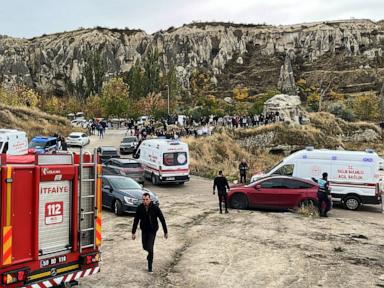
Recently, in Turkey's famed Nevsehir province—specifically in the historic districts where volcanic rock meets relentless human foot traffic—a massive section of a rock formation gave way. It did not crumble slowly over decades, giving warning with creeping cracks and drifting pebbles. It sheared off. Tons of volcanic tuff came crashing down without a sound loud enough to outrun, crushing the space beneath it and killing at least two people.
Emergency crews arrived with heavy machinery, floodlights, and search dogs, digging through boulders the size of delivery vans while tourists stood behind yellow tape, holding their phones, trying to comprehend how a postcard could suddenly turn into a mass casualty site.
News reports reduced the tragedy to forty words. A headline. A casualty count. A quote from a local governor promising an investigation. Then the internet moved on.
We should not move on. Because what happened in Cappadocia is not a freak geological accident. It is the inevitable collision between a fragile, dissolving geology and a modern tourism industry that treats living rock like reinforced concrete.
The Architecture of a Slow Collapse
To understand why the rocks of Cappadocia fail, you have to stop thinking of them as stone.
Geologists call it ignimbrite, or volcanic tuff. Millions of years ago, ancient volcanoes—Mount Erciyes, Mount Hasan, Mount Gulludag—erupted, blanketing central Anatolia in thick layers of ash, mud, and lava. Over eons, wind and rain carved that compressed ash into the famous fairy chimneys, fluted valleys, and honeycombed cliffs that draw millions of visitors every year.
Think of volcanic tuff less like granite and more like an enormous, hardened sponge made of compressed sand and glass shards. It is soft enough to carve with a hand chisel, which is precisely why Byzantine monks, early Christians, and Ottoman villagers hollowed out entire underground cities, churches, and homes inside it.
That softness is Cappadocia's magic. It is also its fatal flaw.
Because tuff is porous, it drinks water. During the wet Anatolian winters and spring thaws, rain and melted snow seep deep into the microscopic pores of the rock. When temperatures drop below freezing at night, that trapped water expands, turning to ice and pushing the rock grains apart from the inside out. By morning, the sun warms the stone, the ice melts, and the water sinks deeper. Freeze. Thaw. Expand. Contract.
I remember walking through the Love Valley just outside Goreme a few autumns ago, running my fingers along the base of a sixty-foot spire. At eye level, the rock looked smooth, sculpted by wind. When I looked down at my boots, I noticed a fresh fan of white powder pooling around the base—tiny, newly shed granules that hadn't been there the week before. A local guide walking beside me kicked the dust with his heel and shrugged. "The mountains are melting," he said, half-joking. "Every year they get a little shorter."
He wasn't wrong. Erosion here is not a geological abstraction measured in millions of years. It happens between breakfast and dinner.
The Weight of Four Million Footsteps
Nature has been slowly dismantling Cappadocia since the Pliocene epoch, and for most of human history, the people living there adapted to it. Villagers knew which cliffs groaned after a heavy rain. They abandoned caves when hairline fractures appeared above doorways. In the 1950s and 1960s, the Turkish government actually relocated entire populations out of rock-cut villages like Zelve and old Cavusin because rockfalls had made them too dangerous for daily life.
Then came the cameras. Then came the boutique cave hotels.
Consider a hypothetical scenario that plays out every single morning across Goreme, Uchisar, and Urgup. Picture a couple—let’s call them Elena and Marcus—who have saved for three years for their dream trip to Turkey. They wake up at 4:30 AM in a luxury suite carved into a cliffside. They step out onto a stone terrace clinging to the edge of a volcanic ridge, watching a hundred hot air balloons rise into the pink dawn. Beneath their feet is an ancient, hollow chamber carved centuries ago for storing grain, now retrofitted with heated floors, plumbing, and a plunge pool. Above their heads looms an overhanging shelf of weathered tuff, cracked by decades of thermal stress and dampened by the steam rising from dozens of hotel showers and kitchen vents directly below.
Multiply Elena and Marcus by four million.
According to data from Turkey’s Ministry of Culture and Tourism, Cappadocia regularly welcomes between four and five million visitors annually. Every single one of those visitors wants the authentic cave experience. To meet that demand, the region has undergone a frantic, decades-long transformation.
Ancient dwellings once meant to shelter a single family and two donkeys now house multi-story hotels, rooftop restaurants, and subterranean spas. To make room for modern amenities, builders have carved deeper into fragile formations, widened narrow tunnels, and installed heavy concrete facades onto rock faces never meant to bear structural loads.
Water is the silent accomplice in this equation. Modern tourism requires water—millions of gallons of it for showers, laundry, swimming pools, and landscaping. Much of that water inevitably leaks from aging pipes or drains directly into the porous ground, saturating the rock formations from within and accelerating the exact freeze-thaw cycle that tears them apart.
Add to that the constant, low-frequency vibration of tour buses rumbling past cliff bases, construction crews running jackhammers to carve out new boutique suites, and thousands of hikers climbing off-trail onto narrow ridges for unobstructed sunrise photos.
You do not need a degree in structural engineering to see what happens when you hollow out a sandstone sponge, soak it in water, vibrate it twelve hours a day, and stack tourists on top of it.
The Illusion of Permanence
Why do we keep getting caught off guard when these formations collapse?
Part of the answer lies in human psychology. Our brains are poorly equipped to process slow-moving hazards. When you look at a massive rock wall, your eyes register permanence. Stone is the universal metaphor for strength. We say "solid as a rock." We carve memorials into it because we believe it outlasts everything.
When you walk beneath an overhang in Cappadocia, you do not see the microscopic fractures propagating behind the surface. You do not feel the moisture weakening the clay binders between the volcanic ash particles. You see a breathtaking landscape that looks identical to the photographs you saw on Instagram six months ago.
Even local authorities and business owners fall into this trap, though theirs is complicated by economics. Cappadocia’s economy relies overwhelmingly on heritage tourism. When a rockfall occurs, the immediate instinct is damage control—cordoning off the specific site, clearing the rubble, and reassuring travelers that the region remains open and safe.
This is not the first time Cappadocia has buried people under its own beauty. In 2013, a massive boulder detached from a cliff in the Ortahisar district, crashing onto a tourist vehicle and killing two French travelers while injuring several others. In 2017, another rockfall struck near an open-air museum, prompting temporary closures and renewed promises of geological monitoring. Each time, engineers arrive with sensors, warning signs go up along a few trails, and high-risk zones are fenced off.
And each time, within months, the fences are bypassed by hikers chasing a better angle, or new permits are quietly issued for construction just yards away from unstable cliffs.
The terrifying truth is that monitoring a landscape like Cappadocia is an almost impossible task. Unlike a bridge or a skyscraper, which has blueprints, steel stress ratings, and predictable failure points, a volcanic rock formation is chaotic. Two pillars standing ten feet apart can have wildly different mineral compositions. One might stand for another five centuries; the other might shear off tomorrow afternoon because a stray pocket of clay absorbed too much winter rain.
Walking Through a Living Ruin
I have to be honest here: writing this makes me uncomfortable, because I love Cappadocia. Anyone who has watched the first light of morning hit the Rose Valley, turning the pale stone into bruised purple and molten gold, knows it is one of the most moving places on Earth. Telling people to stay away feels wrong, almost insulting to the thousands of hospitable guides, bakers, potters, and hoteliers whose livelihoods depend on sharing their home with the world.
But loving a place means refusing to lie about what it is.
Cappadocia is not a theme park. It is not a museum with reinforced glass and steel guardrails. It is an active, eroding geological formation that happens to be inhabited. When you step into a valley there, you are walking through a ruin that is still in the process of being ruined.
If we want to prevent the next headline—the next frantic rescue operation under floodlights, the next family receiving a devastating phone call from a Turkish hospital—both the industry and the travelers have to change how they interact with the stone.
For authorities, it means enforcing hard, uncompromising boundaries. Ground-penetrating radar, LiDAR scanning, and seismic tiltmeters are no longer optional luxuries; they are basic life-safety requirements for any cliffside hotel or major trail. Unregulated excavation for new cave rooms must stop entirely. If a geological survey flags an overhang as unstable, the restaurant beneath it has to close, regardless of how much revenue it generates during peak season.
For travelers, it requires abandoning the entitlement that modern tourism breeds. When you see a wooden barrier or a faded sign warning of falling rocks, it is not a suggestion meant for less agile tourists. It is a line drawn between solid ground and a potential grave. Staying on marked trails, refusing to climb onto fragile fairy chimneys for photographs, and choosing accommodations that prioritize structural safety over dramatic cliff-edge aesthetics are small, unglamorous choices that keep people alive.
What Remains After the Dust Clears
Back in Nevsehir, after the heavy machinery pulled away and the yellow tape was rolled up, the landscape looked much as it had the day before. A fresh scar of pale, unweathered rock now marks the cliff face where the boulder broke free—bright white against the gray, weathered stone surrounding it.
In a few years, wind and rain will sand down the sharp edges of that scar. Lichen will creep across its surface. The dust will wash into the soil, and tour buses will roll past the exact same spot, filled with passengers staring out the windows in awe at the timeless beauty of the valley.
Until the next piece lets go.


