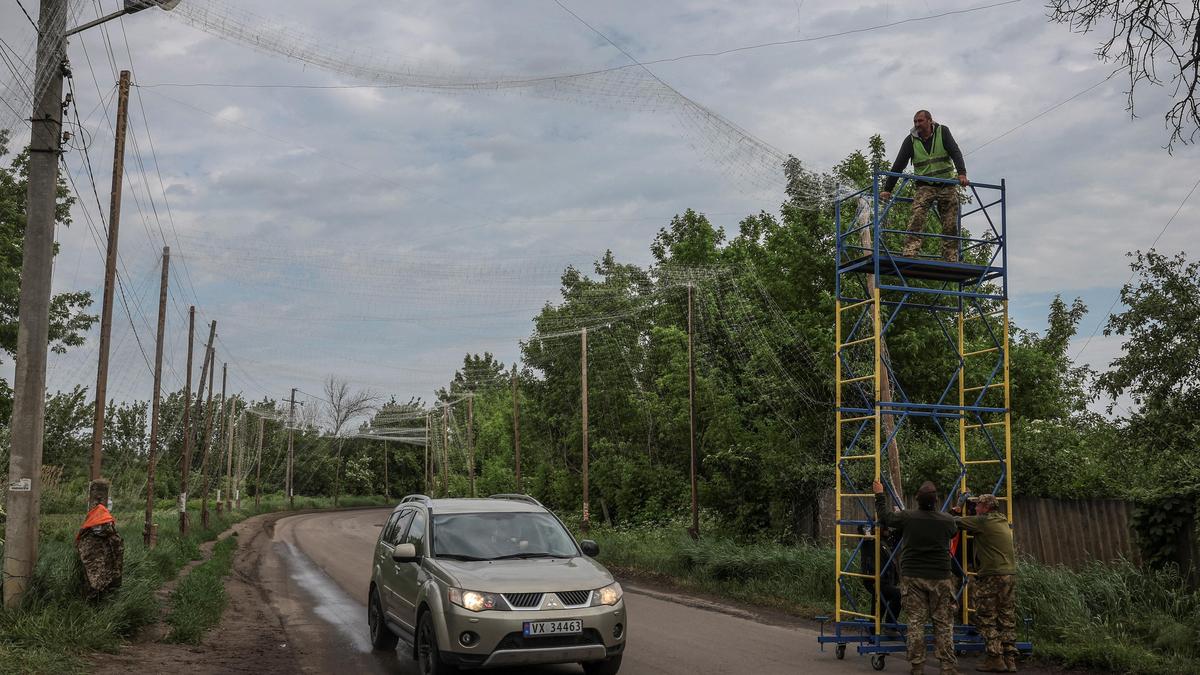
A bus gets hit in a contested zone. Seven people die. Eleven more end up in a hospital. The local authority—in this case, a Kremlin-appointed official in the Donetsk region—issues a brief statement blaming a drone strike. Within minutes, global news feeds copy and paste the numbers, slap on a reactive headline, and move on to the next press release.
This is lazy journalism. More importantly, it is a fundamentally flawed way to understand modern kinetic warfare.
When media outlets treat a drone strike on a civilian transit asset as an isolated, tragic anomaly, they miss the systemic shift happening on the ground. Drone warfare is not just about the immediate body count. It is about spatial denial, algorithmic logistics, and the brutal reality of gray-zone enforcement. Media coverage focuses entirely on the who and the how many, completely ignoring the why of autonomous and semi-autonomous interdiction.
Stop looking at these incidents through the lens of 20th-century artillery shelling. The infrastructure of conflict has changed, and the way we analyze it must change too.
The Illusion of the Isolated Incident
Standard conflict reporting operates on a predictable loop. An event happens, casualties are verified by local authorities, and the incident is filed away as a singular data point in a broader war of attrition.
This framework is obsolete. In modern high-intensity conflict zones, no vehicular movement within thirty kilometers of the contact line is accidental, and no strike is an isolated event.
[Traditional Artillery] ----> Area Saturation ----> Collateral Damage
[Modern FPV/Loitering]  ----> Positive ID/Targeting ----> Asset Interdiction
When a drone hits a bus in a frontline hub like Donetsk, it highlights a grim mechanical reality: the total elimination of safe transit corridors through persistent aerial surveillance.
I have spent years analyzing defense procurement and tracking the operational deployment of unmanned aerial vehicles (UAVs). In classic counter-insurgency warfare, success was measured in secured territory or neutralized cells. Today, success is measured in logistically suffocating the adversary.
A bus is not just a civilian vehicle in the eyes of a drone operator or a targeting algorithm; it is a high-capacity logistics vector capable of moving personnel, supplies, or intelligence assets. Western military theorists often talk about "precision strike capability" as a tool for minimizing harm, but the inverse is true in peer-to-peer attrition warfare. Precision means everything within the target zone is intentional.
Dismantling the Collateral Damage Myth
The public loves the comforting narrative that technology brings clean warfare. The premise embedded in standard news reports is that civilian infrastructure is hit either by mistake or out of pure malice.
Let us dismantle that premise entirely.
In a zone characterized by heavy electronic warfare jamming, automated targeting, and dense military integration into civilian spaces, the line between a civilian asset and a military objective disappears completely.
- Dual-Use Reality: Commercial transport networks in contested territories are routinely requisitioned for troop rotation, ammunition transport, and localized evacuation.
- The Sensor-to-Shooter Loop: Modern first-person view (FPV) drones and loitering munitions operate on incredibly tight sensor-to-shooter timelines. An operator sees a high-value target or a mass-transit vehicle entering a restricted vector, and the decision matrix takes seconds, not hours.
- The Economics of Inexpensive Attrition: A standard quadcopter modified for a strike costs less than a thousand dollars. When the cost of interdiction drops this low, the threshold for engaging any moving target drops to near zero.
To argue that these strikes are merely tragic accidents of war is to ignore the doctrine of total denial. The goal of using cheap, pervasive drone fleets is to make life, commerce, and governance within the contested region entirely untenable. It is psychological coercion enforced by carbon-fiber propellers and shaped charges.
Why Official Press Releases Are Terrible Data Sources
Relying on Russia-installed officials or Ukrainian military spokesmen for accurate operational context is a fool's errand. Yet, the mainstream press treats these Telegram announcements as definitive baseline data.
When Denis Pushilin or any other regional leader publishes a casualty list, it serves a specific political function: reinforcing the narrative of external victimhood to justify domestic mobilization or retaliatory strikes. Conversely, the striking party will rarely confirm or deny the specific nature of the target, hiding behind the fog of war.
If you want to know what actually happened to that bus in Donetsk, you do not look at the official casualty statements. You look at the telemetry data, the electronic warfare signatures in the sector, and the open-source satellite imagery of the surrounding supply routes.
A truly rigorous analysis reveals that these strikes usually occur at critical chokepoints where military supply lines intersect with civilian transit. The tragedy is real, but the analytical framework used by global newsrooms to explain it is completely bankrupt.
The Dangerous Downside of Counter-Intuitive Analysis
There is a distinct risk in adopting this cold, mechanistic view of conflict. When you strip away the emotional weight of a headline detailing seven dead and eleven wounded, you risk validating the very dehumanization that drives modern algorithmic warfare.
Acknowledging that a passenger bus was targeted as a logistics node rather than a random mistake can feel cynical. It can be weaponized by state actors to justify atrocities. But ignoring the structural reality of drone interdiction is worse. It leaves the public completely unprepared for the reality of modern warfare, where every signal, every vehicle, and every civilian corridor is monitored, analyzed, and categorized as a potential target.
The Reality of the Modern Front Line
Stop asking whether a strike violated international norms or whether the target was explicitly civilian. In a digitized, high-attrition conflict, those questions are obsolete before the drone even launches.
The hard truth nobody wants to admit is that the modern front line is a panopticon. If it moves, it can be seen. If it can be seen, it can be hit for the price of a mid-tier smartphone.
The report out of Donetsk isn't a story about a single tragic drone strike. It is a warning that in the era of pervasive, low-cost autonomous warfare, the concept of a safe civilian zone no longer exists.
Accept the reality of the doctrine, or keep reading the same empty headlines forever.