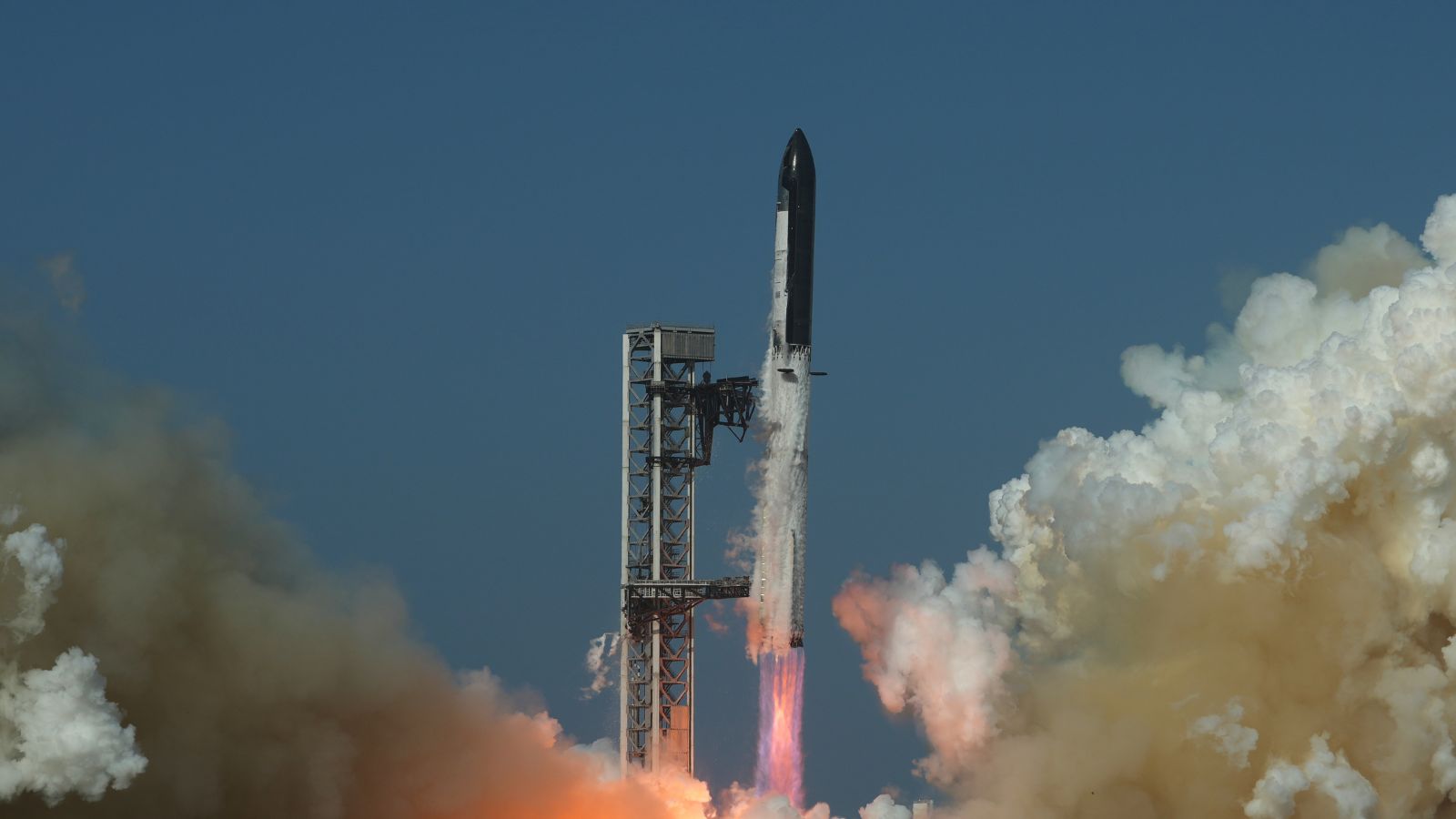
The smoke clears over Starbase, but the fundamental mechanics of aerospace economics have shifted permanently. SpaceX launched another Starship test flight, packing the payload bay with the most advanced Starlink hardware yet constructed. This was not merely another routine clearance of the Federal Aviation Administration airspace. This flight represented a brutal acceleration in the industrialization of low Earth orbit.
When you watch a stainless steel behemoth clear the tower, the sensory overload obscures the spreadsheets beneath. People stare at the fire. They cheer the sheer kinetic violence of thirty-three Raptor engines roaring in unison. They miss the ledger entirely. Every single test flight is a stress test for an orbital factory model designed to manufacture broadband capacity at a scale the telecommunications industry has never witnessed.
SpaceX is no longer just building a rocket. They are stress-testing a conveyor belt.
The Economics of Mass Deposition
Traditional aerospace engineering operated on the principle of artisanal precision. You built a spacecraft the way an Italian workshop built a sports car. Every bolt was documented, every tile was hand-bonded, and every launch window was treated like a state funeral. That model died the moment Starship prototypes started smashing into concrete pads on the Texas coast.
Elon Musk understood a basic industrial truth that legacy defense contractors spent decades ignoring. Failure is cheap if your feedback loop is measured in weeks instead of decades. By building iteratively in public, the company traded PR risk for engineering velocity.
Now, the math has changed again. The integration of next-generation Starlink satellites into these early-stage Starship test flights tells a very specific story. They are not waiting for perfection. They are validating utility while the hardware is still maturing.
- The old model: Perfect the vehicle over twenty years, then fly a payload.
- The new model: Fly the cargo before the vehicle is even civilized, absorbing crash data as a manufacturing tax.
This approach terrifies competitors. If you are an executive at a legacy satellite manufacturer or a traditional telecom giant, you are looking at a system designed to drop thousands of metric tons of infrastructure into orbit annually. You cannot compete with a company that treats its own rockets as disposable delivery vans for its own recurring revenue generators.
Inside the Payload Bay
The hardware riding inside these giant shells deserves a hard look. The latest Starlink iterations are not simply scaled-down transponders. They are massive arrays packed with direct-to-cell capabilities, higher-bandwidth laser inter-link terminals, and phased-array antennas that put older ground infrastructure to shame.
Let us be realistic about the engineering bottlenecks. Putting heavier satellites into orbit requires more than just a bigger fuel tank. It demands radical thermal management, advanced radiation hardening, and automated deployment mechanisms that cannot fail when opened in a vacuum.
When a Starship carries these advanced units aloft, it validates the volumetric capacity of the architecture. Falcon 9 is an exceptional machine, but it is a constricting bottleneck. It is a delivery van with a roof rack. Starship is a cargo freighter.
Consider the sheer physical volume. A single Starship can swallow entire constellations of older-generation satellites in one gulp. When you scale the payload volume by a factor of five or ten, the cost per gigabit delivered to the end user plummets off a cliff. That is the structural advantage that keeps telecom executives awake at night. You cannot subsidize your way out of a physics problem when your rival is operating at ten times your scale efficiency.
The Regulatory and Environmental Friction
Of course, the ascent is only half the battle. Every time these massive vehicles rattle the Texas coastline or trigger environmental reviews, the friction points multiply.
The Federal Aviation Administration, local wildlife advocates, and commercial aviation authorities are caught in a reactive posture. They were built for an era where orbital launches happened a dozen times a year from secure military bases. They were not built for a cadence that resembles a regional commercial airline schedule.
Critics point out the ecological cost of frequent heavy-lift operations near fragile coastal ecosystems. Those concerns are legitimate. The acoustic energy, the propellant residue, and the sheer footprint of industrial expansion along the Gulf Coast leave permanent marks.
Yet, the regulatory machinery is grinding against an unstoppable economic incentive. Governments want sovereign broadband networks. Militaries want resilient, low-latency tactical communication nodes that cannot be jammed by cutting fiberoptic cables on the ocean floor. When national security intersects with commercial dominance, environmental litigation becomes a speed bump rather than a roadblock.
The Global Broadband Monopoly Problem
We need to talk about the market concentration. By marrying heavy-lift launch capability directly with a global satellite internet monopoly, SpaceX is constructing a vertically integrated empire that spans from heavy manufacturing to retail consumer billing.
Historically, telecommunications markets have been fiercely guarded by national borders and local monopolies. Cable companies and cellular providers enjoyed regional pricing power because physical infrastructure was expensive to deploy. You had to dig trenches, string copper, and negotiate municipal right-of-ways.
Starlink bypasses the trench entirely. It connects the user terminal on a cabin roof directly to an orbiting constellation moving at seventeen thousand miles per hour.
When you combine that consumer reach with a rocket capable of deploying hundreds of gigabits per launch, you create a defensive moat that is nearly impossible to drain. Competitors like Amazon's Project Kuiper are pouring billions into catching up, but they are playing a high-stakes game of catch-up against a moving target that is already iterating its third generation of hardware while they are still trying to field their first.
The Unspoken Vulnerabilities
Every empire has structural weaknesses. To pretend this architecture is invulnerable is bad analysis.
First, orbital debris management is an escalating crisis. Pumping tens of thousands of active satellites into low Earth orbit turns the upper atmosphere into a crowded, high-speed highway system. A single kinetic event, an unexpected solar storm, or a software glitch cascading through an autonomous constellation could render entire orbital shells unusable for decades.
Second, the capital expenditure required to sustain this pace is astronomical. Even with Starlink beginning to show positive cash flow, the cash burn of developing a fully reusable, rapidly turnaround-capable heavy-lift transportation system is staggering. If global capital markets tighten, or if a catastrophic launch failure grounds the fleet for an extended period, the financial pressure will mount instantly.
Third, geopolitical risk looms large. A global satellite network is visible to everyone and vulnerable to state-sponsored electronic warfare, laser blinding, or kinetic anti-satellite weapons. When your entire revenue model depends on hardware passing over foreign territories that may view your presence as an intelligence threat or a sovereignty violation, the diplomatic tightrope becomes razor-thin.
The Industrial Reality
The latest test flight wasn't a PR stunt. It was a progress report from the front lines of a manufacturing revolution.
We are watching the transition of space from a scientific frontier into an industrial zone. The romantic era of space exploration, where every mission was named after a Greek god and carried a payload built by a committee, is dead. In its place stands a ruthless, data-driven machine that measures success in tons to orbit and dollars per gigabit.
The rockets will get bigger. The satellites will get denser. The regulatory battles will grow louder.
The transformation is already complete. Orbit is just another market, and the factory floor has finally moved past the atmosphere.