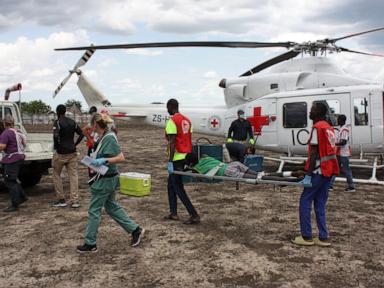
The arithmetic of survival in South Sudan has turned lethal. As of August 19, 2026, the death toll for humanitarian personnel and contractors stands at 36 lives cut short this year alone. This figure is not merely a statistical update; it is a grim milestone that surpasses the entire body count of 2025 in less than eight months. When the United Nations marked World Humanitarian Day, the announcement carried none of the usual hollow celebratory weight. Instead, it served as an indictment of a security environment that has completely disintegrated.
The reality on the ground is that the neutral markers of aid—white land cruisers, distinct logos, and the international conventions of protection—are no longer shields. In places like Jonglei, Warrap, and Unity state, these emblems have increasingly become targets. The surge in violence is not a random byproduct of instability; it is the result of a calculated breakdown in the norms of conflict that once kept non-combatants distinct from the battlefield.
The Erosion of Humanitarian Space
For years, the operational theory for aid groups was based on the concept of humanitarian space. The idea was simple: if you kept your distance from local power struggles, clearly identified your vehicles, and maintained a strictly apolitical profile, you could navigate the frontlines to reach the starving. That theory is dead.
Today, aid workers are navigating a theater defined by fragmented militias, opportunistic armed youth groups, and a recurring pattern of intercommunal violence that shows little respect for the distinction between a combatant and a nurse. The data provided by the UN Office for the Coordination of Humanitarian Affairs tells a story of systematic obstruction. Beyond the 36 deaths, there have been more than 450 reported incidents of violence against humanitarian personnel and assets between January and July 2026. This represents a doubling of the incident rate compared to the same period in the previous year.
When a supply convoy is ambushed, it is rarely a crime of passion. In many instances, the hijacking of fuel, cash, and communications equipment is a logistical strategy for armed groups. By cutting off access to opposition-controlled areas or contested territories, these actors exert control over entire populations. Aid is no longer just aid; it is the currency of the regional conflict.
Beyond the Statistics
To understand why the violence is escalating, one must look at the nature of the actors involved. South Sudan is struggling to maintain even the appearance of stability under the 2018 peace agreement. In the vacuum left by failed state oversight, local armed groups and militias have assumed the role of de facto regulators. These groups are often driven by grievances that have nothing to do with national politics and everything to do with local resource control, such as cattle rustling or the seizure of grazing land.
A hypothetical scenario illustrates the danger: imagine a small team attempting to transport critical medical supplies through a region controlled by a local youth militia. In a functional state, the team would coordinate with local authorities. In the current South Sudan, those authorities may have no actual influence over the specific group controlling that stretch of road. The militia views the aid convoy as a portable treasury—a source of high-value supplies that can be resold or used to sustain their own fighters. The "neutrality" of the aid workers is seen as a weakness, a lack of local protection that makes them easy prey.
The consequences are systemic. When aid organizations pull out of a region due to security threats, it is not just the staff who suffer. Millions of civilians who are already facing acute food insecurity are effectively abandoned. The departure of an NGO is a death sentence for the vulnerable populations left in the wake of the retreat.
The Failure of Accountability
The recurring call for "impartial investigations" from the United Nations and humanitarian coordinators has reached a point of exhaustion. Behind closed doors, officials admit that these calls have little traction. Without a mechanism for local enforcement that is recognized by all parties to the conflict, the cycle of violence remains unbroken.
Armed actors have learned that killing an aid worker carries almost no political or legal cost. There is no consequence to the battlefield status of these militias. As long as the perpetrators are integrated into local power structures or represent the only "security" that some communities have, the justice that international bodies demand will remain theoretical.
Furthermore, the funding crisis adds another layer of vulnerability. Organizations are under immense pressure to deliver results with fewer resources. This forces them to take risks—to push into volatile areas with thinner security blankets and less logistical support. It is a desperate trade-off: stay and face the threat of violence, or leave and watch the community perish from hunger and disease.
The current trajectory is unsustainable. As the nation grapples with the fallout of failed peace processes and escalating intercommunal skirmishes, the humanitarian community has become an unwilling participant in the chaos. The protection of aid workers was once a given; today, it is an increasingly rare, hard-won privilege that few can guarantee. Unless the parties to the conflict and the authorities in Juba move beyond rhetoric to establish actual, enforced safe corridors, the death toll will continue to climb. The era of the protected humanitarian is closing, and in its place, we are seeing the emergence of a new, brutal reality where the cost of saving lives is paid in the lives of those trying to help.


