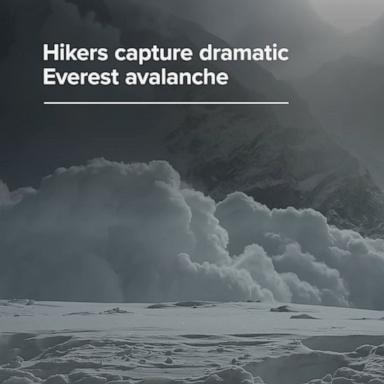
The air at 18,000 feet doesn’t just feel cold. It feels thin, brittle, and oddly silent, as if the atmosphere itself is holding its breath. When you stand at Everest Base Camp, you are a guest in a cathedral of ice, a place where the scale of the world shifts so violently that your own life feels like a brief, frantic heartbeat against the stillness of the Khumbu Glacier.
Then the stillness breaks.
It starts not as a sight, but as a vibration in the marrow of your bones. A low, guttural growl that suggests something massive has just woken up and is very, very angry. This is the reality captured in the recent footage circulating from the slopes of the world’s tallest peak. It isn't a "dramatic event" in the way a movie scene is dramatic. It is the sound of the sky falling.
To understand what those hikers felt as the white wall of the avalanche thundered toward them, you have to discard the idea of snow as something soft or festive. At high altitudes, an avalanche is a kinetic monster. It is a mixture of pulverized ice, jagged rock, and compressed air moving at speeds that defy logic. When the ridge gives way, the debris can clock over 200 miles per hour. It creates its own weather system—a "powder blast" that can knock a grown man off his feet or collapse a tent before the actual snow even touches it.
The Illusion of Stability
Most people who trek to Everest expect the challenge to be physical exhaustion or the biting wind. They prepare for the "Death Zone" above 8,000 meters. But the danger often begins much lower, in the transitional spaces where the mountainside is constantly renegotiating its relationship with gravity.
Imagine a hiker named Elias. He’s spent three years saving for this trip. He’s trained in the thin air of the Rockies; he’s bought the best Gore-Tex money can buy. He is standing near the Khumbu Icefall, filming the majestic peaks on his phone, feeling a sense of triumph. In his mind, the mountain is a backdrop. A postcard.
When the crack happens, Elias doesn't run. Not at first. There is a psychological delay, a "normalcy bias" that whispers it’s probably just the wind or it’s too far away to hurt me. He watches the white plume tumble down the Lhotse face. It looks slow from a distance, almost graceful, like milk poured into a glass of water.
But the grace is a lie.
The physics of a Himalayan avalanche involve a terrifying transformation of potential energy into kinetic force. Gravity pulls at millions of tons of snow, and as it descends, friction creates heat, slightly melting the bottom layer. This creates a lubricant. The mountain essentially turns into a giant, vertical slip-and-slide made of granite and ice. By the time Elias realizes the cloud is growing larger—that it is consuming the entire horizon—it is often too late to do anything but crouch and pray.
The Science of the Shudder
Why now? Why does the mountain choose a random Tuesday to shed its skin?
The triggers are often invisible to the naked eye. We talk about "dramatic avalanches" as if they are freak accidents, but they are the logical conclusion of a complex environmental equation. Temperature fluctuations are the primary culprit. When the sun hits a south-facing slope, it warms the upper layers of snow. This creates a "wet slab" instability. Below that, buried deep under weeks of snowfall, there might be a layer of "hoar frost"—tiny, brittle crystals that act like ball bearings.
One heavy footfall, one minor seismic shift, or even a slight change in wind direction can cause that weak layer to collapse. Once it goes, the structural integrity of the entire slope vanishes.
The hikers in the recent video were lucky. They were far enough away to witness the spectacle without being swallowed by the "runout zone." But the terror in their voices is a reminder of the invisible stakes. They weren't just watching a natural phenomenon; they were watching a reminder that human presence on Everest is entirely conditional. The mountain doesn't care about your permit, your experience level, or your summit goals.
The Breath of the Mountain
There is a specific phenomenon called the "air blast" that survivors often describe with more horror than the snow itself. As the mass of an avalanche hurtles down a narrow couloir, it pushes a massive volume of air ahead of it. This creates a pressure wave.
People have been killed by avalanches without ever being touched by a single snowflake. The sheer force of the air can rupture lungs or throw bodies against rock faces. In the footage, you see the hikers ducking behind boulders, a primitive instinct that serves them well. They are seeking a "dead zone" of pressure where the wind might skip over them.
The experience of being in that cloud is sensory deprivation at its most violent. It is a "whiteout" that exists in three dimensions. You cannot see your hand in front of your face. The roar is so loud it becomes a physical weight on your chest. You breathe in "snow flour"—particles so fine they clog your throat and nose, making you feel like you are drowning on dry land.
The Psychology of the Ascent
We have to ask ourselves why we keep going back. Why, when we see videos of the earth literally dissolving, do thousands of people still flock to Lukla every spring?
The answer lies in the human need to confront the sublime. There is a specific kind of clarity that only comes when you are reminded of your own insignificance. For a hiker at Base Camp, seeing an avalanche is a spiritual ego-stripping. It resets the internal clock. It reminds the traveler that the world is not a playground designed for our entertainment; it is a living, shifting entity that operates on a geological timescale.
However, the frequency of these events is changing.
Long-time Sherpas, the true masters of the mountain, have noted that the "patterns" of the peaks are becoming harder to read. Glacial retreat and erratic weather cycles mean that slopes which were once considered stable are now prone to "spontaneous release." The risk is no longer just about skill; it is about timing. It is a game of Russian Roulette where the cylinder is spun by the climate.
The Weight of the Aftermath
Once the roar fades and the snow settles, a haunting quiet returns to the valley. The dust—that fine, pulverized ice—hangs in the air for hours, shimmering like diamonds in the sun. But the landscape has been permanently altered. New gullies have been carved. Old paths are gone.
For the hikers who filmed the event, the adrenaline will eventually fade into a story told at dinner parties. They will show the video, and people will gasp. But for those who live and work in the shadow of the Khumbu, the avalanche is a reminder of the "invisible tax" paid for the privilege of standing among the giants. Every successful summit is a debt owed to the mountain's temporary mercy.
Consider the reality of the Sherpa teams who must navigate these zones daily to fix ropes and carry supplies. For them, the "dramatic footage" isn't a viral moment; it is a workplace hazard. They move through the "Popcorn" section of the icefall with a quiet, focused urgency, knowing that the serac towering above them could disintegrate at any moment. They don't look at the mountain as a challenge to be conquered, but as a sovereign power to be navigated with extreme humility.
Survival is a Choice of Seconds
If you ever find yourself in that position—if the growl starts and the horizon begins to move—your world shrinks to the next five seconds.
- Deploy the Trigger: If you are wearing an avalanche airbag, you pull it. It doesn't make you float like a balloon; it works on the principle of "inverse segregation," where larger objects stay on top of smaller ones in a moving mass.
- The Swimming Motion: If you are caught, you fight. You "swim" through the snow, trying to stay near the surface.
- The Air Pocket: As the motion stops, you must clear a space in front of your face. The snow will set like concrete within seconds as the friction-heat dissipates. If you don't have an air pocket, you are breathing your own carbon dioxide until the world goes black.
The hikers in the video didn't have to fight for air. They were spectators to the fury. But the reason we cannot stop watching that footage is that we recognize, on some primal level, that the boundary between spectator and victim is razor-thin.
We watch because we want to know how we would react. We watch because the sight of a mountain falling down is the ultimate proof that we are not in control. We are just small, breathing things, standing on the edge of a world that was here long before us and will remain long after our footprints have been wiped clean by the wind.
The mountain doesn't need to roar to be powerful. But when it does, it's a sound you never quite get out of your head. It’s the sound of a billion tons of history deciding to move, and all you can do is stand very still and wait to see if you are part of its path.


