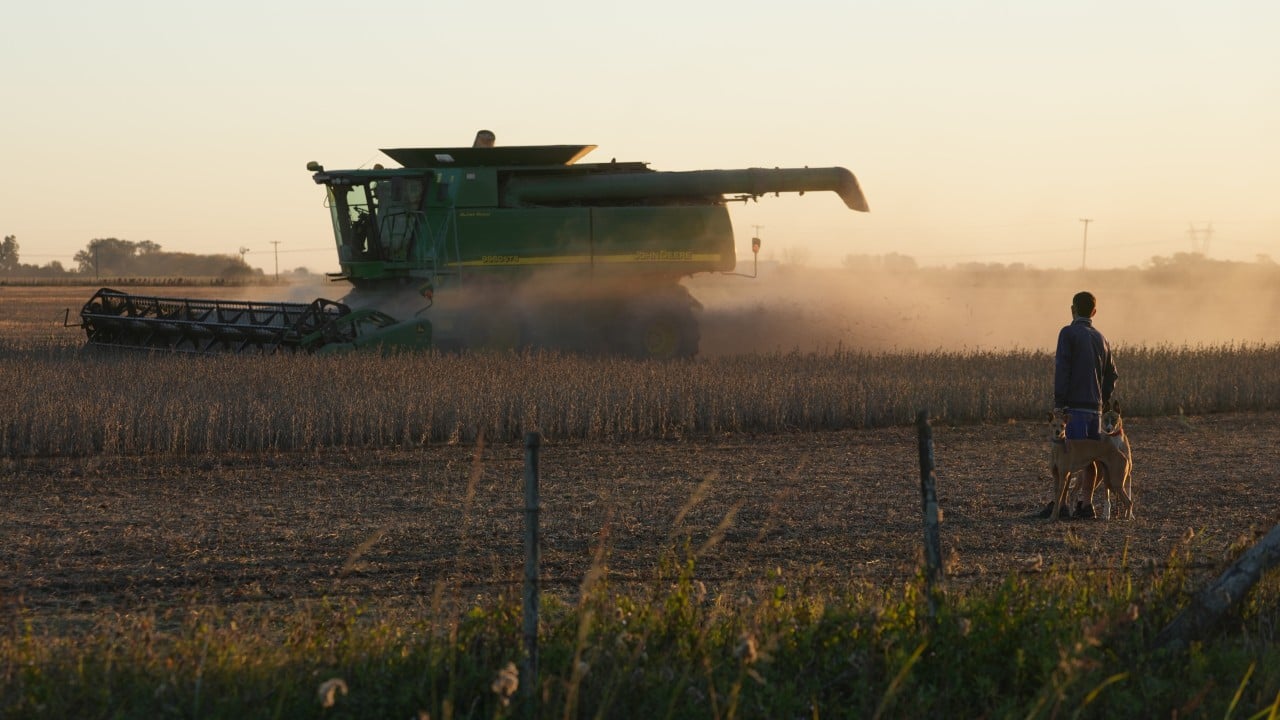
The pre-dawn air in east-central Illinois doesn’t feel like a geopolitical battleground. It just feels cold. In the cab of a John Deere tractor, the only sound is the low, steady thrum of a diesel engine and the occasional crackle of a morning radio talk show. Outside, the headlights cut through a thick wall of mist, illuminating rows of damp, dark earth that stretch out toward an invisible horizon.
For generations, this dirt was a promise. You planted a seed, you sweated through the humid Midwestern July, and by October, you had a crop that the entire world wanted to buy.
But things changed. The soil still does its job, but the promises made on the other side of the globe have started to feel as thin as the morning fog.
When news broke of a fresh agricultural pledge between Xi Jinping and Donald Trump, a lot of folks in the cities breathed a sigh of relief. On paper, it sounded like a victory. Headlines flashed across television screens, stocks ticked upward, and analysts spoke of a renewed era of stability for American agriculture. The world’s two largest economies had shaken hands, and China was back at the table, promising to buy American soybeans.
On the ground, nobody is celebrating.
To understand why a handshake in a gilded ballroom doesn’t spark joy in a farmhouse kitchen, you have to look at the math that governs a farmer’s life. Consider a hypothetical grower—let’s call him Ethan, a third-generation farmer managing two thousand acres of black Illinois loam. Ethan isn’t reading the news as a spectator. He is reading it as a man whose entire livelihood is tied to a roulette wheel he has no control over.
When Ethan goes to the local cooperative to buy his seed, fertilizer, and fuel for the upcoming season, the bank expects concrete numbers. The seed company doesn’t accept political goodwill as collateral. The fertilizer plant demands payment in hard currency. To secure the operating loans required just to put a single seed in the ground, Ethan needs certainty. He needs to know that when his crop is harvested, there will be a buyer waiting at the river terminal.
A pledge is not a contract.
In the world of international trade, a pledge is merely an expression of intent. It is a political weather vane, shifting with the mood of the leaders who signed it. American farmers have been down this road before. They remember the whiplash of the late 2010s, when tariffs were slapped on overnight, supply chains snapped like dry twigs, and millions of bushels of soybeans were left to rot in hastily constructed silopolies because the Chinese market evaporated in a heartbeat.
The memory of those empty silos lingers like a phantom pain. It taught the American agricultural sector a brutal lesson: dependency is a vulnerability.
China is the world’s largest consumer of soybeans, using the protein-rich legume to feed a massive domestic swine herd that fuels the nation's demand for pork. For decades, the relationship was symbiotic. The American Midwest grew the beans; China bought them. It was a beautiful, predictable machine.
Then the machine broke.
When the trade war hit, Chinese buyers didn’t just stop buying American; they adapted. They looked south. They poured billions into Brazilian infrastructure, helping to build roads, ports, and rail lines through the South American interior. Today, Brazil is no longer just a competitor; it is the dominant force in the global soybean trade. Brazilian farmers have cleared millions of new acres, and their ports are running at peak efficiency.
This brings us to the real problem. Even if Beijing sincerely wants to fulfill its agricultural pledges with Washington, the structural dynamics of the market have fundamentally shifted. Chinese state-owned buyers and private crushers are profit-driven entities. If Brazilian beans are cheaper, or if the shipping lanes out of Santos are more reliable than the muddy waters of the Mississippi River, the choice is simple. They will buy from Brazil.
A political promise cannot rewrite the laws of supply and demand.
The Mirage of the Metric Ton
Step inside the office of any rural grain elevator and you will find a wall of monitors tracking the Chicago Board of Trade. The numbers flicker in red and green, a frantic, digital heartbeat representing the collective anxiety of the agricultural world.
Lately, those numbers have been telling a sobering story. Every time a new political agreement is announced, there is a temporary bump. A spike in futures prices. A brief flash of green. But look closer at the volume of actual physical contracts being signed, and the picture becomes much bleaker.
Chinese buyers are operating on a spot-market basis, purchasing only what they need for the immediate future, refusing to commit to the long-term, multi-month forward contracts that American exporters rely on to manage risk.
It is a strategy of hesitation. By keeping their options open, Chinese buyers retain the leverage. They can pivot back to South America the moment a political dispute flares up over technology, Taiwan, or currency manipulation.
This leaves the American farmer in a state of permanent limbo.
Imagine trying to run a business where your primary customer refuses to sign a contract longer than thirty days, while your suppliers demand commitments a year in advance. That is the reality confronting the rural economy. The risk hasn’t been mitigated; it has simply been repackaged and handed right back to the person sitting in the tractor.
The Ripple Effect in the Rural Economy
This uncertainty doesn’t stop at the property line of the farm. It flows downward, bleeding into the fabric of small-town America.
When international trade agreements lack teeth, the local implement dealer feels it first. Farmers stop buying new equipment. They patch up the old combine for one more season. They hold off on upgrading the grain dryer. Then the local hardware store notices a dip in sales. The diner down the street sees fewer families coming in on a Friday night.
The economic erosion is quiet, slow, and devastatingly thorough.
To make matters more complicated, the global agricultural landscape is no longer a two-player game. Eastern Europe, despite its geopolitical turmoil, has emerged as a major grain exporter. Parts of Africa are investing heavily in commercial farming. The United States no longer holds a monopoly on the world's fertile soil.
To survive, American agriculture is trying to diversify. There is a frantic rush to expand domestic markets, pushing soybeans into renewable diesel production, aviation fuel, and bio-plastics. The hope is to create a buffer—a domestic safety net that can absorb the shock if the international market collapses again.
But building an entirely new domestic industry takes years. Crushing plants must be built, supply chains re-engineered, and regulatory frameworks established.
Until then, the health of the American heartland remains bound to the whims of international diplomacy.
Searching for Ironclad Guarantees
What would a real guarantee look like?
Farmers aren’t looking for vague dollar amounts thrown out during press conferences. They are looking for structural mechanisms. They want tariff-rate quotas that cannot be unilaterally altered. They want long-term purchasing agreements backed by financial penalties for non-compliance. They want trade policy separated from national security disputes, treated as a matter of global food security rather than a political bargaining chip.
Most of all, they want transparency.
Right now, the trade relationship feels like a black box. A statement is released from Washington or Beijing, and the market scrambles to decode the hidden meaning behind every adjective. It is an exhausting way to make a living.
The sun is fully up now, burning away the last of the Illinois fog. The fields stretch out in sharp relief, a vast, flat expanse of potential. It is beautiful, but it is also intimidating.
Ethan shifts the tractor into gear. The heavy tires begin to churn the soil, preparing the ground for a crop that will cost hundreds of thousands of dollars to raise, a crop that will require sleepless nights, broken bones, and a lifetime of institutional knowledge to bring to harvest.
He will plant the seeds anyway. He has to. It is the only thing he knows how to do, the only part of the equation he can control.
But as the machine moves forward, leaving deep tracks in the dark earth, there is no illusion of a safety net. The handshakes in Washington and Beijing feel very far away, completely detached from the quiet reality of the field, where the only thing that truly matters is the rain, the sun, and the terrifying gamble of the open market.