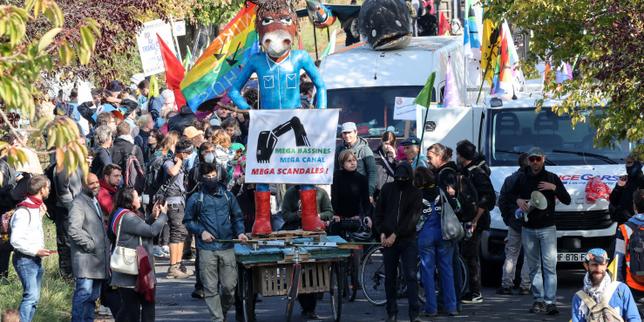
The mud of Pas-de-Calais sticks to your boots in a way that feels personal. It is heavy, rich earth, the kind that has fed generations, swallowed armies, and quietly rebuilt itself after every scar history managed to carve into the French landscape.
On a damp weekend, more than a thousand people gathered on this land. They did not come to admire the horizon. They came because the horizon is about to be systematically dug up. In related developments, take a look at: The Phu Quoc Tragedy and the Deadly Cost of Rapid Tourism Growth.
The Canal Seine-Nord Europe is a colossus of engineering. On paper, it is a masterpiece of modern infrastructure: a 107-kilometer-long highway of water designed to link the Seine basin with the northern European river network. The goal is to move millions of tons of freight from gridlocked highways onto massive barges. It promises progress, green logistics, and economic vitality.
But progress always asks someone else to pay the bill. The New York Times has also covered this critical topic in extensive detail.
For the people standing in the rain in Pas-de-Calais, the bill is too high.
Imagine a family farm. Let us call the farmer Jean-Pierre, a composite of the third-generation landowners who look at the bright orange surveying stakes with a mixture of grief and fury. For Jean-Pierre, the canal is not a triumph of low-carbon transport. It is a massive trench cutting his livelihood in half. To the planners in Paris, a field is a polygon on a digital map. To the person driving the tractor, it is a delicate ecosystem of drainage, soil health, and memories. When you cut through that with a channel wide enough for mega-barges, you do not just disrupt traffic. You sever the veins of the countryside.
The protest was not a gathering of radical fringe activists. It was a coalition of the deeply rooted. Mayors wearing official sashes stood shoulder-to-shoulder with environmentalists and local residents. More than a thousand voices rose against the drone of heavy machinery.
The conflict reveals a profound irony at the heart of modern ecological planning. To save the planet from carbon emissions, we are destroying local ecosystems. The argument for the canal rests on a grand scale: one large barge can replace up to 220 trucks. The math seems indisputable. Carbon footprints shrink. Highways become safer. The European economy flows a little faster.
Consider what happens next when that grand scale collides with local reality.
A canal of this magnitude requires water. Millions of cubic meters of it. To keep the channel navigable during increasingly dry summers, massive reservoirs must be constructed. Water will be diverted, pumped, and managed on an unprecedented scale. Local communities look at their dropping groundwater tables and dry wells from recent droughts, and they ask a simple, terrifying question: Where will our water go when the barges need to float?
The debate is often framed as progress versus stagnation, or global good versus local selfishness. That is a lie. The people protesting in the Pas-de-Calais understand the climate crisis. They feel it in the shifting seasons and the unpredictable harvests. What they object to is the colonial nature of the solution. A project conceived in distant boardrooms is being imposed on a landscape that will bear the physical scars forever.
The scale of the construction is difficult to grasp until you stand at the edge of an active zone. The earth is peeled back, exposing raw chalk and clay. Monstrous yellow excavators bite into hillsides, reshaping contours that have existed since the last ice age. The silence of the rural north is replaced by the relentless, low-frequency thrum of diesel engines. It feels like an invasion.
The authorities insist that environmental mitigation is a priority. They promise replanted hedges, artificial wetlands, and ecological corridors to help wildlife cross the artificial barrier. But a engineered wetland is not an ancient marsh. A planted hedge takes decades to support the biodiversity of the one bulldozed in an afternoon. Nature cannot be copy-pasted.
The real problem lies elsewhere, buried beneath the economic justifications. The canal is built for a world of endless growth, a world where the volume of goods moving across borders must always increase. The protestors are asking a deeper question, one that technical reports conveniently ignore: Do we really need to move this much stuff?
As the afternoon waned in Pas-de-Calais, the crowd marched along the perimeter of the construction site. They carried banners, played music, and planted symbolic trees in the path of the future waterway. It was an act of defiance, but also an act of love for a specific place.
The grand project will likely move forward. The concrete will be poured, the locks will be built, and eventually, the water will rush in to fill the massive trench. The trucks may indeed leave the highways, replaced by the quiet glide of container barges.
But as the waters rise to create this new digital map of Europe, a piece of the region's soul will be quietly submerged beneath the shipping lanes.

.webp)