Loneliness is not merely an emotional deficit; it is a systemic coordination failure. The modern epidemic of isolation persists because conventional intervention strategies treat it as a subjective feeling to be cured through passive consumption, cognitive reframing, or digital-first social networks. These methods fail because they ignore the fundamental mechanics of human connection, which require shared physical coordination, objective-driven cooperation, and a decentralized context that lowers the social friction of interaction.
To understand why hands-on volunteering within food distribution charities successfully mitigates isolation, we must bypass the sentimental narratives of "giving back" and analyze the operational frameworks of shared labor. Food charities function as highly efficient, low-friction social engines. By stripping away the performative demands of modern socialization and replacing them with highly structured, physical tasks, these environments bypass the cognitive bottlenecks that make making friends in adulthood difficult.
The Social Friction Bottleneck: Why Organic Connection Fails
Adult isolation is reinforced by a high activation energy for new relationships. In a standard social environment—such as a bar, a networking event, or a digital forum—individuals must navigate a complex matrix of social friction.
Social Friction = (Performance Anxiety + Evaluative Threat) / Contextual Scaffold
In unstructured environments, the contextual scaffold is near zero. Participants must initiate conversations, establish common ground, manage self-presentation, and continuously evaluate mutual interest. This creates a high cognitive load and triggers evaluative threat—the fear of rejection or negative judgment.
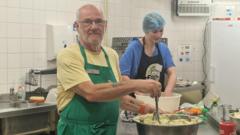
Food charity environments, specifically warehouse sorting lines, soup kitchens, and distribution hubs, reverse this equation. They introduce a rigid, task-based architecture that lowers social friction through three distinct mechanisms:
- Shared External Focus (Triadic Co-orientation): In a face-to-face social setting, the interaction is dyadic (person-to-person). The focus is on the other individual, which heightens self-consciousness. In a task-based environment, the interaction is triadic (person-to-person-to-object). Two volunteers sorting produce are focused on a physical box of apples, not directly on each other. This externalized focus acts as a psychological buffer, allowing conversation to flow incidentally rather than performatively.
- Pre-negotiated Social Norms: When entering a volunteer shift, the rules of engagement are pre-established. Every participant is there for the same explicitly stated purpose. This eliminates the ambiguity of intent that plagues modern social encounters, immediately establishing a baseline of shared values and mutual trust.
- Low-Stakes Parallel Play: Mimicking the developmental stages of early childhood, adult parallel play—working side-by-side on identical but independent tasks—creates a sense of connection without requiring constant verbal validation. The physical presence of another human working toward the same objective generates a subconscious sense of belonging, independent of conversational success.
The Operational Anatomy of Food Charity Environments
Not all volunteering environments are created equal. Environmental design dictates the rate of social connection. Food charities, by virtue of their supply chain and distribution mechanics, possess unique structural properties that make them uniquely suited to alleviate isolation.
The Kinesthetic Sorting Line
The physical layout of a food bank sorting line is a masterclass in unintentional social design. Typically, volunteers are arranged in a linear or circular configuration around a conveyor belt or central sorting table.
This spatial arrangement creates several positive social externalities:
- Forced Proximity without Intrusion: Volunteers work within arm's reach of one another, establishing a shared physical boundary that encourages casual banter but does not require direct eye contact.
- Complementary Task Dependency: One volunteer opens bulk boxes, another inspects the contents for quality control, a third categorizes the items, and a fourth seals the distribution crates. This sequence creates an assembly line where the output of one individual directly enables the input of the next. This interdependence fosters a subconscious recognition of mutual utility, a powerful antidote to the feeling of uselessness that often accompanies deep isolation.
- The Rhythmic Sync Effect: Repetitive, physical labor (sorting, packing, lifting) synchronized across multiple people triggers behavioral entrainment. Neurological studies suggest that synchronous motor activity increases interpersonal rapport, social cohesion, and collective trust by releasing endorphins linked to cooperative group survival behaviors.
The Equalization of Status
Social hierarchies in professional and digital spaces often exacerbate feelings of alienation. Food charity sorting lines act as radical socio-economic equalizers. When individuals put on identical high-visibility vests or aprons and engage in manual labor, visible markers of professional class, wealth, and social status are temporarily erased.
A corporate executive, a university student, a retired mechanic, and an unemployed individual work side-by-side with identical agency. The conversations in this space naturally shift away from status-seeking inquiries ("What do you do?") toward immediate operational needs ("Do we need more cardboard boxes?"). This status equalization reduces the social anxiety associated with class disparity and fosters genuine, horizontal human connections.
The Neurobiological Value Loop of Shared Labor
To fully appreciate why physical food charity labor resolves the biological markers of loneliness, we must examine the physiological feedback loops activated during these shifts. Loneliness is a chronic state of threat. It activates the sympathetic nervous system, raising cortisol levels and putting the body in a state of hyper-vigilance.
Participating in a food charity shift systematically de-escalates this threat state through a predictable value loop.
[Physical Labor / Rhythmic Movement]
                │
                ▼
[Reduction of Cortisol & Adrenaline]
                │
                ▼
[Shared Task Completion (Dopamine Spike)]
                │
                ▼
[Prosocial Interpersonal Synchrony (Oxytocin Release)]
                │
                ▼
[Down-regulation of Amygdala (Threat Level Decreased)]
Physical exertion combined with social coordination shifts the nervous system from a sympathetic (fight-or-flight) state to a parasympathetic (rest-and-digest) state. When a volunteer helps pack 500 family food boxes, the brain receives a double payload of neurochemical rewards: dopamine from the clear, visual completion of a highly structured goal, and oxytocin from the shared, cooperative effort required to get there.
This neurobiological shift has lasting effects. Regular volunteers frequently report a reduction in generalized anxiety and an increased capacity for emotional regulation in their daily lives. The volunteer shift acts as a controlled environment where the brain can safely practice social engagement without the fear of rejection, gradually rebuilding social resilience.
Limitations and Operational Friction Points of the Model
While the benefits of food charity volunteering on isolation are profound, the model is not a universal panacea. To optimize these spaces for social wellness, we must analyze the structural limitations and potential failure modes of the system.
The Volunteer Burnout Loop
Food charities operate on thin margins and are frequently understaffed. This operational reality can lead to "volunteer exploitation," where professional staff prioritize logistics and throughput volume over the volunteer experience.
When a shift becomes overly optimized for pure efficiency (e.g., maximizing pallets processed per hour), the space for social interaction shrinks. If volunteers are pushed to work in isolation at extreme speeds with zero downtime, the triadic co-orientation benefit is lost, and the shift simply becomes unpaid, exhausting manual labor. This triggers burnout, causing lonely individuals to withdraw from the program entirely.
The Transience of the Connection
One of the key limitations of the volunteer environment is the transient nature of the relationships formed. Because volunteers sign up for variable shifts, they rarely see the exact same cohort of people week after week.
This fluid membership creates a structural ceiling:
- Friction in Transitioning from Loose to Tight Ties: While a volunteer shift is excellent for creating "weak ties" (casual, low-stakes acquaintances), it lacks a natural transition mechanism to convert those into "strong ties" (close personal friends). The institutional boundary of the charity often prevents individuals from crossing over into personal social spheres.
- The "Shift-End" Drop-off: Once the shift is over and the aprons are removed, the social scaffolding immediately collapses. Volunteers typically disperse to their cars, creating a jarring transition back into isolation.
Tactical Architecture: Designing Food Charities for Social Resilience
To maximize the therapeutic potential of food charities, organizations should intentionally design their operational pipelines to foster sustained human connection without compromising their primary mission of hunger relief. This requires a shift from pure logistics management to a dual-optimization model that values social capital as a primary output of the system.
1. Implement Cohort-Based Scheduling
Instead of allowing completely open, ad-hoc shift registration, charities should design and promote recurring, cohort-based volunteering blocks (e.g., "The Tuesday Night Sorting Crew"). By encouraging volunteers to commit to the same time slot for a six-week cycle, organizations build structural predictability. This repetitive exposure allows weak ties to naturally mature into deep, reliable friendships through the psychological principle of mere exposure.
2. Designate Structural Transition Zones
To solve the "shift-end drop-off," facilities must build physical and temporal transition zones into their operational flow.
- The 15-Minute Decompression Window: Allocate the final fifteen minutes of a three-hour shift to a shared, sit-down break with light refreshments.
- Spatially Separate the Social Space: Create a welcoming, designated break room or outdoor courtyard adjacent to the warehouse floor. This physical separation allows the brain to transition from "task-mode" to "social-mode" before individuals depart.
3. Balance Task Complexity with Cognitive Load
Organizations must deliberately design tasks to maintain a balance between productivity and social flow. High-intensity tasks requiring extreme concentration or loud machinery (such as forklift operation or complex computer logging) should be paired and rotated with rhythmic, low-cognitive-load tasks (like assembling cardboard boxes or labeling bags). This ensures that every volunteer spent a portion of their shift in an environment where casual conversation is physically and cognitively possible.
By viewing food charity not merely as a mechanism for resource distribution, but as a highly engineered incubator for social health, we unlock a scalable, self-funding solution to the isolation epidemic. The cure for loneliness is not to look inward, but to look outward at a shared conveyor belt, working alongside a stranger to solve a concrete, physical problem.