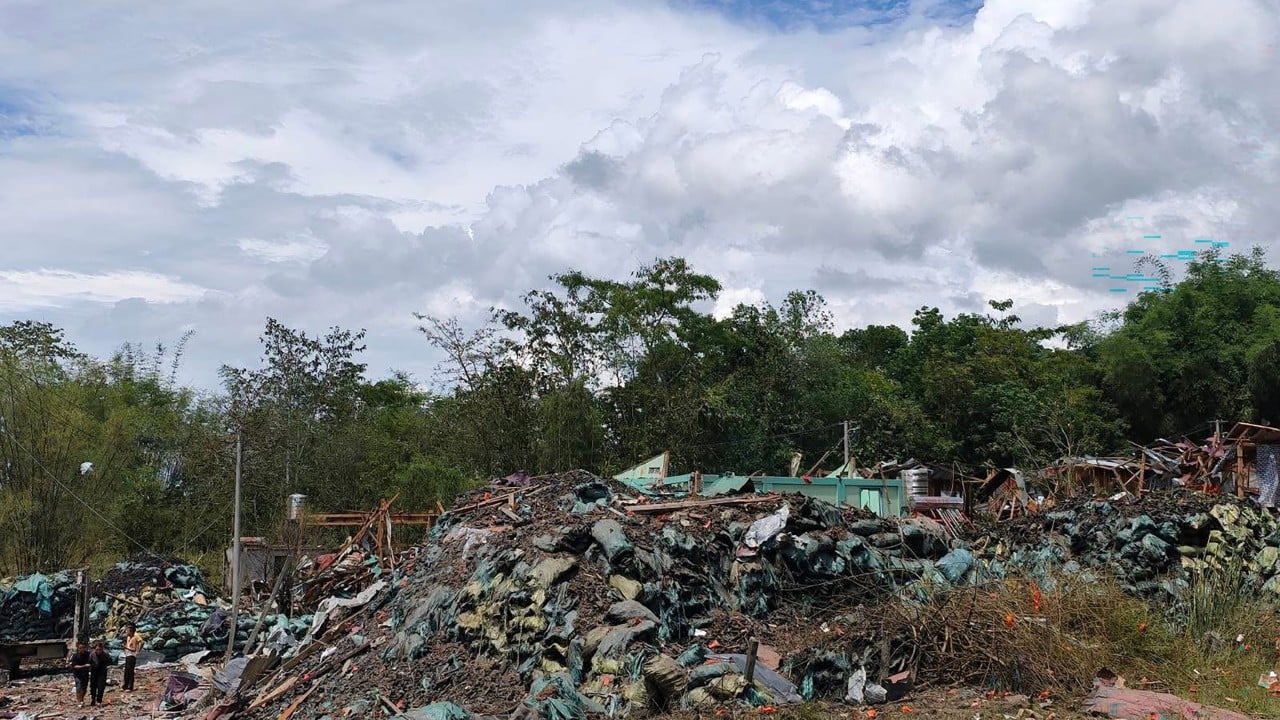
A catastrophic explosion at a mining explosives depot in the northeastern Myanmar town of Namhkam has killed at least 55 people, including six children, and left dozens more maimed. The blast, which occurred on May 31, 2026, tore through Kaungtup village, destroying more than 100 homes and scattering human remains across a three-kilometer radius near the Chinese border. While initial reports framed the disaster as a tragic workplace accident, the reality is far uglier. This was the inevitable consequence of a lawless, multi-billion-dollar shadow economy controlled by ethnic insurgent cartels and fueled by illicit Chinese industrial demand.
The building that vaporized at noon on Sunday was not a licensed industrial warehouse. It was an improvised stockpile of gelignite managed by the economic department of the Ta’ang National Liberation Army (TNLA). The rebel group quickly issued a statement expressing condolences and promising an investigation. But a real investigation requires looking at the structural rot of Shan State, where insurgent groups fund their mini-states by operating highly hazardous, unregulated mining operations right under the nose of Beijing.
The Chemistry of Neglect
Gelignite is a highly effective blasting agent. It is also exceptionally volatile when mismanaged. Invented by Alfred Nobel, the substance consists of nitroglycerin absorbed in a base of wood pulp and sodium nitrate, creating a gelatinous mass that resists water damage, making it ideal for the damp, subterranean conditions of northern Myanmar's stone quarries and rare-earth mines.
The problem lies in its shelf life. When kept in makeshift storage facilities without climate controls, gelignite degrades. Over time, the nitroglycerin seeps out of the matrix, pooling at the bottom of boxes or sweating onto the floor as a highly sensitive liquid. In this state, the slightest friction, a shift in ambient temperature, or a dropped tool can trigger a detonation.
Given the tropical humidity of Shan State, storing mass quantities of commercial explosives in a residential zone like Kaungtup is equivalent to sitting on a kinetic time bomb. The TNLA used the village as a logistics hub because its proximity to the Chinese border town of Ruili allows for easy smuggling of mining equipment and chemical precursors. The local population did not have a say in the matter; they were simply the human shields for a lucrative rebel enterprise.
The Rebel Mining Monopoly
To understand why 55 civilians died in Namhkam, one must understand how the TNLA finances its war against the Myanmar military junta. Since the Three Brotherhood Alliance launched Operation 1027 in late 2023, ethnic armed organizations have seized vast swaths of territory along the Chinese border.
Taking territory is expensive. Governing it is even pricier. To maintain its standing army and administrative apparatus, the TNLA operates an extensive network of informal taxes and direct monopolies over local industries.
- Stone Quarrying: Heavy infrastructure projects on both sides of the border require immense amounts of aggregate material.
- Rare-Earth Mining: The hills of Shan and Kachin states contain heavy rare-earth elements vital for global electronics and electric vehicle supply chains.
- Taxation Corridors: Independent mining operators must purchase their explosives directly from rebel economic wings or pay exorbitant protection fees to import them.
This economic model prioritizes rapid extraction and high margins over basic human safety. There are no environmental impact assessments in rebel-held Shan State. There are no occupational health and safety inspectors. When a mining site or an explosives depot poses a threat to a village, the locals have no courts to turn to and no regulatory bodies to file complaints with. The insurgent group is the police, the judge, the tax collector, and the mining boss all at once.
The Chinese Supply Chain Blindspot
The explosion occurred just three kilometers from China. This geographical detail is not a coincidence. The entire extractive industry in northeastern Myanmar exists to serve the insatiable hunger of the Chinese industrial machine just across the border.
+------------------------+      +--------------------------+      +------------------------+
|  Chinese Capital &     | ---> |  Insurgent Control       | ---> |  Raw Materials         |
|  Smuggled Precursors   |      |  (TNLA Monopolies)       |      |  Shipped Back to China |
+------------------------+      +--------------------------+      +------------------------+
Chinese state media broadcaster CCTV was quick to report on the damage to residential properties, but notably quiet on the origin of the explosives. For years, commercial explosives, detonators, and mining chemicals have flowed southward across the porous Yunnan border. The raw materials extracted using these explosives—ranging from heavy metals to construction-grade stone—then flow right back north.
This symbiotic relationship creates a massive ethical blindspot. Chinese companies profit from cheap, unregulated commodities while washing their hands of the environmental destruction and human collateral damage occurring mere miles from their border. The TNLA provides the muscle and takes the blame when things go wrong, ensuring the supply chain remains unbroken.
The Illusion of the Rebel State
The tragedy at Namhkam punctures the romanticized narrative surrounding Myanmar’s ethnic armed groups. In the international imagination, these groups are often viewed simply as freedom fighters resisting a brutal military dictatorship. While the junta's own atrocities are well-documented and monstrous, the governance model of the rebel groups in their newly secured territories is far from a democratic utopia.
The TNLA’s immediate promise to provide "relief, healthcare, and rehabilitation" to the victims is a cynical PR move designed to maintain control over an angry local population. The local township hospital in Namhkam, overwhelmed by more than 70 severely injured patients, relies on rudimentary equipment and volunteer medics. The resources poured into acquiring military-grade gelignite vastly outstrip the resources invested in local healthcare infrastructure.
This imbalance reveals the fundamental flaw of the current conflict ecosystem. As long as territorial control is funded by unregulated, dangerous resource extraction, civilian populations will remain expendable raw material. The blast in Kaungtup was not a freak accident. It was the predictable cost of doing business in a warzone where explosives are treated as currency and human lives are treated as overhead.
The bodies recovered from the debris have already been sent for cremation, clearing the physical evidence of the disaster. The smoke over Namhkam will clear, the houses will be rebuilt with cheap materials, and the economic department of the TNLA will inevitably source another shipment of gelignite to keep the mines running.