The air tasted like pennies and old newspapers.
Outside the window, the morning sun did not rise as a golden orb; it hung in the sky like a bruised orange, muffled by a grey shroud that clung stubbornly to the horizon. In Calgary, when the landfill smolders, the smoke does not simply vanish. It settles. It creeps under doorways, curls through the seals of car windows, and finds its way into the quiet corners of living rooms where children play and elders rest.
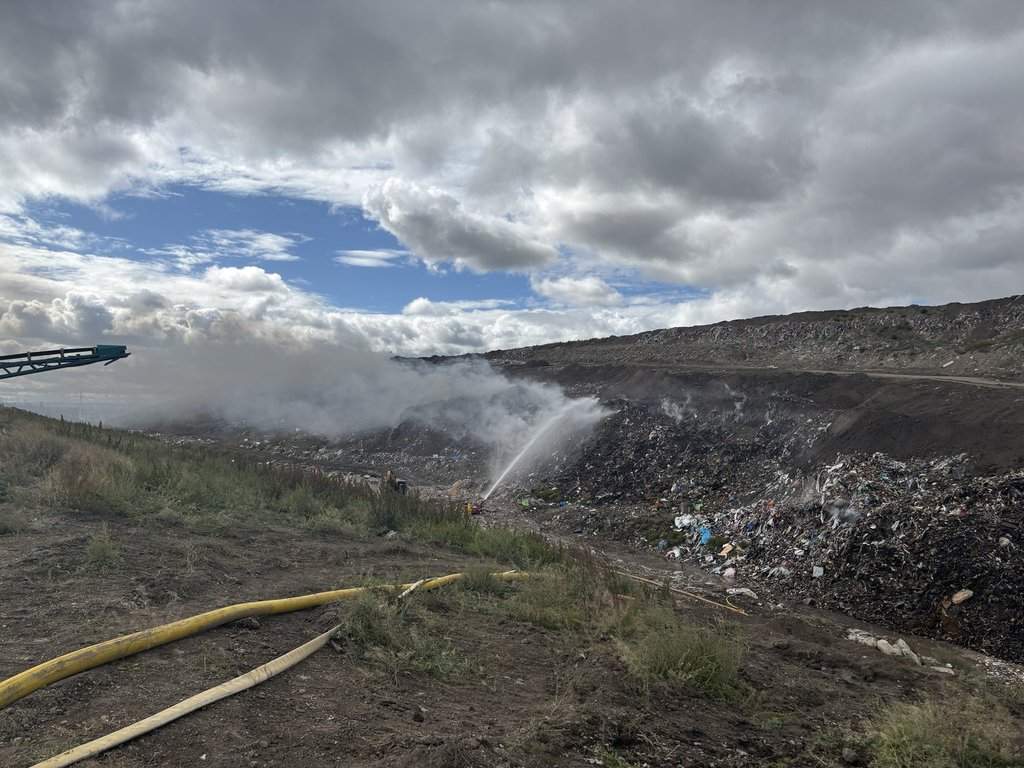
For weeks, a persistent, deep-seated fire has burned beneath the surface of a local waste site. To the casual observer driving along the distant ring road, it might look like nothing more than an unusual fog. But ask anyone whose throat began to scratch on a Tuesday morning, or whose asthma inhaler became a constant pocket companion, and they will tell you a different story. This is a story about the invisible weight we carry in our lungs when the ground beneath our cities refuses to stay quiet.
What Lies Beneath
Waste is supposed to be out of sight and out of mind. We bag it, bin it, and forget it. We trust that massive engineering feats will contain our discarded lives safely away from the air we share.
Yet, deep inside a landfill, organic matter, plastics, and debris can undergo slow, smoldering combustion. Unlike a forest fire that roars with crackling flames and demands immediate evacuation, a underground landfill fire is a slow-motion ghost. It lacks oxygen, burning low and producing a dense, acrid cocktail of particulate matter, carbon monoxide, and various volatile organic compounds. It is notoriously difficult to extinguish. Pouring water on the surface often does little more than create steam, while the hidden embers continue to feed on trapped oxygen far below.
Consider what happens when that smoke meets a temperature inversion—a meteorological trap where a layer of warm air sits over a cap of cooler air near the ground. Instead of rising into the upper atmosphere, the smoke is pinned down. It blankets neighborhoods, turning a routine morning commute into an exercise in shallow breathing.
The Data Behind the Haze
When citizens demand answers, authorities respond with numbers. Air quality monitoring stations hum quietly on rooftops and mobile units deploy to neighborhoods closest to the site, measuring fine particles known as PM2.5.
These microscopic specks are small enough to bypass the nose and upper airways, sliding deep into the lungs and even crossing into the bloodstream. When officials announce that the Air Quality Health Index has climbed to moderate or high risk, those digits translate into tangible disruptions. Schools cancel outdoor recess. Runners trade their evening jogs for indoor treadmills. People with chronic respiratory conditions lock their windows and watch the air quality readings like stock tickers, waiting for a shift in the wind.
The upcoming release of detailed air quality data is not merely a bureaucratic formality. It is an acknowledgment of a shared burden. People want to know what they are inhaling. They want to know how far the plume stretches and how long their city will taste like a chimney. Transparency matters because uncertainty breeds a unique kind of anxiety. When you cannot trust the very air filling your chest, every breath feels conditional.
Living in the Shadow of the Plume
Imagine waking up at six in the morning, the house still dark, and feeling an immediate tightness in your chest before you even touch the floor. You walk to the kitchen, peer through the glass, and realize the skyline has disappeared.
This is the reality for communities downwind of prolonged industrial or municipal incidents. It forces a reckoning with how interconnected our urban systems truly are. We generate the waste; we consume the goods; and occasionally, the byproduct returns to us in the most intimate way possible.
Public health officials emphasize caution. Stay indoors, they advise. Run air purifiers. Limit strenuous activity. But these are stopgap measures, not solutions. They highlight the vulnerability of daily life against environmental friction. A city is not just steel and glass; it is an ecosystem of breathing bodies reacting to every shift in the wind.
The Long View
Fires like the one in Calgary remind us that managing a modern metropolis requires constant vigilance. As waste management technologies evolve, so too must our readiness to handle the unexpected anomalies that threaten public well-being.
When the new data finally drops, it will fill spreadsheets and generate news alerts. But its true value lies in how it guides human behavior and policy moving forward. It asks us to look closer at what we discard and how we govern the massive footprints we leave on the landscape.
The smoke will eventually clear. The inversion will break, a fresh front will sweep down from the mountains, and the Calgary sky will return to its sharp, blue clarity. Until then, the city breathes together, waiting for the wind to turn.