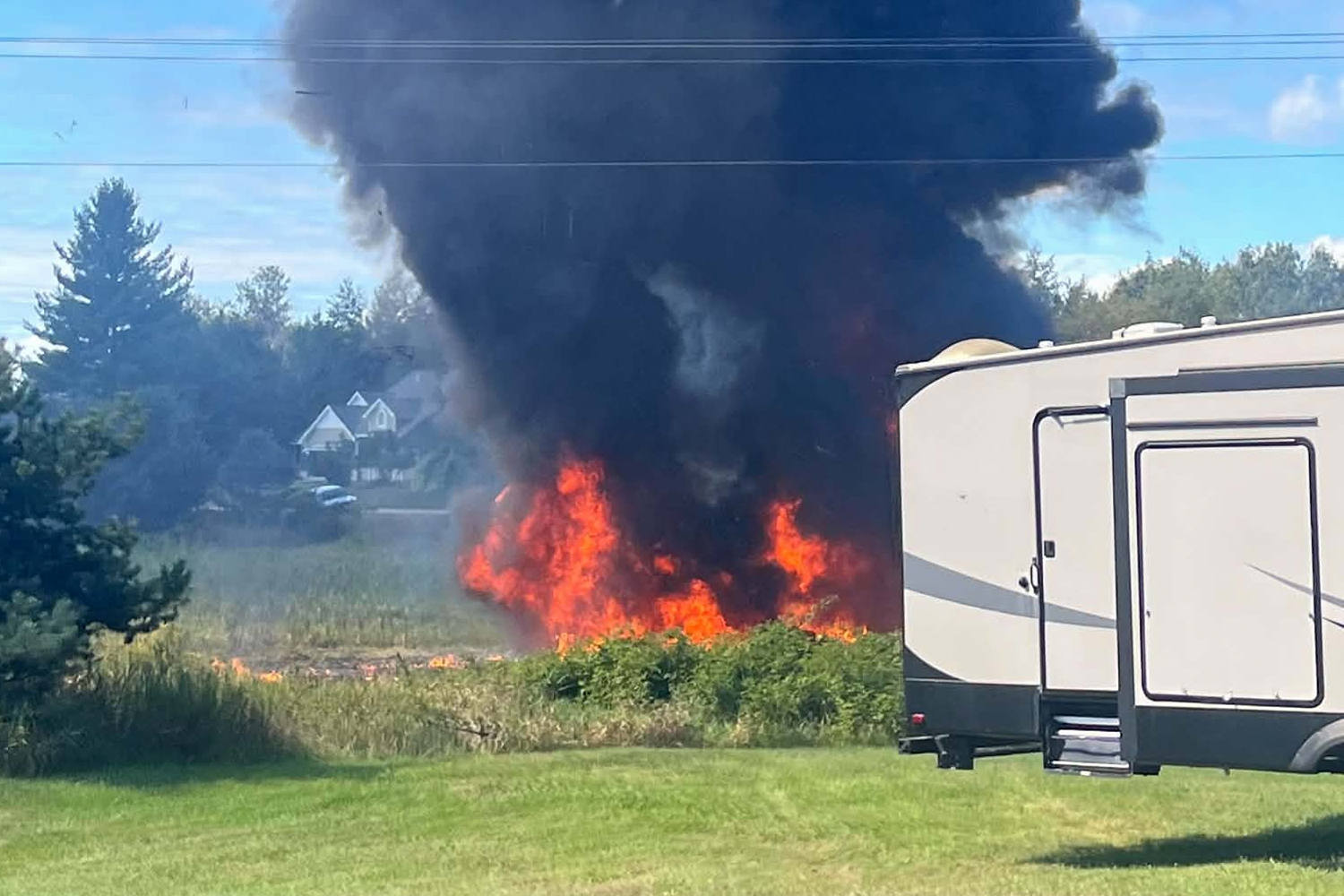
The afternoon air smelled of pine needles and damp earth, the kind of quiet stillness that belongs exclusively to the remote corners of northern Michigan. In towns where the forest presses close against gravel roads, time moves differently. Porches creak under the weight of old rocking chairs. Coffee grows cold in ceramic mugs while neighbors talk across property lines about the coming frost, the migration of deer, or the sudden roar of military aircraft cutting across the upper atmosphere.
For the people living beneath the flight paths of the Midwest, those thunderous streaks overhead were as routine as the weather. They were the sound of national defense, distant and abstract, written in white trails against a blue canvas. For a different view, check out: this related article.
Then came the sound that changed everything.
It wasn't a sonic boom. It was a tearing of the sky, a violent, metallic shriek that rattled windowpanes and sent startled birds exploding from the birch canopy. Similar coverage on this trend has been shared by NPR.
Seconds later, the silence of the woods shattered completely.
In an instant, an ordinary Tuesday transformed into a catastrophe. An F-16 Fighting Falcon, a machine of incredible precision and formidable power, had met its violent end in a residential neighborhood.
(Note: While the exact chronological sequence of the pilot’s final moments is reconstructed from standard military aviation protocols during catastrophic engine failures, the terror experienced on the ground is an unfiltered human reality.)
Imagine standing in your kitchen, watching dust motes drift through a shaft of afternoon sunlight, only to have the floor violently heave beneath your feet. That is what the residents experienced. The impact did not arrive with a polite warning. It arrived with a wall of blinding orange fire, a shockwave that flattened fences, and a towering column of black smoke that choked out the autumn sun.
Debris rained down like shrapnel from a broken clock. Jagged pieces of titanium and composite fiber tore through rooftops, scattering across backyards where children had been playing only hours before. The smell of aviation fuel—acrid, sweet, and suffocating—mixed with the scent of burning pine.
For the pilot, the final seconds were a masterclass in split-second calculations and agonizing choices. Modern fighter jets are marvels of engineering, but they are also unforgiving beasts. When a catastrophic mechanical failure or system malfunction occurs at low altitude, the margin between survival and tragedy is measured in heartbeats. Ejection is a violent, spine-compressing ordeal, a rocket-propelled exit from a cockpit turning into a fireball.
Reports would later confirm that the pilot managed to eject before the impact, parachuting into the dense timber nearby, battered and disoriented, yet alive. But the jet itself continued on an unguided trajectory, choosing its landing point with terrifying indifference.
The immediate aftermath was a blur of flashing red and blue lights, the wail of sirens echoing down narrow country lanes, and the frantic urgency of first responders. Rural volunteer firefighters, local sheriff deputies, and state troopers converged on a scene that looked like it belonged on a foreign battlefield rather than a quiet American neighborhood.
Evacuations were ordered with shouting voices and flashing strobes. Families were ushered away from their homes, clutching pets and winter coats, staring back at plumes of smoke rising from where their living rooms used to be. Miraculously, despite the catastrophic nature of the crash site—smashing into populated residential zones where backyards touch tree lines—no civilian fatalities were immediately reported. It was an astonishing stroke of grace in the middle of a nightmare.
Why do these things happen?
It is the question every resident asks while standing behind a police tape, staring at the smoking crater of a neighbor's property. We build machines of astonishing complexity. We ask young men and women to strap themselves into multimillion-dollar jets and push the limits of physics in airspace shared with civilian life. We trust in rigorous maintenance schedules, pre-flight checklists, and the collective expertise of aerospace engineers.
Yet, entropy remains undefeated.
A turbine blade experiences microscopic fatigue. A hydraulic line fractures under unimaginable pressure. An electronic flight control system glitches for a fraction of a second. In a car, such a failure means pulling over to the shoulder of a highway, lifting the hood, and waiting for a tow truck. In a fighter jet traveling at supersonic speeds, a mechanical failure leaves seconds to decide whether to wrestle a dying aircraft away from human habitation or punch out and let physics take the wheel.
Military training routes across northern Michigan are designed to simulate tactical environments, keeping pilots sharp and ready for global contingencies. The vast forests, low population density, and sweeping airspace make it an ideal theater for readiness training. But "ideal" on a topographical map looks very different when viewed from the kitchen window of a suburban ranch-style home bordered by woods.
When a multi-million-dollar fighter jet drops out of the sky, the abstract concept of national defense suddenly crashes into the tangible reality of a scorched lawn and a shattered chimney.
As night fell over northern Michigan, the fire gave way to glowing embers and the steady hum of generators. Floodlights carved long, ghostly shadows through the smoke. Investigators in hazardous material gear began the painstaking, microscopic work of sifting through ash and twisted metal, searching for the black box, interviewing witnesses, and piecing together the narrative of a disaster that unfolded in the blink of an eye.
The neighbors gathered down the road, huddled in groups beneath the autumn chill. They spoke in hushed tones, marveling at the sheer luck that no lives were lost, yet deeply shaken by how fragile their sanctuary had proven to be. The sky, which had always felt like a protective ceiling over their quiet lives, now felt vast, unpredictable, and heavy.
Tomorrow, the jets will fly again. Training must continue; vigilance is the price of an uncertain world. But for the people of that small neighborhood, the roar of an engine overhead will never sound quite the same. It will no longer be just a distant rumble of power. It will be a reminder of how quickly the ordinary can vanish, leaving only smoke, silence, and the resilience of those who rebuild.