The saltwater breeze hitting the coast of Miami carries more than just the scent of the Atlantic. For generations, it has carried the heavy, unresolved weight of a ninety-mile stretch of ocean. It is a distance short enough to see across on a remarkably clear day, yet vast enough to swallow families, futures, and the geopolitical ambitions of twelve consecutive American presidents.
Every evening in Little Havana, elderly men sit at wooden tables under the shade of banyan trees, slamming dominoes onto the surface with a cracks that sound like gunfire. They argue. They remember. They talk about Havana not as a dot on a map, but as a stolen piece of their youth. For sixty years, the conversation has remained stubbornly unchanged. The embargo stayed. The Castro surname remained etched into the bedrock of Cuban governance. The stalemate felt permanent, an unyielding monument to the Cold War. Expanding on this theme, you can also read: Why Pope Leo XIV Heading to Uruguay This November Matters More Than You Think.
Then, the script flipped.
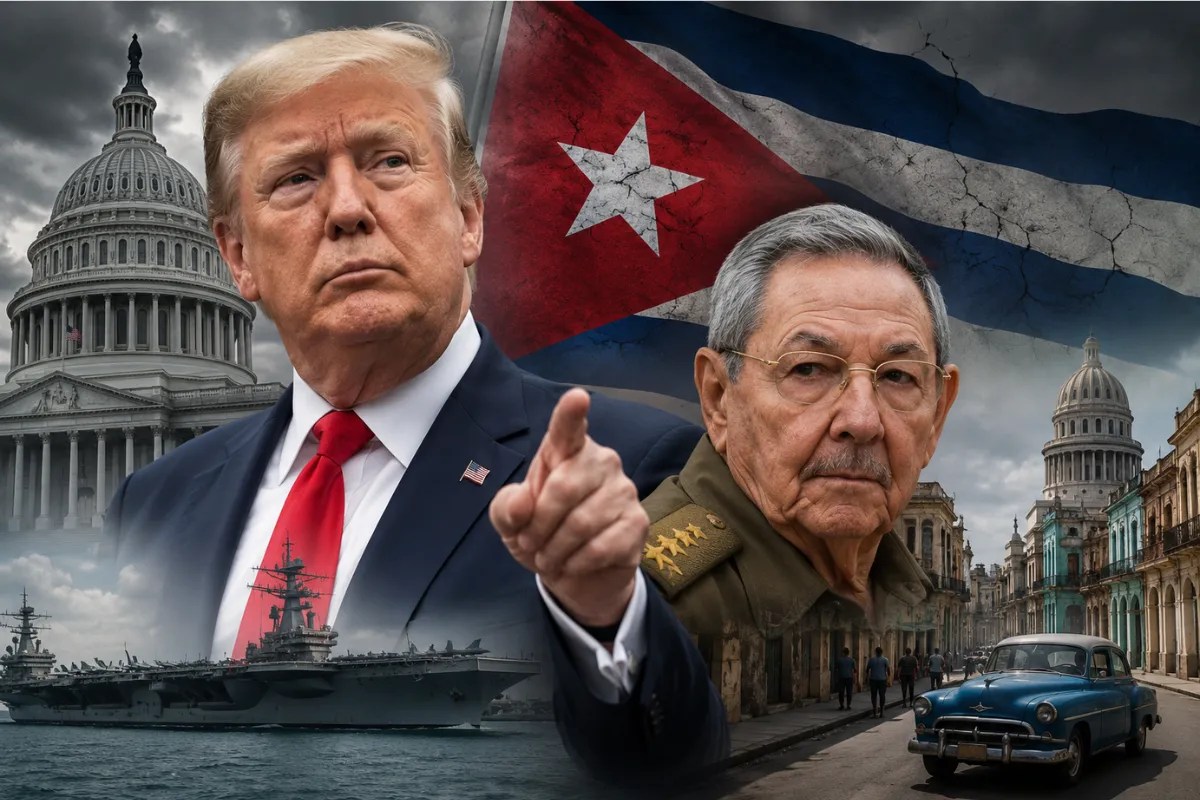
The announcement out of Washington did not just ripple through the political corridors; it shattered the familiar monotony of a six-decade-old conflict. Donald Trump took to the stage, speaking with the blunt bravado that has defined his political era, and aimed squarely at the unfolding crackdown on Raul Castro’s inner circle. His words were not wrapped in the careful, sanitized language of traditional diplomacy. He pointed toward the island and made a massive declaration. What could not be settled, broken, or bypassed in fifty or sixty years, he promised to finish. Experts at NPR have shared their thoughts on this trend.
Suddenly, the cold calculations of international sanctions became deeply, intensely personal.
The Weight of Sixty Winters
To understand why a single political statement can make hands shake over a cup of Cuban espresso, you have to look past the policy papers. You have to look at the math of human lives.
Consider a hypothetical family: let us call them the Sanchezes. In 1962, a young man leaves a vibrant, chaotic Havana on a makeshift boat, leaving behind a sister he promises to send for within months. He builds a life in Florida, watches his hair turn silver, becomes a grandfather, and dies in a hospital in Miami without ever seeing that sister again. His children inherit the longing. His grandchildren inherit a vague, inherited nostalgia for a home they have never touched.
This is the human toll of a sixty-year policy standstill.
For more than half a century, the American approach to Cuba was a machine frozen in time. The logic was simple: isolate the regime, choke the economy, and wait for the collapse. Yet, year after year, the regime endured. The Soviet Union fell, the global economy transformed, the internet was born, but the silence across the Florida Straits remained. Washington analysts spoke of "containment" and "pressure campaigns," phrases that sounded neat in briefing rooms but translated to divided families, rationed medicine, and a suffocating sense of helplessness for millions on the island.
The recent targeting of Raul Castro—the symbolic and literal institutional pillar of the old guard—signaled a crack in the fortress. It was the catalyst for Trump’s intervention, a moment to declare that the old playbook was being tossed into the fire.
Breaking the Script of Diplomacy
Traditional diplomacy is an exercise in patience. It moves at the speed of glaciers, relying on backchannel negotiations, carefully worded communiqués, and incremental shifts that rarely satisfy the people living through the crisis. It is a game of chess where both players have agreed to a perpetual draw.
Trump’s approach relies on a completely different psychological framework. It treats decades of diplomatic precedent not as a foundation to build upon, but as evidence of systemic failure.
"If it hasn't worked since the Kennedy administration," the underlying logic asks, "why are we still pretending the next turn of the screw will be any different?"
The promise to achieve what twelve predecessors could not is undeniably seductive. It taps into a profound collective frustration. It appeals directly to those who are tired of nuance, tired of waiting, and tired of a status quo that has outlived the politicians who created it. By framing the issue as a personal challenge—a task that required a specific brand of disruptive willpower—the rhetoric shifted the narrative from a dry bureaucratic dispute to a high-stakes drama of political resolve.
But a fundamental question hangs in the humid air: how do you dismantle a geopolitical knot that has resisted every tool in the American arsenal for over half a century?
The Anatomy of the Stalemate
The challenge of Cuba has never been a lack of American effort. It has been the unique resilience of a regime built entirely to withstand American pressure. The embargo was not a passive policy; it was a comprehensive economic blockade designed to force a breaking point.
To comprehend why it failed to produce a transition of power, look at how isolation can be weaponized. When an external power cuts off a nation, the ruling elite rarely suffers the consequences. Instead, they use the scarcity to tighten their grip. They control the distribution of what little remains. They point across the water at the embargo and blame every broken streetlamp, every empty grocery shelf, and every systemic failure on the foreign adversary.
The embargo became the regime’s oxygen. It was the ultimate excuse for internal repression.
This is the complex landscape into which the current administration stepped. Targeting Raul Castro’s financial and political apparatus is an attempt to strike at the nerve center of this survival mechanism. It is an acknowledgment that general economic pressure is too blunt an instrument, one that often harms the population while leaving the architects of the system untouched. The focus has narrowed to the individuals holding the keys to the state.
Yet, the emotional core of the issue remains volatile. In Miami, the older generation hears the promise of a swift resolution and feels a surge of long-dormant hope. The younger generation, raised on a diet of pragmatic skepticism, wonders if they are witnessing a genuine strategic breakthrough or simply another chapter in a long history of powerful rhetoric designed for domestic consumption.
The Echoes in the Cafeteria
Walk into any bakery along Calle Ocho during the afternoon rush. The air is thick with the scent of fried dough and roasted beans. The television mounted in the corner plays news loops of Washington press conferences, the faces of American politicians flickering against the mirrored walls.
The patrons do not speak in the abstract terms of geopolitics. They do not use terms like "bilateral relations" or "multilateral coalitions."
They speak of cousins in Matanzas who cannot find basic antibiotics. They speak of the exorbitant fees required to send remittances back home. They speak of the agonizing uncertainty of waiting for visas that may never materialize. For these people, the policy shift is not a headline; it is a direct intervention into their daily survival.
There is a profound vulnerability in this community. To care deeply about Cuba is to live with a chronic wound. Every time a president takes the microphone and promises a new dawn, that wound is reopened. There is a desire to believe, coupled with a deep, defensive cynicism born from decades of broken promises and false dawns.
The current escalation has heightened the tension. The crackdown on the Castro legacy represents a direct assault on the symbolic heart of the Cuban state. If the administration can truly leverage this moment to force a fundamental realignment, it will rewrite the history books. If it cannot, it risks adding another layer of disillusionment to a community that has already sacrificed too much.
The Uncharted Horizon
The old rules of engagement have clearly been discarded. The strategy of quiet containment has been replaced by a policy of public confrontation and high-stakes ultimatums.
The true test of this new approach will not be measured by the applause at a campaign rally or the fierceness of a statement issued from the Oval Office. It will be measured by the tangible changes that occur—or fail to occur—on the streets of Havana. It will be measured by whether the young people of Cuba begin to see a future for themselves within their own borders, rather than looking out at the horizon, wondering if a homemade raft can carry them to freedom.
The sun begins to drop low over the Miami skyline, casting long shadows across the avenues. The domino games are winding down. The old men pack away their tiles, their faces lined with the maps of a country they left behind a lifetime ago. They have heard the promises of presidents before. They have watched the tides of the Florida Straits rise and fall for sixty years, waiting for the day when the water no longer represents a barrier, but a bridge.
The words from Washington have promised that the wait is finally coming to an end. The world watches, holding its breath, to see if the shadow will finally lift, or if the ocean will keep its secrets for another sixty years.