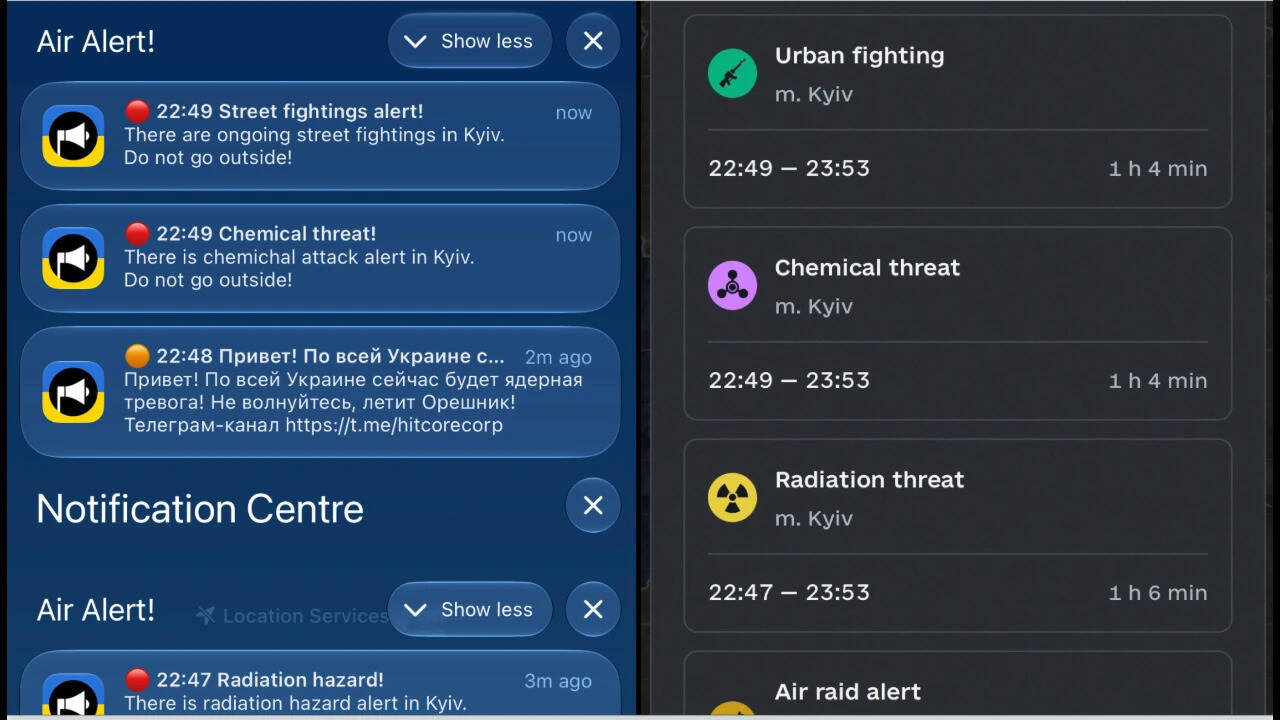
The sound does not ask for your attention. It seizes it.
If you have ever stood in a cramped hallway in Kyiv or Kharkiv at three in the morning, waiting for the distant thud of an incoming Shahed drone to resolve into either silence or shattered glass, you know the exact frequency of the Air Alert app. It is a sharp, mechanical wail that bypasses the rational mind entirely and plugs straight into the brainstem. You do not think when it goes off. You grab your coat. You grab your child. You move toward concrete.
Now, picture a hypothetical mother—let us call her Olena—living on the seventh floor of a Soviet-era panel building in central Ukraine. Outside, the night is unusually quiet. No distant hum of engines, no anti-aircraft tracer fire stitching the clouds. Inside, her phone illuminates the dark bedroom with a cold blue light. The familiar red icon flashes. Except the text does not warn of ballistic missiles or artillery shelling. It reads, in stark official lettering, that a nuclear strike is imminent, advising immediate evacuation and radiation protocols.
Stop. Breathe. Feel the floor drop out from beneath your feet.
In reality, no mushroom cloud was blooming over the horizon. No silo doors had opened. Yet for thousands of Ukrainians who received fraudulent push notifications after attackers breached an emergency alert system, the terror was entirely indistinguishable from the real thing. A string of compromised code had turned a digital lifeline into a psychological weapon.
The Architecture of Absolute Trust
To understand why a fake nuclear alert is more than a mere digital prank, you have to understand the unique contract forged between citizens and their smartphones during wartime.
In peacetime, push notifications are an annoyance. We swipe away promotional codes, breaking news banners, and calendar reminders without a second thought. We have developed a thick callous against digital urgency. War strips that callous away overnight. When Russia launched its full-scale invasion of Ukraine in February 2022, the air raid siren ceased to be a relic of Cold War history drills and became the primary metronome of daily survival.
Developers and Ukrainian authorities rapidly built and deployed digital warning systems—most notably the Air Alert application developed by Ajax Systems in partnership with the Ministry of Digital Transformation—to bridge the gap where physical street sirens could not be heard. Within months, millions of people downloaded these tools. They granted them override permissions, allowing the apps to bypass "Do Not Disturb" settings, scream at maximum volume in the dead of night, and dictate when families ate, slept, worked, or hid in subway stations.
That level of compliance requires total, unquestioned faith. You cannot pause to fact-check an air raid siren on Telegram while a supersonic missile travels at several kilometers per second. Hesitation is fatal. Therefore, the system relies on an unspoken covenant: We will never cry wolf, and you will always obey.
When hackers infiltrate the backend infrastructure of an emergency notification service—or hijack regional administrative credentials to push unauthorized alerts—they are not stealing credit card numbers or encrypting corporate servers for ransom. They are poisoning the well of public trust.
How a Digital Lifeline Turns into a Weapon
Consider what happens next when an attacker breaches a public warning system.
Think of an emergency alert network like a town’s historic church bell. For generations, the bell rings only when the river floods or a fire breaks out. Everyone knows the sound, and everyone drops their tools to run toward the square. Now imagine a saboteur sneaks into the belfry at midnight and rings the alarm furiously while the sky is clear. The first time, the town panics and tramples one another in the dark. The second time, half the town stays in bed, muttering about fools in the tower. By the third time, when the river actually breaches the levee, nobody comes out at all.
Cybersecurity researchers who analyze attacks on critical infrastructure call this "alert fatigue," though that clinical phrase fails to capture the sheer cruelty of weaponizing survival instincts. In the documented cases where Ukrainian digital infrastructure and emergency broadcast channels have been compromised—ranging from hijacked local radio stations broadcasting false surrender announcements to unauthorized push notifications sent through breached administrative panels—the technical execution is often surprisingly straightforward.
Attackers rarely need Hollywood-style zero-day exploits to pull off an information operation. Often, the entry point is a compromised password belonging to a regional administrator, a phishing email opened on a municipal computer, or an unpatched vulnerability in a third-party notification gateway. Once inside the distribution console, the intruder holds the megaphone. They type a few sentences, select the target regions, and hit send.
In milliseconds, millions of pocket-sized sirens detonate simultaneously across the country.
I have spoken with friends in eastern Ukraine who described the specific, metallic taste of adrenaline that floods your mouth when an unexpected alert hits your screen. Even when your rational brain suspects a glitch—even when you look out the window and see streetlamps glowing calmly—your nervous system refuses to stand down. You check official channels frantically. You call your aging parents across town, their hands shaking too badly to unlock their phones. You wonder if the internet is about to go dark.
And even after the Ministry of Digital Transformation or regional military administrations issue rapid denials, confirming that the system was hacked and no nuclear threat exists, the damage is already done. The poison is in the bloodstream.
The Invisible Scars of Cognitive Warfare
We tend to measure war in physical tonnage: craters in asphalt, shattered apartment blocks, displaced populations, megawatts knocked off the electrical grid. We struggle to measure psychological attrition because it leaves no rubble for satellite cameras to photograph.
Yet modern conflict operates heavily in the cognitive domain. Military strategists understand that you do not always need to destroy an army’s tanks if you can paralyze the society standing behind them. A fake nuclear threat alert is a textbook example of cognitive warfare—an operation designed not to break concrete, but to break human composure.
Let us look closely at the mechanics of that panic. Nuclear anxiety carries a uniquely suffocating weight in Ukraine. This is the land of Chornobyl, where the memory of invisible radiation drifting across silent forests is baked into generational trauma. Furthermore, the Russian occupation of the Zaporizhzhia Nuclear Power Plant—the largest in Europe—has kept the specter of a radiological disaster hovering over the country since 2022. Every Ukrainian household knows where their potassium iodide tablets are kept. They have read the government pamphlets on sealing window frames with wet towels and duct tape.
So when a hacked app flashes a nuclear warning, it does not land on blank ground. It strikes an exposed nerve that has been raw for years.
The immediate consequence is physical chaos. People bolt onto staircases in the dark, risking falls and heart attacks. Roads jam as terrified drivers attempt to flee cities simultaneously, blocking actual emergency vehicles. Hospitals see spikes in acute stress reactions, hypertensive crises, and panic attacks.
The secondary consequence is far more insidious. Every false alarm introduces a micro-fraction of doubt into future warnings. The next time the siren screams at four in the morning, a exhausted father in Dnipro might stare at his phone for ten agonizing seconds, wondering: Is this a real ballistic launch, or is it another hack?
In a war where the flight time of a missile from Belgorod to Kharkiv is under sixty seconds, ten seconds of doubt is an eternity.
Why Securing the Siren Is Harder Than It Looks
It is tempting to look at a breach like this and demand simple answers. Why wasn't the app unhackable? Why didn't encryption stop them?
To be honest, anyone working in cybersecurity who tells you a networked system can be made completely impervious is either lying or trying to sell you something. Emergency alert ecosystems are notoriously difficult to lock down because they must balance two competing imperatives: absolute security and instantaneous speed.
Think of a fire extinguisher mounted on a wall. You could lock it inside a titanium safe with a biometric scanner and a twelve-digit passcode so no vandal could ever tamper with it. It would be completely secure. It would also be completely useless when the curtains catch fire.
Emergency notification networks face this exact dilemma. During an active military assault, local civil defense operators need to trigger warnings within seconds of radar detection. Adding clunky layers of multi-person approval or slow bureaucratic verification could delay an alert until after the impact has already occurred. At the same time, decentralization—giving dozens of regional offices the keys to broadcast warnings—dramatically expands the attack surface. An adversary does not need to breach the heavily fortified central servers in Kyiv if they can steal credentials from a single overworked clerk in a regional administration office.
Cyber defenders in Ukraine have fought an extraordinary, relentless battle behind the scenes since the invasion began, repelling thousands of state-sponsored cyberattacks aimed at power grids, banking systems, telecom operators, and government registries. For the most part, those defenses have held remarkably well. Digital resilience became one of Ukraine’s quietest triumphs—a nation keeping its digital state running while missiles rained down on its physical cities.
Which is precisely why attackers pivot toward soft psychological targets. When you cannot take down the banking grid, you hack the emergency alert system. If you cannot break the shield, you make the shield scream in the ear of the person holding it.
Rebuilding Faith in a Compromised Signal
So how does a society protect itself when the very tools built to save lives can be hijacked to terrorize?
The response requires both hardened engineering and radical human transparency. On the technical front, security architects are increasingly isolating notification pipelines, enforcing hardware-based multi-factor authentication for every single operator with broadcast privileges, and requiring cryptographic dual-key verification for high-severity alerts—meaning no single compromised account can ever unilaterally trigger a catastrophic warning like a nuclear strike.
Equally critical is cross-channel verification. Digital hygiene in wartime has evolved into a survival skill. Citizens have learned, through bitter experience, never to rely on a single point of failure. When an extraordinary alert appears on one app, people instinctively cross-check official verified Telegram channels, state broadcasters, and local military administrations before acting on extreme protocols.
Speed of communication becomes the antidote to panic. When Ukrainian authorities respond to a hack within minutes—acknowledging the breach plainly, explaining what happened without bureaucratic evasion, and confirming the status of actual air defense radars—they arrest the spiral of rumor before it can calcify into mass hysteria. Vulnerability and candor, it turns out, are powerful defensive weapons. Admitting "our system was breached, you are safe" restores credibility infinitely faster than silence or spin.
The Quiet Vigilance of the Dark
Eventually, the fake notification disappears from the lock screen. The engineers patch the vulnerability. The compromised credentials are revoked, the logs are analyzed, and the digital walls are built a little higher than they were the night before.
Life resumes its tense, rhythmic cadence.
Back in that seventh-floor apartment, our hypothetical mother, Olena, sits on the edge of her bed long after the official all-clear has been posted across the news channels. Her heart rate slowly descends from a sprint to a heavy, uneven thud. She sets the phone face-down on the nightstand, just inches from her hand. She cannot turn it off. She cannot delete the app. Tomorrow night, or the night after that, the sky will hum again, and she will need that cold blue light to tell her when to wake her child and run for the stairs.
She closes her eyes in the dark, listening to the radiator tick in the quiet room, knowing that the hardest part of survival is having to trust the voice that already lied to you once.