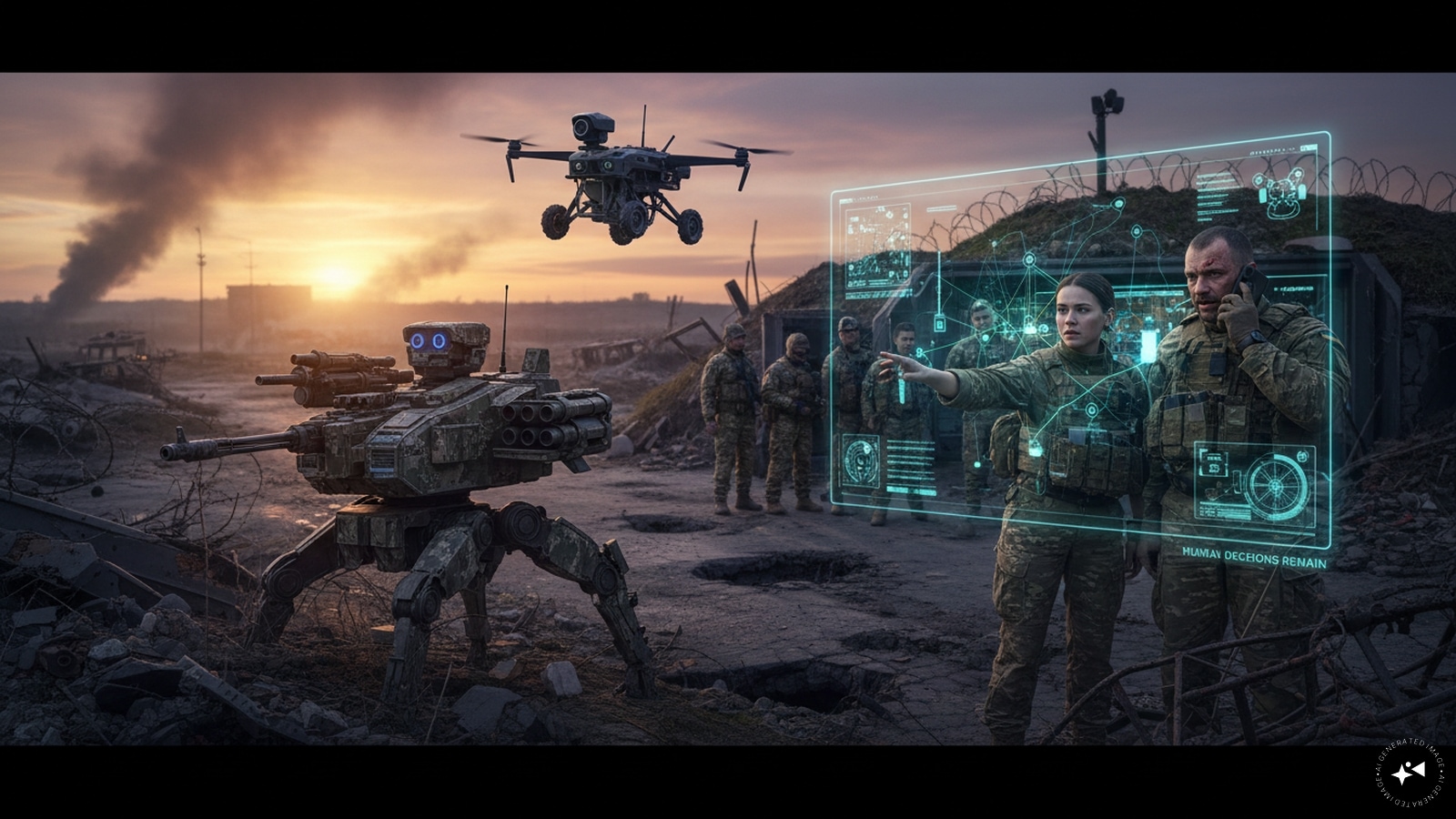
Modern military strategy has fallen in love with a clean, antiseptic fiction. Defense analysts and tech executives routinely promise that artificial intelligence and robotics will transform combat into an exercise in pure computational efficiency, replacing messy human judgment with the cold, infallible logic of machine vision and automated targeting. Millions of defense dollars flow toward automated turrets, unmanned aerial vehicles, and algorithmic command networks under the assumption that he who processes data fastest wins the war. This premise is not merely flawed. It is actively dangerous.
Look past the glossy promotional videos produced by defense contractors and examine what is actually happening on active frontlines. The reality of modern combat reveals an environment defined not by sterile algorithmic precision, but by massive electronic interference, brittle code, and the brutal attrition of inexpensive hardware. Artificial intelligence does not remove human friction from the battlefield. It merely automates it, accelerating errors to machine speed while introducing vulnerabilities that traditional military planners are entirely unprepared to defend against.
The core misconception centers on the nature of autonomy itself. True battlefield independence requires a machine to perceive an ambiguous environment, interpret intent, weigh tactical rules of engagement, and execute a lethal decision without human intervention. Yet, current engineering capabilities are nowhere near this threshold. For instance, consider a hypothetical ground robot navigating a ruined urban corridor during a heavy snowstorm. Dust, smoke, and shifting shadows instantly degrade its neural network inputs. The underlying software, trained on pristine laboratory datasets, encounters visual anomalies it cannot classify. It hesitates, or worse, misidentifies a civilian relief worker as a combatant because an algorithmic weight calculation misfires.
Military technology has long promised a shield of absolute computational protection, yet combat engineering remains tethered to the physical laws of electronics and radio frequencies. Radio silence is a luxury of the past. Electromagnetic spectrums in contemporary conflict zones are saturated with noise, spoofing signals, and active jamming arrays. When an unmanned system loses its datalink to a remote operator, its onboard artificial intelligence is supposed to take over. In practice, the sudden severing of telemetry often causes systems to stall, spin in circles, or execute emergency self-destruction routines.
The economics of this technological shift tell an equally grim story. Defense bureaucracies prefer high-cost, multi-million-dollar hardware platforms integrated with proprietary software suites. These platforms are marvels of engineering when tested in controlled environments. Against an adversary deploying thousands of commodity quadcopters strapped with improvised explosives and controlled by frequency-hopping analog links, these expensive systems experience catastrophic attrition rates. A $500 drone built with off-the-shelf commercial components can neutralize a $10 million armored vehicle if the vehicle's automated defensive aids are blinded by simple localized radio frequency jamming.
This dynamic creates an unsustainable procurement loop. Defense contractors build systems that require pristine data feeds and uninterrupted satellite communication, ignoring the reality that the first casualty of any serious conflict is the electromagnetic spectrum. When global positioning systems are jammed and communications are severed, complex machine-learning models trained in cloud data centers become useless dead weight. Soldiers on the ground do not need more chatty dashboards or automated reconnaissance nodes that require three software engineers to reboot. They need durable, mechanically simple tools that function when every circuit board is swimming in mud and electromagnetic static.
The Mirage of Algorithmic Supremacy
Military procurement agencies are notoriously susceptible to technological silver bullets. Every decade brings a new gospel. First it was precision-guided munitions, then network-centric warfare, and now algorithmic dominance. The common thread is a desire to engineer humanity out of the theater of operations.
Yet, machine learning models are fundamentally pattern recognizers, not tactical thinkers. They excel at extrapolation within known boundaries, but they shatter when confronted with novel tactical adaptations. If an opposing force alters its camouflage patterns, changes its electronic signatures, or adopts unorthodox movement formations, an AI-driven targeting system requires retraining, validation, and redeployment. Software updates cannot be pushed via cloud architecture when communication lines are actively contested by electronic warfare units firing high-powered noise across every civilian and military band.
Consider the data dependency trap. Training an effective object-recognition model for military applications requires petabytes of annotated footage depicting specific terrain, weather conditions, and hardware variants. This data must be gathered, cleaned, and labeled by human analysts. If the theater of operations shifts from arid scrubland to dense pine forests, the previous training dataset loses validity. The models suffer from severe domain shift, resulting in ghost detections, missed targets, and friendly fire incidents. The digital supply chain behind these systems is fragile, reliant on rare earth mineral supply chains and specialized semiconductor fabrication plants vulnerable to geopolitical disruption.
Commanders who lean too heavily on automated advisory systems also risk falling victim to automation bias. When a staff officer sees a high-confidence bounding box appear on a tactical display accompanied by a green algorithmic confirmation, cognitive laziness sets in. The human element stops questioning the data. Critical analysis is sidelined in favor of operational speed. When the algorithm gets it wrong, the consequences are immediate and irreversible.
The Logistics Nightmare at the Edge
Hardware maintenance on the automated battlefield is an overlooked crisis. Commercial robotics are designed for structured warehouse environments or controlled agricultural fields. Frontline military deployments expose delicate sensors, optical lenses, and high-performance computing units to microscopic shrapnel, explosive concussions, extreme thermal shifts, and corrosive moisture.
Autonomous ground vehicles require constant calibration. Lidar arrays must be realigned after every heavy artillery barrage. Servo motors clogged with fine particulate dirt burn out within hours. Software patches conflict with legacy hardware firmware, requiring skilled technicians who are rarely available near the forward line of troops. When a robotic logistics carrier breaks down under fire, recovering it requires dedicating human personnel and vehicles to an extraction mission, defeating the original purpose of removing humans from harm's way.
Furthermore, the power consumption demands of edge-computing neural networks are staggering. Running complex computer vision models and autonomous navigation algorithms requires heavy graphic processing units that draw massive amounts of electrical current. Infantry units operating on foot cannot carry the battery weight required to sustain these systems for extended periods. Generators deployed to power forward recharging stations produce massive thermal and acoustic signatures, acting as neon signs for enemy thermal-imaging reconnaissance drones.
Rewriting the Doctrine of Attrition
The future of conflict will not belong to the nation that fields the most sophisticated algorithm. It will belong to the side that solves the mathematics of cost, resilience, and logistical sustainability.
Armies must pivot away from fragile, exquisite weapon systems wrapped in layers of unproven software autonomy. The focus must shift toward modular, degradation-resistant engineering. Systems must be designed to fail gracefully. When an electronic component is fried by an electromagnetic pulse or a neural network is blinded by counter-measures, the platform must transition instantly to basic mechanical or manual control without endangering friendly forces.
Defense planners are slowly beginning to realize that quantity has a quality all its own, especially when paired with low-cost autonomy that does not rely on satellite constellations or pristine cloud infrastructure. The imperative is not to build smarter machines, but to build resilient systems capable of operating in a degraded state against an active, thinking adversary who is constantly rewriting the rules of the engagement space. Until military leadership breaks its addiction to the silicon myth, the next major conflict will expose a gap between software promises and battlefield reality that no amount of code can bridge.