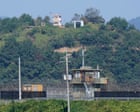
Morning on the Korean border arrives not with light, but with silence. It is a heavy, brittle quiet that settles over the frozen ridges of the Demilitarized Zone, a two-and-a-half-mile scar of earth cutting entirely across the peninsula. For those stationed along this frontier, the air itself feels tightly wound, as if a single stray breath might snap it.
To understand the weight of that silence, you have to imagine walking through the tall grass just north of the Military Demarcation Line. The ground is deceptive. It looks wild, overgrown, and forgotten by time—a accidental sanctuary for wildlife where deer roam freely away from the clamor of modern cities. Yet underneath that carpet of green and brown lies an invisible architecture of fear.
Three soldiers walked into that quiet landscape on a routine patrol. They were young men, likely thinking about the letters from home, the meals waiting for them at the barracks, or simply the biting cold numbing their fingers. Then came the sound. Sharp. Concussive. Final.
In a fraction of a second, the earth beneath them tore open.
Landmines do not negotiate. They do not care about politics, history, or the fragile agreements signed decades ago in dusty conference rooms. They simply wait in the dark, buried inches beneath the soil, engineered for a single devastating purpose. When the smoke cleared, three lives had been violently altered, and the fragile equilibrium holding two nations apart shuddered.
South Korea’s response was swift and uncompromising. Seoul demanded an immediate, formal apology from Pyongyang, labeling the incident a direct violation of the armistice and an unprovoked act of hostility. Officials gathered in emergency briefings, maps glowing under fluorescent lights, tracing coordinates and measuring distances down to the centimeter.
But behind the diplomatic statements and the flashing cameras of the press corps lies a deeper human tragedy.
Borders are drawn with ink on paper, but they are maintained with flesh and bone. Every checkpoint, every strip of concertina wire, and every buried explosive represents a failure of imagination—a monument to the distance between human beings. When a soldier steps on a mine, the shockwaves travel far beyond the immediate blast radius. They ripple through families waiting in anxious suspense, through communities bound by grief, and across an entire nation that has lived under the shadow of division for generations.
Consider the history that brought us here. The Korean War ended in an armistice, not a peace treaty. That distinction is not merely academic; it is a daily reality. It means that technically, the war never truly finished. It merely paused, freezing a nation in time behind a wall of mistrust. Generations have grown up knowing their cousins across the 38th parallel only as adversaries, separated by a frontier so heavily fortified that it can be seen from space.
When incidents like this occur, they expose the terrifying fragility of the status quo.
Diplomacy in this region operates on a knife-edge. Every word is weighed, every retaliation measured, and every silence analyzed for hidden intent. To demand an apology is to demand an acknowledgment of responsibility in a world where admitting fault is often viewed as a fatal weakness. Yet, without accountability, wounds fester. Without truth, reconciliation remains an impossible dream.
As the sun sets over the rugged peaks of the borderlands, the temperature plummets. The guards on duty adjust their heavy gear, scanning the shadowy tree lines through night-vision optics. Somewhere out there in the dark, the unseen barriers remain, waiting in the stillness.
The silence returns. But it is no longer peaceful. It is the tense, watchful breath of a nation waiting to see what tomorrow brings.