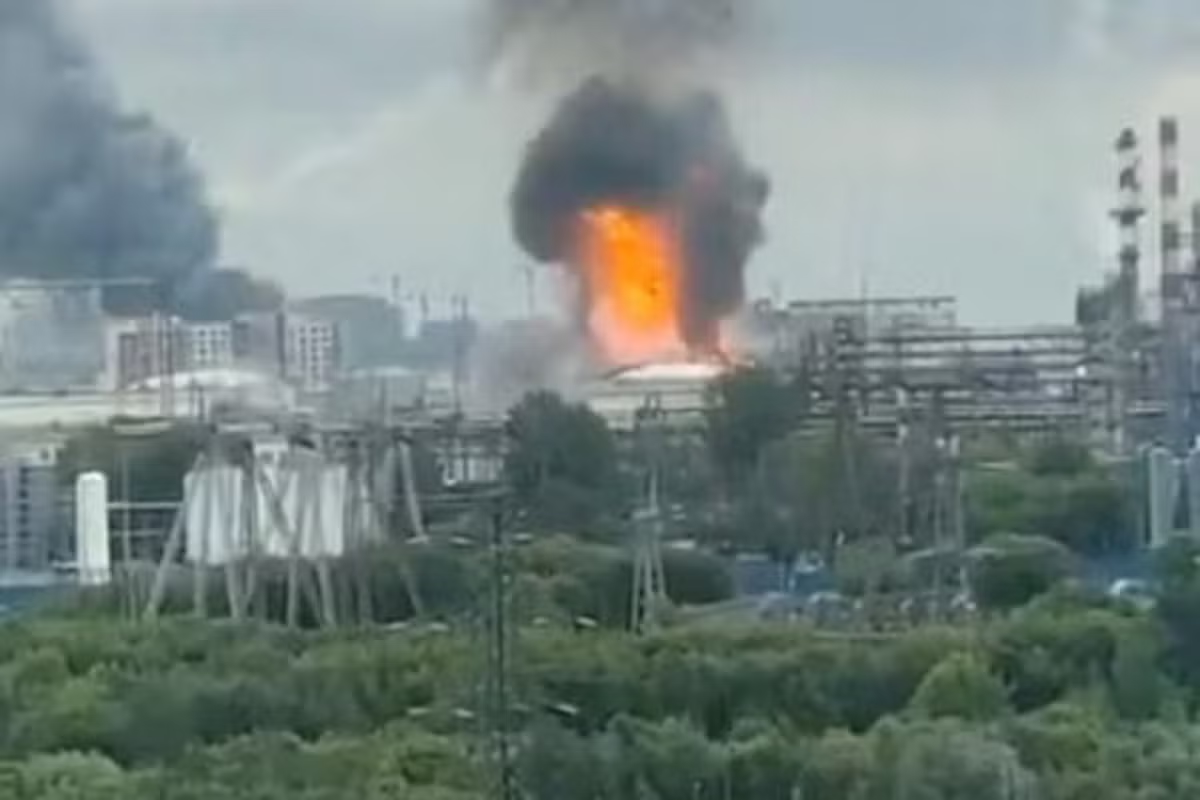
Ukraine is systematically dismantling Russia's domestic fuel supply by converting cheap commercial drones into long-range precision missiles. This campaign targets a glaring vulnerability: the highly specialized, Western-dependent distillation towers deep within Russian oil refineries. By striking these specific nodes, Kiev has forced Moscow into a desperate balancing act between fueling its military machine and keeping domestic gas prices from triggering public unrest.
The strategy bypasses traditional front-line air defenses entirely. It focuses instead on industrial attrition thousands of miles away from the trenches.
The Strategy of Asymmetric Attrition
Military analysts frequently focus on territorial gains and troop casualties. However, modern warfare is ultimately a battle of industrial capacity and logistics. Ukraine’s current aerial campaign recognizes that Russia’s greatest economic asset is also its most fragile vulnerability.
The targets are not random. Drone operators are intentionally bypassing storage tanks—which are easily replaced and contain finite amounts of product—and are instead steering their payloads directly into the fractional distillation towers. These towers are the heart of any refinery. They separate crude oil into gasoline, diesel, and aviation fuel.
Without them, a refinery is just an expensive collection of pipes.
Replacing these towers requires highly specialized engineering. Most of the sophisticated components in Russia’s modern refineries were installed during the post-Soviet modernization boom, heavily relying on European and American engineering firms. Under current international sanctions, acquiring the bespoke parts needed to rebuild a fractured distillation column is an agonizingly slow, clandestine process involving complex shell companies and third-country intermediaries.
The Precision Geography of the Drone Fleet
To understand the scale of this disruption, one must look at the geography of Russian oil infrastructure. The vast majority of Russia's refining capacity sits in the European part of the country, well within the 1,000-to-1,500-kilometer range of Ukraine's latest generation of uncrewed aerial vehicles (UAVs).
Consider how these attacks unfold on a technical level. Ukraine is utilizing low-altitude, carbon-fiber drones that present a minimal radar cross-section. They fly beneath the detection ceilings of traditional long-range surface-to-air missile systems like the S-400. By navigating along river valleys and avoiding known military installations, these slow-moving aircraft slip through the gaps of a domestic air defense network designed to intercept high-altitude bombers and supersonic missiles, not flying lawnmowers.
When a 50-pound warhead detonates against a pressurized distillation column filled with superheated hydrocarbon vapors, the result is catastrophic. The initial explosion is immediately followed by an intense, self-sustaining chemical fire that warps the structural steel of the entire facility.
The Domestic Economic Squeeze
The Kremlin now faces a brutal mathematical equation. Russia produces far more crude oil than it needs, but its capacity to turn that crude into usable fuel is shrinking.
When a refinery goes offline, the economic ripples travel fast.
- Localized fuel shortages hit agricultural regions first, threatening seasonal harvests.
- Wholesale gasoline prices spike on the St. Petersburg International Mercantile Exchange.
- The government is forced to burn through financial reserves to subsidize retail fuel pumps to keep citizens complacent.
To mitigate the crisis, Moscow has historically resorted to temporary bans on gasoline exports. While this stabilizes domestic gas stations, it cuts off a vital source of hard foreign currency that the Kremlin requires to fund its military import networks. It is a direct trade-off between keeping the tanks rolling in the Donbas and keeping commuter cars running in Moscow.
The Sanctions Friction
If Russia could easily repair these facilities, the Ukrainian drone campaign would be a minor nuisance. The true efficacy of the strategy relies entirely on the friction created by Western trade restrictions.
A modern refinery relies on automated control systems, specialized catalysts, and high-tolerance metallurgy that Russia does not produce natively. While China can supply basic industrial goods, replacing a highly customized Western-designed refinery component is not a plug-and-play operation. Engineers must modify the entire facility's architecture to accept non-standard parts, a process that extends repair timelines from weeks to many months.
This reality exposes the limits of Russia's economic resilience. The country can produce millions of artillery shells using Soviet-era industrial blueprints, but it cannot easily replicate the high-tech chemical engineering required to sustain twenty-first-century fuel production.
The Limits of Defense
Moscow has attempted to counter this campaign by deploying pantsir air defense systems directly around major industrial sites and erecting massive metal netting over vulnerable pipes. These net systems can catch smaller commercial quadcopters, but they offer little protection against larger, fixed-wing drones traveling at high speeds.
Furthermore, pulling air defense systems away from the front lines to protect domestic civilian infrastructure creates critical gaps in the theater of war. Ukraine's strategy forces its adversary to choose between protecting its soldiers in Ukraine or protecting its economic engine at home.
As the range of these uncrewed systems continues to expand, more of Russia's industrial base comes into the crosshairs. The conflict is no longer contained to a static frontline; it is playing out in the automated control rooms of energy infrastructure deep within the Russian interior, where the destruction of a single steel tower can paralyze an entire regional economy.