Wealth used to have a predictable sound. It was the heavy chime of a bank vault door in Zurich, the clink of crystal in a Manhattan boardroom, the dry rustle of nineteenth-century ledger paper turning under an oil lamp. It smelled of refined petroleum, iron ore, and the slow, heavy accumulation of concrete and steel over decades. The tycoons who commanded the upper echelons of global fortune built empires you could stub your toe on. Ports, refineries, telecommunication towers punching through the dust of developing metropolises—these were the tangible anchors of supremacy.
Then came the static.
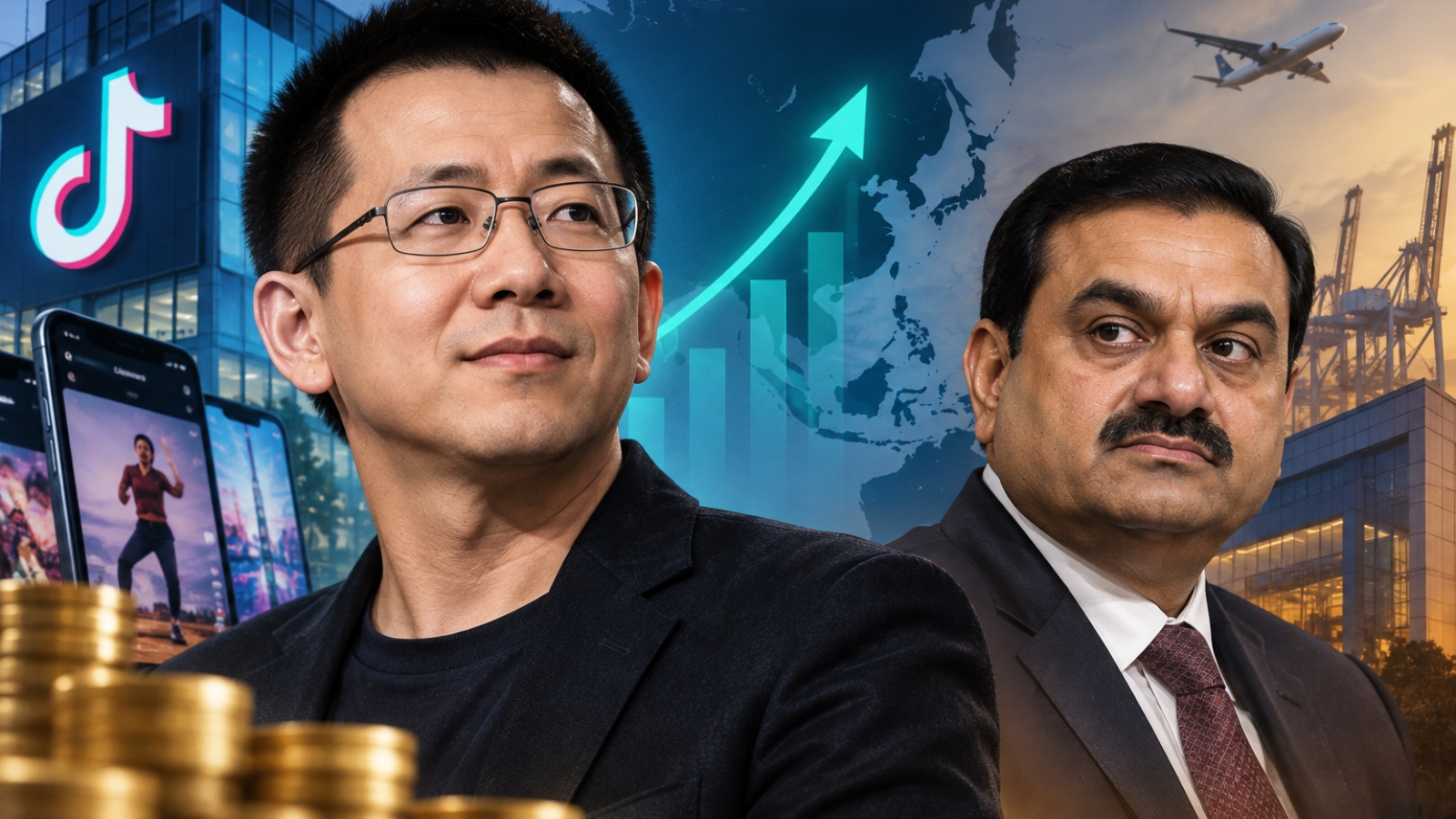
Somewhere in a nondescript Beijing office, a quiet man with wire-rimmed glasses and an engineers focus was building something entirely weightless. Zhang Yiming did not own a single cargo ship. He laid no pipelines across jagged mountain passes. He did not extract a single barrel of crude oil from the earth. Yet, as the financial indexes recalibrate their trembling needles, a seismic shift has occurred across the eastern hemisphere. The old titans of heavy industry, names synonymous with vast physical domains like Gautam Adani, have been quietly bypassed.
Zhang Yiming is now Asia’s richest person.
To understand the magnitude of this transition, you have to look past the dry ticker tape of financial journalism and examine what we actually consume. We no longer buy things to hold them; we buy moments of distraction. We rent our attention spans to an invisible algorithm, second by second, scroll by scroll.
Consider the sheer psychological gravity of what ByteDance engineered. It is easy to dismiss TikTok as a playground for teenagers dancing to three-second audio loops. That dismissal is precisely why legacy wealth missed it. They were looking at factories while the world moved into the nervous system.
Imagine sitting on a crowded subway car in Mumbai, Seoul, or Tokyo. Look down the aisle. Almost every face is illuminated by the cool, blue glow of a vertical screen. Eyes are glazed, thumbs flicking upward with the metronomic precision of heartbeats. Every upward swipe is a tiny, frictionless transaction of human focus. Multiply that by billions of souls across one hundred and fifty countries, twenty-four hours a day, punctuated only by sleep.
That is the factory floor of the twenty-first century. There is no smoke. There is no unionized labor striking outside iron gates. There is only code, running on distant server racks, harvesting the most precious, non-renewable resource on Earth: human curiosity.
For decades, the Asian wealth playbook was ruthlessly consistent. You partnered with state infrastructure. You acquired land rights. You weathered political administrations, built massive conglomerates, and moved commodities from where they were buried to where they were burned. It was a game of physical gravity. The heavier your assets, the higher you rose.
Zhang inverted the equation. He realized that lightness scales infinitely.
When he founded ByteDance in a modest four-bedroom apartment in Beijing back in 2012, the conventional wisdom of Chinese tech belonged to giants like Tencent and Alibaba—portal emperors who owned the digital town squares and retail storefronts. Zhang did not want to build a town square. He wanted to build an automated oracle. He didn't care what you liked; he cared about what you would watch next before you even knew you wanted to see it.
His breakthrough, Toutiao, and its global phenomenon, TikTok, bypassed the traditional social graph entirely. You did not need to follow your friends to be entertained. You only needed to surrender to the machine. The recommendation engine became the product. It was a staggering realization: content doesn't need to be searched for if the delivery mechanism understands human weakness better than humans do.
And that brings us to the uncomfortable human core of this staggering ascent.
财富, wealth, has always been a mirror reflecting what a civilization values. When oil barons topped the lists, we valued energy and mobility. When steel magnates ruled, we valued industrial might. Today, the ascension of a creator of a dopamine delivery system tells us something sobering about our collective state of mind. We are lonely, exhausted, and desperately hungry for micro-doses of validation and escape.
Zhang himself is an anomaly in this theater of excess. Unlike the flamboyant billionaires of past eras who collected mega-yachts and football clubs as extensions of their egos, Zhang cultivated a ghost-like profile. He stepped down as CEO in 2021, sensing the gathering regulatory storms in Beijing, retreating into the shadows while his creation continued to print cultural currency. He is a billionaire who reads like a software engineer, disciplined, detached, and remarkably invisible.
Yet his invisibility stands in stark contrast to the massive, undeniable footprint his creation leaves on human behavior.
When wealth shifts from things you can touch to things that hold your mind, the rules of geopolitical gravity change overnight. Traditional industrialists can have their assets seized, taxed, or nationalized relatively easily. A physical port can be blockaded. A coal mine can be regulated out of existence. But how do you blockade an idea that lives in the cloud? How do you regulate an algorithm that adapts its behavior the moment a government official tries to look under the hood?
You try, of course. Governments from Washington to New Delhi have wrestled with the amorphous beast, banning it, auditing it, threatening it, forcing carve-outs and corporate restructuring. Yet the machine keeps spinning. The engagement loops are too tight, the human appetite for quick distraction too insatiable.
Standing at the apex of this empire, Zhang Yiming embodies the new aristocracy. It is an aristocracy of attention architects. They do not rule by decree or by the barrel of a gun; they rule by curation. They have discovered that if you can control the rhythm of what a human being looks at for just twenty minutes a day, you can accumulate more capital than kings who once owned continents.
The ledger of the world has been rewritten. The ink isn't ink anymore. It is light, flickering against the glass, counting down the seconds until the next refresh.


