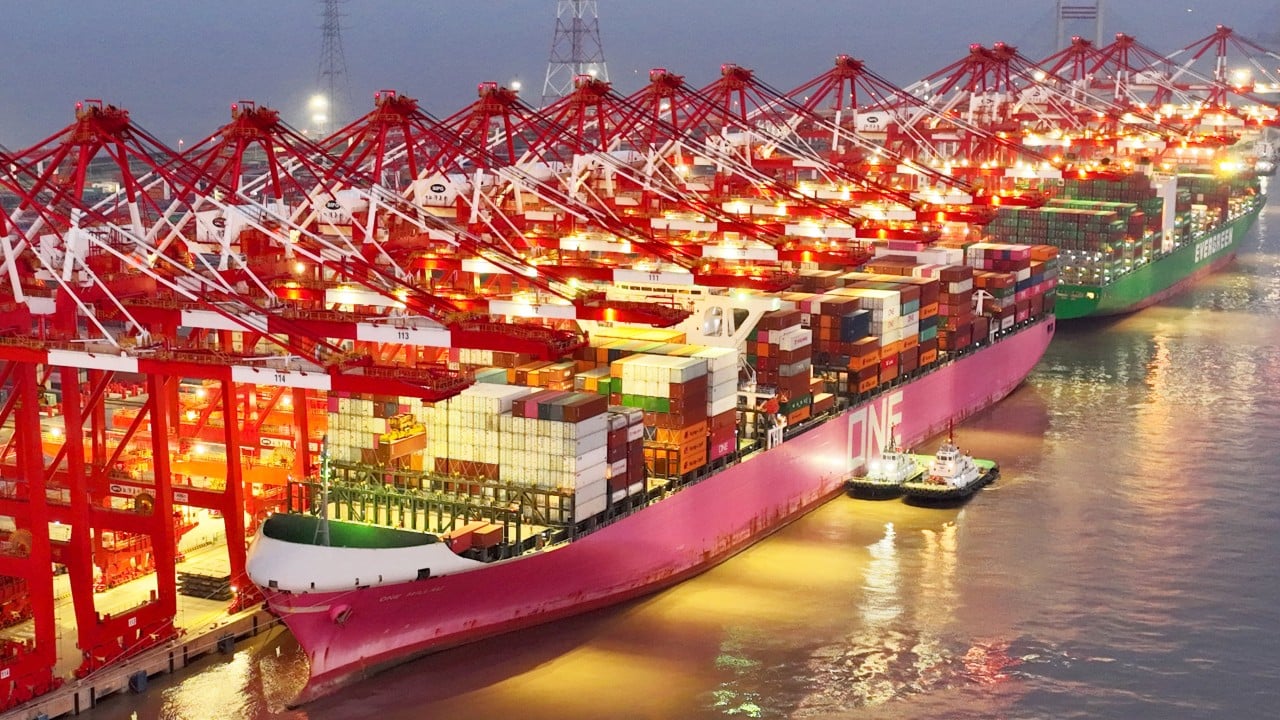
Shanghai’s ascent to the second-highest ranking in global maritime hub indices—trailing only Singapore—marks a structural shift in international logistics from physical cargo handling to high-margin maritime service dominance. Standard industry narratives attribute this rise to China’s sheer export volume and port infrastructure scale. That explanation confuses the symptom with the mechanism. Shanghai has led the world in twenty-foot equivalent unit (TEU) container throughput for over a decade, yet its climb in comprehensive hub rankings is a recent phenomenon driven by deliberate capital allocation into maritime finance, admiralty law, marine insurance, and green fuel bunkering.
To understand how a port transitions from a box-moving utility into a command center for global trade, analysts must separate physical port operations from maritime cluster economics. Physical throughput is a low-margin, capital-intensive commodity business exposed to cyclical demand shocks. Maritime services—shipbroking, hull and machinery insurance, protection and indemnity (P&I) clubs, and maritime arbitration—generate recurring, non-cyclical revenue streams that anchor capital regardless of where a vessel physically docks. Shanghai’s trajectory demonstrates a state-backed industrial policy engineered to capture these upstream and downstream value pools, directly challenging the historical hegemony of London, Singapore, and Oslo.
The Structural Divergence Between Throughput and Hub Status
A maritime hub is not merely a transshipment point; it is an agglomeration of decision-making power. For decades, global shipping operated on a bifurcated geography. East Asian ports like Shanghai, Ningbo-Zhoushan, and Busan handled the physical movement of goods, while European centers—predominantly London, Hamburg, and Piraeus—controlled vessel financing, chartering, legal dispute resolution, and classification societies.
This division persisted because maritime services rely on deep institutional trust, predictable common-law frameworks, and unrestricted capital flows. Moving a container requires cranes, deep-water berths, and hinterland rail connections. Financing a $150 million ultra-large container vessel (ULCV) or arbitrating a multi-million-dollar general average claim requires liquid capital markets, convertible currencies, and independent judicial enforcement.
Industry indices, such as the Xinhua-Baltic International Shipping Centre Development Index, evaluate ports across three weighted dimensions:
- Port Factors: Cargo throughput, berth capacity, draught depth, and crane productivity.
- Shipping Services: Shipbroking, ship management, maritime law, insurance, and ship finance.
- General Environment: Customs efficiency, tax regimes, talent pool depth, and regulatory transparency.
Shanghai maxed out its score in the first category years ago, largely through the automated Yangshan Deep-Water Port. Its recent climb to the number two position reflects rapid point accumulation in the second and third categories. By subsidizing the relocation of shipping headquarters, establishing specialized maritime courts, and building domestic ship-leasing platforms, Beijing has systematically dismantled the geographic separation between cargo origin and maritime governance.
The Three Pillars of Shanghai’s Maritime Service Capture
China’s strategy to elevate Shanghai into a top-tier maritime center relies on three distinct operational mechanisms that convert state-controlled trade volume into service-sector market share.
1. Captive Ship Finance and Leasing Arbitrage
Following the 2008 global financial crisis, traditional European shipping banks—such as HSH Nordbank, Royal Bank of Scotland, and Commerzbank—retreated from maritime lending due to Basel III capital adequacy requirements. Chinese financial institutions stepped into this liquidity vacuum, specifically through bank-affiliated financial leasing companies based in Shanghai’s Lingang Special Area and Lujiazui financial district.
Rather than issuing traditional mortgages, Chinese lessors utilize sale-and-leaseback structures. A foreign shipowner sells a vessel to a Shanghai-based leasing entity and immediately leases it back over a ten-to-fifteen-year period. This structure achieves two objectives simultaneously:
- It provides Western and Greek shipowners with high loan-to-value ratios (often exceeding 80 percent) that commercial banks cannot match.
- It transfers legal ownership of the global merchant fleet onto Chinese balance sheets, routing interest payments, legal documentation, and structuring fees directly through Shanghai.
As Chinese shipyards—including China State Shipbuilding Corporation (CSSC) yards in Shanghai’s Changxing Island—capture over half of global newbuild orders, Chinese lessors bundle shipyard financing with vessel construction. The buyer receives integrated debt and equity financing at the point of fabrication, bypassing London and New York financial intermediaries entirely.
2. Admiralty Law and Arbitration Localization
Maritime commerce runs on standardized contracts—such as BIMCO charter parties and Lloyd’s Open Form salvage agreements—that historically defaulted to English law and London arbitration. When disputes arise over cargo damage, demurrage, or collision liability, the fees flow to English King’s Counsel and London arbitrators.
To break this monopoly, China expanded the jurisdiction of the Shanghai Maritime Court and promoted the China Maritime Arbitration Commission (CMAC). The mechanism for shifting legal venue relies on commercial pressure from Chinese state-owned enterprises (SOEs). When entities like COSCO Shipping, Sinopec, or China Baowu Steel Group charter vessels or purchase raw materials on a Cost, Insurance, and Freight (CIF) or Free on Board (FOB) basis, they increasingly mandate Shanghai arbitration clauses in the underlying contracts of affreightment.
Because Chinese importers represent the world’s largest buyers of iron ore, crude oil, coal, and soybeans, foreign shipowners face a binary choice: accept Chinese dispute resolution venues or lose access to the world’s primary cargo base. Over time, this creates a self-reinforcing precedent library, training domestic admiralty lawyers and reducing the perceived legal risk for international counterparties.
3. The Energy Transition as a Bunkering Reset
The International Maritime Organization’s (IMO) decarbonization mandates represent the single largest infrastructure reset in shipping since the transition from sail to steam. Under traditional marine fuel regimes (heavy fuel oil and very low sulfur fuel oil), Singapore maintained an unassailable moat as the world’s premier bunkering hub due to its refining capacity and strategic location along the Strait of Malacca.
Alternative marine fuels—specifically liquefied natural gas (LNG), green methanol, and green ammonia—require entirely new storage, liquefaction, and ship-to-ship transfer infrastructure. Because these fuels have lower volumetric energy density than fuel oil, vessels must bunker more frequently and closer to major cargo load centers to avoid sacrificing payload capacity for fuel tank space.
Shanghai has exploited this physical constraint by constructing the world’s first large-scale bonded LNG and green methanol bunkering facilities at Yangshan Port. By integrating renewable energy production in China’s northern provinces with coastal synthesis plants, China controls the upstream feedstock for green methanol. Shipping lines operating Asia-Europe loops—such as Maersk, CMA CGM, and COSCO—now refuel directly in Shanghai while loading containers, stripping Singapore of a lucrative service touchpoint and locking carriers into Shanghai’s port ecosystem.
The Gravity Well of Vertical Integration
The primary analytical error in mainstream coverage of Shanghai’s rise is treating port infrastructure, shipbuilding, and maritime finance as separate sectors. In the Chinese maritime model, they operate as a vertically integrated flywheel.
Consider the lifecycle of a modern dual-fuel container ship ordered in China:
- Design and Fabrication: The vessel is engineered by a Shanghai-based marine design institute and built at Hudong-Zhonghua or Jiangnan Shipyard.
- Classification: The ship is classed by the China Classification Society (CCS), eroding the market share of DNV, Lloyd’s Register, and the American Bureau of Shipping.
- Capitalization: A Shanghai leasing bank finances the construction, taking title to the asset.
- Operations: The vessel is operated by COSCO Shipping or chartered to a European liner alliance, calling primarily at Shanghai to load manufactured exports.
- Insurance and Fueling: Hull and machinery coverage is underwritten by PICC Property and Casualty or the China Shipowners Mutual Assurance Association, while the vessel bunkers green methanol at Yangshan.
Every node in this chain reinforces the adjacent nodes. High shipyard output justifies specialized leasing desks; high leasing volume demands local legal and insurance underwriting; massive cargo volume ensures high berth utilization and fuel demand. This closed-loop ecosystem insulates Shanghai from external competitive pressures that fragment Western maritime clusters, where shipyards, banks, and cargo owners operate across different jurisdictions under competing regulatory regimes.
Structural Bottlenecks and Capital Friction
Despite its rapid ascent, Shanghai’s trajectory toward the number one global position faces severe structural constraints. Replicating Singapore’s status requires more than domestic scale; it requires becoming a neutral, frictionless intermediary for third-party trade—trades where neither the buyer, seller, nor vessel owner is Chinese.
Capital Account Controls
The most significant barrier to Shanghai’s maritime dominance is the non-convertibility of the Chinese Renminbi (RMB) on the capital account. Global shipping is denominated in US dollars. Freight rates, bunker prices, vessel valuations, and insurance premiums are priced and settled in USD.
While China has established cross-border RMB settlement pools within the Shanghai Free Trade Zone, international shipowners remain reluctant to hold large cash reserves in RMB due to repatriation friction and currency volatility. Singapore operates with an open capital account, allowing instant, unrestricted multi-currency clearing. Until foreign shipowners can move capital in and out of Shanghai without regulatory approval from the State Administration of Foreign Exchange (SAFE), international shipping conglomerates will continue to house their treasury and commercial headquarters in Singapore, Dubai, or Geneva.
Geopolitical Alignment and Neutrality Risk
A premier maritime hub functions like Switzerland in global banking: it must remain politically neutral to serve all belligerents and trading blocs simultaneously. Singapore’s core value proposition to global shipping lines is its geopolitical non-alignment, ensuring that vessels registered or managed there will not become collateral damage in bilateral trade disputes.
Shanghai cannot offer neutrality. As trade friction between the United States, the European Union, and China intensifies, Western shipowners face compliance risks when routing core corporate functions through mainland Chinese jurisdictions. Recent US Trade Representative investigations into Chinese shipbuilding subsidies and potential port fees on Chinese-built vessels introduce direct regulatory risk. Foreign carriers will gladly use Shanghai for physical cargo loading and green fuel bunkering—operational necessities dictated by geography—while keeping their legal domicile, equity listings, and strategic command centers in neutral jurisdictions to mitigate sanctions exposure.
Talent and Institutional Depth in Complex Underwriting
While Shanghai has successfully scaled standardized ship leasing and basic hull insurance, high-end maritime risk transfer remains concentrated in London’s Lloyd’s market and the International Group of P&I Clubs. Underwriting complex war-risk policies, catastrophic environmental liabilities, or novel technological risks (such as ammonia propulsion toxicity) requires centuries of actuarial data and a dense concentration of specialized underwriters willing to syndicate catastrophic risk.
Shanghai’s insurance market remains heavily weighted toward domestic hull coverage. Foreign shipowners rarely place complex, multi-layered reinsurance treaties in Shanghai due to concerns over claims-paying speed during geopolitical crises and a relative scarcity of senior marine actuaries with international experience.
Comparative Hub Architecture
To evaluate the ceiling of Shanghai’s growth, strategy teams must map the structural differences between the top three global maritime hubs:
- Singapore (The Neutral Clearinghouse): Low physical hinterland demand, entirely dependent on transshipment. Dominates global bunkering, ship management, and Asian commodity trading. Competitive moat rests on English common law, zero-friction capital flows, geopolitical neutrality, and tax incentives under the Maritime Sector Incentive (MSI) scheme.
- Shanghai (The Industrial Anchor): Massive domestic import/export hinterland. Dominates physical container throughput, shipbuilding, and state-backed ship leasing. Competitive moat rests on captive cargo volume, vertical integration of state enterprises, and early-mover scale in green fuel production.
- London (The Institutional Brain): Minimal physical port throughput. Dominates maritime law, arbitration, marine insurance syndication, and shipbroking. Competitive moat rests on centuries of legal precedent, deep capital markets, and network effects among specialized service providers.
Shanghai has effectively bypassed London’s physical irrelevance while closing the service gap, yet it cannot easily replicate Singapore’s neutrality or London’s common-law infrastructure.
Strategic Execution for Maritime Operators
Shipping executives, cargo owners, and maritime financiers cannot treat Shanghai merely as a port of call; they must engage with it as a regulatory and financial ecosystem. Optimizing operations around Shanghai’s current capabilities requires three tactical adjustments:
- Bifurcate Physical and Corporate Footprints: Establish operational subsidiaries in Shanghai’s Lingang Special Area to access subsidized green fuel bunkering, shipyard slot allocations, and RMB-denominated local logistics financing. Simultaneously, maintain corporate holding structures, vessel registries, and primary treasury functions in Singapore or European jurisdictions to preserve capital mobility and insulate global fleets from bilateral trade sanctions.
- Deploy Chinese Leasing for Fleet Renewal, Not Balance Sheet Dependence: Utilize Shanghai-based bank leasing houses to fund capital-intensive fleet transitions, particularly for dual-fuel newbuilds ordered from Chinese yards where bundled financing reduces the weighted average cost of capital (WACC). Cap exposure to any single Chinese lessor at 25 to 30 percent of total fleet debt to prevent refinancing bottlenecks if geopolitical tensions restrict cross-border dollar liquidity.
- Audit Charter Party Venue Clauses: When negotiating long-term contracts of affreightment with Chinese state-owned charterers, avoid blanket acceptance of mainland arbitration if the underlying cargo involves third-party international syndicates. Negotiate compromise venues—such as the Hong Kong International Arbitration Centre (HKIAC) or the Singapore Chamber of Maritime Arbitration (SCMA)—which offer proximity and familiarity to Chinese counterparties while preserving common-law enforceability under the New York Convention.
Shanghai will not displace Singapore as the world’s premier neutral maritime clearinghouse until China liberalizes its capital account and decouples its judiciary from state industrial policy—two reforms that contradict Beijing’s current macroeconomic trajectory. However, by weaponizing its domestic cargo gravity and dominating the physical supply chain of green maritime fuels, Shanghai has permanently broken the Western monopoly on high-value shipping services. Global maritime power is no longer concentrated in a single hegemonic center; it has fractured into a multipolar system where physical scale, green energy supply, and captive finance allow Shanghai to dictate the operational terms of global trade.