Surveillance footage showing residents bolting out of shaking structures captures immediate human fear, yet it misses the structural physics that turn a magnitude 7.0 rupture on a high-altitude plateau into a multi-week operational crisis. Conventional breaking-news coverage treats CCTV clips and headline magnitudes as the whole story. A rigorous analysis separates what the camera shows from why buildings fail, how shallow depth magnifies ground motion, and why cold, high-elevation terrain compounds every hour after the mainshock.
Deconstructing the Breaking-News Narrative
Standard earthquake dispatches rely on a predictable sequence: state the magnitude, mention shaking buildings, show people running, and cite early casualty or damage counts. That structure serves speed, not diagnosis. Magnitude measures total seismic energy released at the source, not how violently the ground accelerates at a specific street corner. A shallow rupture at roughly 10 kilometers depth delivers concentrated energy directly beneath nearby settlements, whereas a deeper event of the same magnitude spreads energy across a wider volume before it reaches the surface.
Breaking reports also conflate visible panic with structural collapse. People running out of doors during strong horizontal acceleration react to perceptible motion and noise—falling goods, creaking timber, and shifting masonry. Yet human injury and fatality patterns in severe seismic events are driven overwhelmingly by structural system failure, falling debris, secondary landslides, and post-quake exposure rather than running itself.
The Blind Spots in Footage-First Reporting
- Source vs. Site Distortion: Footage shows non-structural chaos (tumbling shelves, swaying fixtures, fleeing crowds) that looks dramatic on screen even when a reinforced frame holds together.
- Missing Structural Taxonomy: Grouping all buildings under a single "shaking buildings" label hides the sharp divide between engineered frames and unreinforced traditional construction.
- Static Snapshots Over Time: Early counts miss delayed hazards such as aftershocks weakening damaged walls, slope failures blocking mountain roads, and nighttime temperature drops.
The Four Pillars of High-Plateau Seismic Risk
Evaluating a magnitude 7.0 event across the Tibetan Plateau requires tracking four interacting systems rather than looking at seismic scale in isolation.
1. Tectonic Geometry and Shallow Energy Transfer
The collision between the Indian and Eurasian plates drives active faulting and crustal deformation across the plateau. When slip occurs on a shallow fault—around 10 kilometers deep—seismic waves travel a short path to the surface with less geometric spreading and attenuation than deep-focus quakes. Near-fault ground motions can produce sharp velocity pulses and strong vertical and horizontal acceleration that test connections before occupants can even reach an exit.
The illustration above shows how slip along a fault offsets surface features and radiates seismic energy outward. In real high-plateau ruptures, complex fault geometry, normal or strike-slip kinematics, and local basin or sediment layers can amplify shaking unevenly from one valley floor to the next.
2. Building Typology and Failure Mechanics
Known field engineering across comparable plateau earthquakes demonstrates a stark performance gap by construction type:
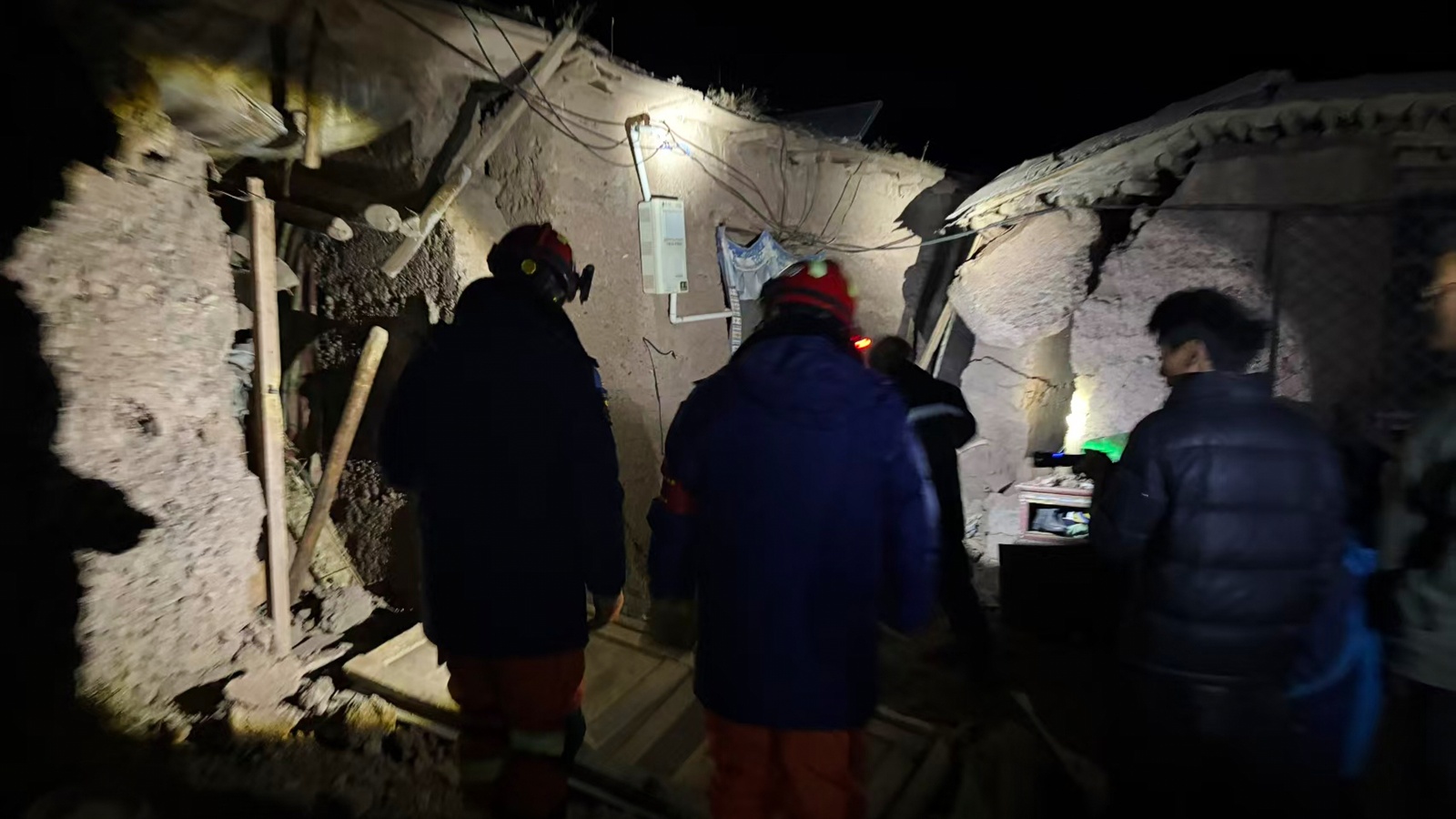
- Traditional Earth-and-Timber Construction: Load-bearing walls made of adobe, rammed earth, or stone paired with heavy roofs and wooden beams often lack strong lateral bracing and continuous diaphragm action. Under cyclic lateral loads, walls crack, shear, or lose bearing support for roof beams, leading to partial or full collapse.
- Unreinforced or Weakly Confined Masonry: Brittle wall materials fail diagonally under shear when lateral forces exceed mortar and bond strength, especially where heavy upper loads sit atop unbraced walls.
- Engineered Reinforced Concrete and Steel Frames: Properly detailed frames with ductile reinforcement and continuous load paths are designed to absorb inelastic deformation without total collapse, even when non-structural infill partitions crack or spall.
A reasonable engineering hypothesis for any unreinforced or mixed-age settlement hit by a shallow magnitude 7.0 shock is that collapse risk concentrates where heavy roofs meet unanchored walls or where older masonry sits on loose, saturated, or sloping ground. That is a structural inference based on mechanics, not a substitute for post-event structural inspection.
3. Terrain Instability and Lifeline Bottlenecks
High-relief mountain valleys and steep slopes turn ground shaking into secondary mass movement. Rockfalls, landslides, and roadbed subsidence can sever single-corridor mountain routes, delaying heavy equipment, ambulances, and utility repair crews. When power, water, or communications drop simultaneously, local commanders lose real-time situational awareness just as demand for triage and shelter spikes.
4. Altitude and Thermal Exposure
At high elevations—often above 4,000 meters across plateau settlements—cold air and thin oxygen alter the operational envelope of both survivors and responders. Damaged or collapsed homes strip away thermal insulation at the exact moment displaced residents face freezing wind and sub-zero nights. Cold stress accelerates hypothermia risk for anyone trapped, injured, or sleeping outdoors without insulated shelter, turning a structural event into a race against temperature.
Cause-and-Effect Chains That Drive Escalation
Breaking news lists incidents side by side; operational analysis links them into causal chains where one failure multiplies the next:
- Shallow Rupture -> High Peak Ground Acceleration: Short wave-travel distance preserves high-frequency energy near the epicenter, increasing lateral inertial forces on structures.
- Low Lateral Resistance -> Wall or Roof Collapse: Brittle walls or unanchored timber-to-wall joints fail first, creating heavy rubble where occupants are sheltering or exiting.
- Slope and Road Failure -> Aid Friction: Landslides and cracked pavement narrow or block access routes, forcing rescue teams and supplies to move slower or take longer detours.
- Shelter Loss + Cold Climate -> Secondary Morbidity: Lost roofs and broken windows expose survivors to cold night air, raising hypothermia and respiratory risks after the ground stops moving.
Operational Playbook for High-Risk Regions
Responding effectively to a major plateau quake requires disciplined sequencing rather than ad-hoc improvisation.
Phase 1: Immediate Life Safety and Triage (0 to 24 Hours)
- Execute Drop, Cover, and Hold During Shaking: Avoid sprinting across falling debris or standing beneath parapets, eaves, and overhead power lines while active ground motion continues.
- Map Access Before Dispatching Heavy Assets: Use aerial reconnaissance, satellite imagery, and scout teams to verify which mountain roads and bridges remain passable before committing convoys.
- Prioritize Thermal Protection Alongside Rescue: Pair search-and-rescue teams with insulated blankets, windproof shelters, and warm fluids so rescued and displaced people do not deteriorate from cold exposure.
Phase 2: Hazard Containment and Stabilization (Days 1 to 7)
- Account for Aftershocks in Entry Protocols: Treat every damaged building as unstable during aftershock sequences; use spotters and shoring before entering voids.
- Monitor Dams, Glacial Lakes, and Unstable Slopes: Inspect upstream water retention structures and cracked hillsides for secondary flood or slide threats.
- Establish Redundant Comms and Micro-Grid Power: Deploy portable satellite links and local generation at clinics and staging hubs to keep coordination running when grid lines fail.
Limitations and Trade-Offs
No response protocol eliminates risk completely. Remote mountain geography limits how fast heavy machinery can reach isolated villages, and severe weather can ground aircraft or slow convoy movement. Retrofitting every traditional structure ahead of time faces budget, heritage, and logistical constraints, while rushing permanent rebuilding without strict seismic detailing risks repeating the same failure mode in a future event.
Strategic Recommendation for Resilience Planners
Treat every magnitude 7.0-class high-plateau earthquake as a two-stage hazard—an acute structural shock followed immediately by a thermal and logistics bottleneck—and pre-position modular winterized shelter, off-grid communications, and rapid road-clearing kits in hub towns before the next rupture occurs. Pairing cold-weather logistics readiness with strict seismic reinforcement on vulnerable masonry and earth-timber housing addresses the true failure points that CCTV footage alone can never explain.
Watch the CCTV coverage of the Tibet earthquake
This video shows surveillance footage of people rushing out during the magnitude 7.0 Tibet earthquake, illustrating the immediate human reaction analyzed in the article.


