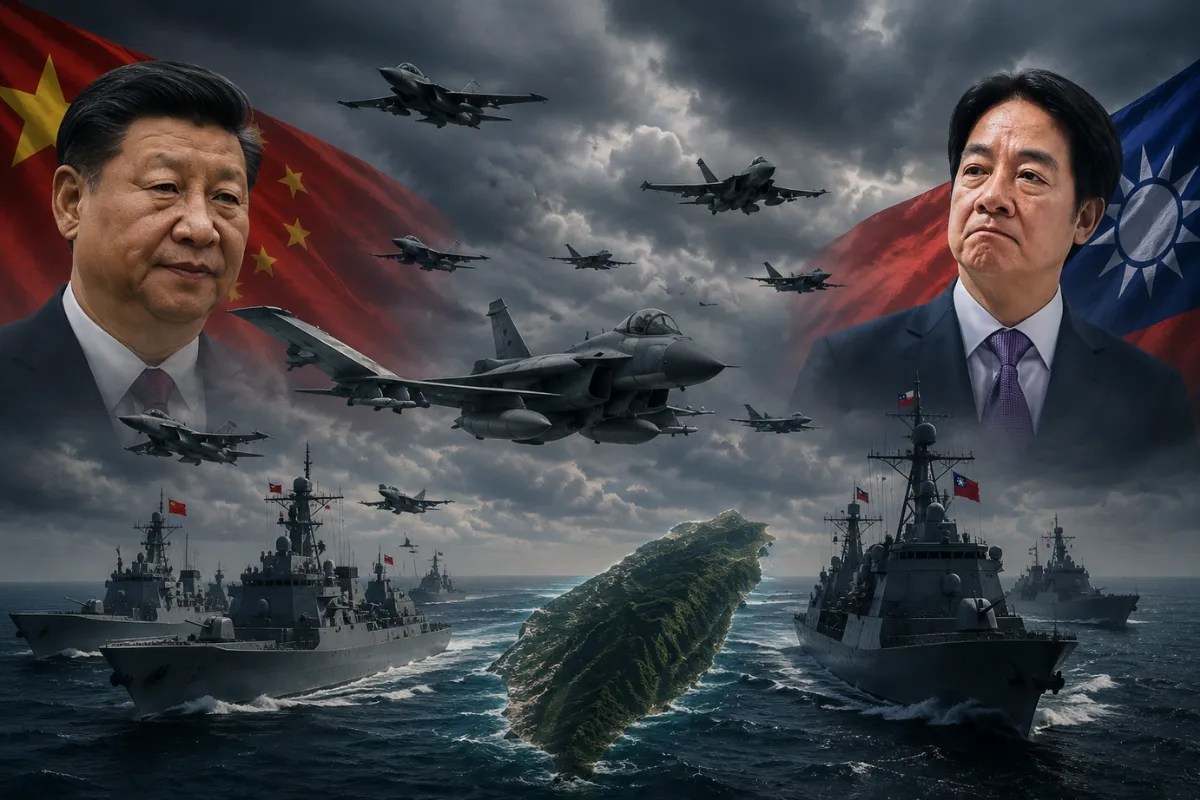
The morning over the Taiwan Strait rarely arrives with a roar. It begins with a soft, gray haze that blurs the line between the sky and the sea. For the fishermen launching their boats from the coast of Hsinchu, this stillness is a deceptive gift. They check their nets, sip bitter tea from metal flasks, and watch the horizon.
Then comes the sound.
It is a low, tearing rumble that vibrates in the chest before it hits the ears. Nine metal shapes slice through the clouds. Chinese fighter jets. They do not drop bombs. They do not fire missiles. They simply cross an invisible line in the air, linger just long enough to register on radar screens in Taipei, and vanish back into the mist.
To the rest of the world, scanning headlines on a smartphone screen, this is just another blip in the global news cycle. We read about the Middle East, we worry about rising inflation, and then we see a brief note about nine jets in Asia. We scroll past. It feels distant. It feels like a chess game played by billionaires and bureaucrats.
But geography dictates destiny. For the twenty-three million people living on a sweet-potato-shaped island, those nine jets are not a headline. They are the sound of a clock ticking.
The Invisible Line That Keeps the Peace
Imagine drawing a line down the center of your living room. You and your neighbor have agreed, without ever signing a formal contract, that stepping over that line means trouble. For decades, the Taiwan Strait Median Line served as that unspoken boundary. It is an imaginary demarcation, a gentleman's agreement born in the Cold War, meant to keep two heavily armed sides from making a fatal mistake.
Now, look at what happened on a seemingly ordinary Tuesday. Nine Chinese military aircraft—including advanced J-11 and J-16 fighters—did not just fly near Taiwan. They crossed that median line.
To understand why this matters, we have to look past the steel and the speed of the aircraft. This is psychological warfare disguised as routine training. When a nation repeatedly crosses an established boundary, the boundary ceases to exist. It is an exercise in normalization. The goal is to make the extraordinary feel ordinary. If you see a wolf at your garden gate every single morning, eventually you stop calling the police. You just accept that the wolf lives there now.
But the danger of normalization is that it erases the margin for error.
Military pilots fly at supersonic speeds. When nine combat-ready aircraft enter a highly restricted air defense identification zone (ADIZ), young Taiwanese pilots are forced to scramble their own jets. They climb into their cockpits, hearts hammering, knowing that a single mechanical failure, a misunderstood radio transmission, or a twitch of a finger could ignite a global conflagration.
The View from the Balcony
Let us ground this geopolitical abstraction in a real space. Consider a young woman named Mei-ling. She is twenty-eight, works at a semiconductor firm in Tainan, and spends her Tuesday evenings sitting on her balcony, listening to indie pop through her headphones.
When the roar of the interceptor jets echoes overhead, she does not run for a bomb shelter. She does not even drop her phone. She simply looks up, watches the white vapor trails fade into the twilight, and sighs.
This is the true weight of the conflict. It is not the sudden explosion; it is the slow, grinding erosion of peace. Mei-ling’s generation has never known war, yet they have never known absolute security either. They live in a permanent state of geopolitical limbo. They buy apartments, they plan weddings, they invest in stocks, all while knowing that their entire world sits on a fault line.
The human mind is remarkably adaptable. It can normalize almost anything. But that adaptation comes at a cost. It creates a quiet, background anxiety that colors every decision. Do you start a long-term business when a superpower claims the ground beneath your feet? Do you bring children into a world where the sky can turn hostile in a matter of minutes?
The competitor articles focus on the numbers. Nine jets. Two nations. One strait. They miss the girl on the balcony. They miss the fact that every time those jets cross the line, a collective shudder runs through twenty-three million lives.
A Chain Reaction Across the Globe
It is easy to look at the map and assume this is a localized family feud. China views Taiwan as a breakaway province; Taiwan views itself as a self-governed democracy. That is the standard narrative.
But the world is no longer a collection of isolated islands. We are bound together by invisible threads of trade, technology, and treaty.
Consider the device currently in your hand. The microchips that power your smartphone, your laptop, your car, and even your refrigerator likely originated in a factory just a few miles from where those Chinese jets flew. Taiwan produces over sixty percent of the world’s semiconductors, and over ninety percent of the most advanced chips.
A conflict in the Taiwan Strait would not just be a humanitarian disaster; it would instantly paralyze the global economy.
Factories in Michigan would grind to a halt. Hospitals in London would face shortages of medical equipment. The digital infrastructure of the modern world would suffer a stroke. This is the irony of our interconnected age: a dispute over a tiny stretch of water in Asia can determine whether a factory worker in Ohio can pay their mortgage next month.
The stakes are not localized. They are total.
The Weight of the Past
We cannot understand the present without acknowledging the ghosts of history. This is not a sudden tantrum by a modern government. It is the continuation of a story that began in 1949, when the Chinese Nationalist government fled to Taiwan after losing a brutal civil war to the Communists.
For decades, both sides claimed to be the rightful rulers of all of China. But as time passed, Taiwan transformed. It shed its authoritarian past and blossomed into one of the most vibrant, progressive democracies in Asia. It built an identity rooted in free speech, open elections, and human rights.
This transformation created a fundamental ideological rift. To the leadership in Beijing, a successful, democratic, Chinese-speaking society right on their doorstep is an existential critique of their own authoritarian model. It proves that democracy is not a Western luxury, but a viable path for Chinese people.
Therefore, the pressure must be maintained. The gray-zone warfare—the cyberattacks, the economic coercion, and the nine fighter jets—is designed to convince the people of Taiwan that their democracy is an unsustainable dream. It is an attempt to break their will without firing a single shot.
The Strategy of the Slow Squeeze
If a nation intends to invade another, it usually builds up forces on the border, issues ultimatums, and strikes with sudden fury. We saw this in Eastern Europe.
But the strategy in the Taiwan Strait is different. It is a slow squeeze. It is the tactical use of fatigue.
By sending aircraft across the median line week after week, month after month, Beijing forces the Taiwanese military to burn through its resources. Jets require maintenance. Fuel costs money. Pilots get tired. Every scramble wears down Taiwan’s smaller air force just a little bit more.
It also tests the resolve of the international community. The first time jets cross the line, the world expresses outrage. The tenth time, it makes the evening news. The hundredth time, nobody notices.
But we must notice.
The moment we stop paying attention to the slow squeeze is the moment the danger reaches its peak. Because the real threat is not a grand, cinematic invasion like D-Day. The real threat is a miscalculation. A mid-air collision between a Chinese fighter and a Taiwanese interceptor. A panicked pilot squeezing a trigger. A radar operator misinterpreting a defensive maneuver as an attack.
In a crowded sky filled with supersonic weapons, peace relies entirely on perfect behavior from every single actor. And human beings are rarely perfect.
The Sound That Lingers
The sun sets over the strait, painting the water in shades of bruised purple and gold. The nine jets are gone, back to their bases on the mainland, their engines cooling on the tarmac. In Taipei, the night markets come alive. The smell of stinky tofu and fried chicken fills the air. Neon signs flicker to life, casting a kaleidoscope of light over crowded streets.
People laugh, drink beer, and argue about politics. On the surface, life is vibrant, chaotic, and defiantly normal.
But look closer at the faces in the crowd. Listen to the conversations. The awareness is always there, lurking just beneath the surface like a cold current in a warm sea. They know that the peace they enjoy tonight is a fragile thing, suspended by a thread that is being pulled tighter with each passing day.
The story of Taiwan is not a story of statistics or military hardware. It is a story of ordinary people stubborn enough to build a beautiful life in the shadow of a giant. They do not ask for pity. They ask for witness.
As the night deepens, the ocean waves continue to lap against the shore, a steady, rhythmic pulse that has outlasted empires and will outlast ideologies. For now, the sky is empty. But tomorrow, the mist will rise again, and the horizon will offer no promises.


