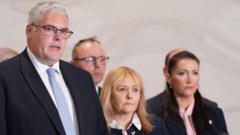
The rain in Belfast does not just fall. It bleeds into the stone, turning the grand, sweeping facades of Stormont into a heavy, dark gray canvas. Up on the hill, the Parliament Buildings look imposing, an architectural fortress designed to project permanence, authority, and safety. Inside those long, echoey corridors, politicians walk with a deliberate, hurried stride, their polished shoes clicking against the marble floor.
To the casual observer, it is a theater of governance. But lately, the air inside the grand halls has felt different. It is thick with an uncomfortable, suffocating silence.
Away from the cameras, outside the meticulously manicured lawns of the estate, sits a small terrace house in a working-class neighborhood. Let us call the woman who lives there Sarah. She is not a politician. She does not write press releases. She is a mother, sitting at her kitchen table, staring at a laptop screen. For Sarah, the phrases flashing across the news alerts—words like "safeguarding protocols," "internal reviews," and "party governance"—are not abstract political jargon. They are a matter of life, death, and the fundamental safety of her children.
When a political party stumbles into a crisis involving safeguarding, the immediate reaction from the political machine is containment. Defensive walls go up. Legal teams draft carefully worded statements. But for the public, every redacted line in a report feels like a personal betrayal. The current political storm enveloping the Democratic Unionist Party (DUP) over its internal safeguarding mechanisms has transcended standard partisan bickering. It has exposed a profound, aching vulnerability at the very heart of Northern Irish public life.
The Weight of the Unspoken
For months, the pressure has been building. Rival political parties across the Stormont spectrum—Sinn Féin, the Alliance Party, the SDLP, and the Ulster Unionist Party—have dropped their usual constitutional battle lines to unite on a single, urgent demand. They want full transparency. They want to know who knew what, when they knew it, and exactly how allegations were handled within the region's largest unionist party.
Consider the mechanics of political power. A political party is not just an ideological club; it is a massive institution that interacts with thousands of ordinary citizens, volunteers, and vulnerable individuals. When questions arise about how such an institution protects people, the stakes could not be higher.
The human mind naturally seeks patterns to make sense of chaos. When information is withheld, the imagination fills the void with the worst possible scenarios. This is the exact crisis of trust currently unfolding. The demand for openness is not merely a tactical move by political opponents to score points before an election, though the cynical might view it that way. For many inside and outside the halls of power, it is a desperate attempt to rescue the concept of institutional integrity.
Imagine the sheer exhaustion of the Northern Irish electorate. For decades, people here have been asked to move past political gridlock, to trust the process, to believe that the institutions built after the peace process are capable of serving them. But trust is an incredibly fragile thing. It takes a generation to build and less than a second to shatter. When a major political entity faces intense scrutiny over how it handles the most sensitive of human issues, and chooses to keep the details behind closed doors, it sends a chilling message to the public: the institution matters more than the individual.
The Anatomy of an Emergency Meeting
Behind the heavy wooden doors of Stormont’s committee rooms, the atmosphere in recent weeks has been described by insiders as electric with tension. Opposing MLAs sit across from each other, not arguing about borders or budgets, but about the fundamental duty of care.
During these sessions, the language used by party representatives can often sound clinical. They talk of "independent audits" and "robust frameworks." But look closer at the faces in the room. Notice the tightened jaws, the furious scribbling on note pads, the glances toward the public gallery. Everyone in that room knows that the eyes of the public are watching, looking for any sign of a cover-up.
The real problem lies elsewhere, far from the grand committees. It rests in the community centers, the church halls, and the local advice clinics where political parties interact with real people. If a citizen cannot feel secure walking into a constituency office, the entire democratic experiment begins to unravel.
The DUP has insisted that its processes are being updated, that it takes these matters with the utmost seriousness, and that internal investigations are underway. In the world of crisis management, this is standard protocol. But standard protocol is no longer enough when the public's faith has dropped below zero. The demand from rival parties for an entirely independent, external oversight mechanism is a symptom of a deeper disease: a total collapse of peer-to-peer trust within the executive.
A System Built on Shifting Sand
To understand how we arrived at this point, one must look at the unique psychology of Northern Irish politics. For years, survival was the only metric that mattered. Parties were built like fortresses, designed to withstand external attacks from political rivals and sectarian critics. In that siege mentality, internal dissent was discouraged, and internal problems were often handled quietly, away from the prying eyes of the press.
But the world has changed. The public is no longer willing to accept the old ways of doing business. The modern citizen demands a level of accountability that the old structures were never designed to provide.
What happens when the old fortress mentality meets the unstoppable force of public scrutiny? The walls begin to crack.
The current standoff over safeguarding transparency is a classic example of this institutional collision. On one side, you have a political party trying to navigate a deeply sensitive internal crisis without causing its own collapse. On the other side, you have a public and a political opposition that recognize that some issues are too important to be hidden behind the veil of party privacy.
It is an agonizing spectacle to watch. For the victims of any safeguarding failure, the political circus surrounding their trauma must feel like a secondary injury. Their experiences are parsed by lawyers, debated by pundits, and used as ammunition in late-night television arguments. In the middle of all the noise, the human element—the actual pain, the fear, the desire for justice—is constantly at risk of being obscured by the glare of the studio lights.
The Cost of the Closed Door
Let us return to Sarah at her kitchen table. She is not interested in which party wins the next seat or who gives the most blistering performance at the podium. She wants to know that if her child ever enters a public space, or interacts with a person in a position of authority, there is a system in place that will protect them without fear or favor.
When she sees politicians dodging questions or hiding behind the phrase "ongoing internal processes," her heart sinks. To her, a closed door does not look like a legal necessity. It looks like a hiding place.
This is the invisible cost of the transparency deficit. Every time a political figure evades a direct question about safeguarding, a little bit more of the social contract erodes. People begin to check out. They stop voting. They stop participating in community initiatives. They come to the cynical, damaging conclusion that all institutions are corrupt and that looking out for oneself is the only logical choice left.
The leaders of the DUP face an incredibly difficult path. They must balance legal responsibilities with an overwhelming moral obligation to the public. But the consensus building among their peers at Stormont is clear: the time for internal curation is over. The demand for full disclosure is not going away. It will follow them into every press conference, every committee meeting, and every constituency door-knock until it is answered.
The rain continues to beat against the windows of the Stormont estate, washing over the statues of past leaders who thought their legacies were etched in unyielding stone. But legacies are not made of stone. They are made of trust. And right now, in the gray light of a Belfast afternoon, that trust is washing away, leaving behind a stark, unavoidable truth: an institution that cannot bear the light of day has no right to demand the public’s faith.