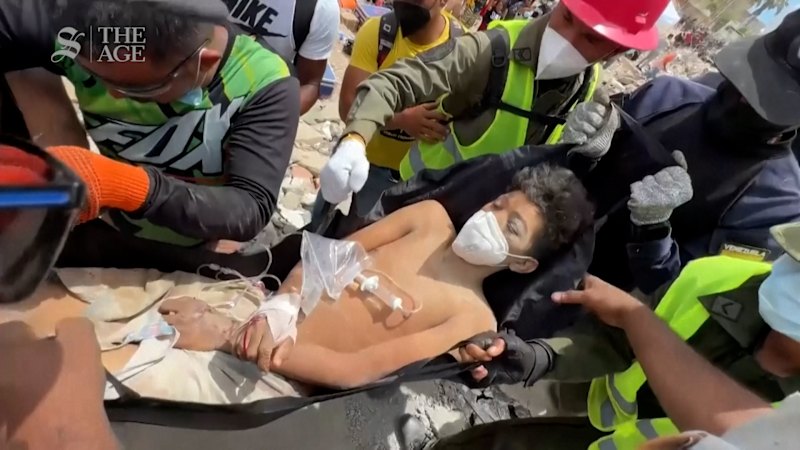
The silence that follows a massive earthquake is not a peaceful thing. It is heavy, thick with the smell of ruptured gas lines, pulverized concrete, and the bitter dust that settles over everything like gray snow. In the immediate aftermath, your mind clutches at small, absurd details. You notice a plastic shoe resting on top of a collapsed cinderblock wall. You notice a dog barking three streets over, entirely indifferent to the fact that the street layout no longer exists.
Then comes the real weight. The realization that the silence isn't just the absence of sound. It is the sudden, terrifying absence of people.
When news wires flash statistics across glowing screens—"70,000 reported missing"—the human brain naturally recoils from the sheer magnitude of the number. It is too vast. It becomes an abstract data point, a column in a spreadsheet, a logistical headache for international relief agencies. We read the headline, feel a momentary prickle of long-distance sympathy, and scroll onward.
But seventy thousand is not a statistic. It is seventy thousand individual dinner tables suddenly left empty. It is seventy thousand phones ringing out into the void, vibrating against the rubble until their batteries die.
To understand what is happening on the ground right now, we have to look past the macro-level disaster reporting and focus on the quiet, agonizing reality of the search.
The Geography of Disappearance
Earthquakes do not strike evenly. They exploit the pre-existing fractures in a society, tearing through the poorest neighborhoods with a violent, discriminatory precision. In Caracas and the surrounding valleys, the informal settlements known as barrios cling to the steep hillsides. These are homes built by hand over decades, stacked precariously on top of one another like houses of cards. When the earth bucked, these hillsides didn't just shake; they liquified.
Consider a hypothetical resident—let us call her Elena. Elena is twenty-four, working a shift at a small grocery store in the center of the city when the first 7.2-magnitude tremor hits. The ground rolls beneath her feet like the deck of a ship. She survives because the commercial building she is in was retrofitted a decade ago.
But her thoughts immediately sprint up the mountain, toward the barrio of Petare, where her mother and four-year-old son were watching afternoon cartoons.
When Elena tries to call, the network is dead. When she tries to take the transit system, the power is out. So she walks. She joins a river of thousands of people walking, then running, toward the plumes of dust rising from the hills. By the time she reaches the entrance of her neighborhood, the landscape is unrecognizable. Entire tiers of houses have slithered down the ravine, burying the roads beneath millions of tons of mud and brick.
This is where the sixty-nine thousand plus missing people are. They are not merely misplaced; they are trapped behind a wall of physical and logistical impossibility.
The scale of this missing-persons crisis is compounded by a bitter reality: Venezuela’s infrastructure was already buckling long before the fault lines slipped. Emergency services face a catastrophic shortage of heavy machinery, fuel, and specialized search equipment. In many neighborhoods, the rescue effort does not consist of yellow excavators and highly trained canine units. It consists of neighbors, standing in a line, passing chunks of broken concrete down a human chain using nothing but their bare, bleeding hands.
The Anatomy of the Search
Every rescue operation operates against a ticking clock known grimly as the golden window. This is the first seventy-two hours, during which the probability of finding survivors beneath the rubble is highest. After that, dehydration, crush injuries, and exposure turn the search from a rescue mission into a recovery operation.
But how do you search an area where the buildings have compressed into a fraction of their original height?
Rescuers use a technique called acoustic calling. A team will stand atop a pile of debris, signal for absolute silence across the entire sector, and shout into the cracks. Then, they listen. They press their ears to the concrete, hoping for a faint tap, a muffled cry, or the scraping of a stone.
It is a psychological torture of the highest order. The wind shifts, a loose piece of corrugated iron rattles, and a hundred hearts skip a beat, thinking it is a sign of life. Most of the time, it is just the mountain settling.
The sheer volume of the missing has completely overwhelmed the traditional systems of identification and tracking. Hospitals are overflowing, operating by flashlight and treating patients in courtyards because the structural integrity of the buildings themselves is suspect. Without central registries up and running, families are forced to wander from clinic to clinic, carrying crumpled photographs, asking anyone in a medical smock if they have seen a boy with a scar on his knee or an elderly man with a silver watch.
This is the invisible stake of the disaster. The physical damage can be measured in billions of dollars, but the psychological trauma of the unknown is unquantifiable. Living in the limbo of a missing relative is a unique form of grief. It is a door that cannot be closed. You cannot mourn, because mourning feels like giving up hope. You cannot move forward, because you are anchored to the spot where you last saw them smile.
The Long Road Back
As the days blur together, the nature of the crisis shifts. The initial shock gives way to the grinding reality of displacement and disease. Clean water becomes more valuable than gold. Broken water mains mix with sewage, creating a breeding ground for waterborne illnesses that threaten to claim more lives than the initial tremors.
The international community has begun to respond, but sending aid into a complex political environment is never straightforward. Cargo planes land at the airport, but translating those pallets of medical supplies, water purification tablets, and heavy rescue gear into actual relief on the hillsides requires a logistical miracle. Roads are cracked open like mirrors; bridges have slumped into rivers.
But amid the devastation, a profound and stubborn resilience has emerged. The very informal networks that built these neighborhoods are now keeping them alive.
Community kitchens have sprung up in areas untouched by the landslides. People who have lost everything are sharing their meager rations with those who have lost even more. Volunteer engineers are moving from block to block, risking their lives to assess which structures can still hold weight and which might collapse with the next aftershock.
The story of Venezuela right now is not merely a story of tectonic destruction. It is a story of human endurance stretched to its absolute absolute limit.
Elena is still up on that hillside. It has been four days. Her fingernails are gone, her hands are caked in dried mud, and her voice is hoarse from screaming names into the dirt. She has not slept more than an hour at a time. Every time her eyes close, she feels the ground shake again.
She is still digging. And around her, thousands of others are doing exactly the same thing, refusing to let the seventy thousand remain a number.
The earth has done its worst. Now, the slow, agonizing, and beautiful work of human love begins under the hot tropical sun, one stone at a time.