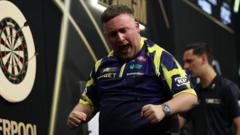
The air inside the M&S Bank Arena in Liverpool doesn't just sit there. It vibrates. It is a thick, boozy soup of adrenaline, chants, and the rhythmic thud of tungsten meeting sisal. For most people, this environment is a sensory assault. For a teenager with a mop of brown hair and the weight of a nation’s expectations on his shoulders, it is simply the office.
Luke Littler walked onto that stage on a Thursday night in April with the swagger of a man who has lived three lifetimes, despite having only recently acquired a driver's license. The narrative following him into Liverpool was one of narrow misses. He had been the story of the Premier League Darts season, yet the weekly titles—the tangible proof of dominance—had been frustratingly elusive.
Across the oche stood the establishment. Luke Humphries, Michael van Gerwen, and specifically, Jonny Clayton. Clayton represents the old guard of the darting world: steady, methodical, and possessing a rhythmic grace that can lull opponents into a false sense of security before he strikes with a clinical double.
The gap between them in the standings wasn't just a matter of points. It was a matter of psychological territory.
The Anatomy of a High-Pressure Dart
To understand why Littler’s performance in Liverpool mattered, you have to understand the physics of a breakdown. In professional darts, the target is roughly the size of a fingernail. When you are standing 7 feet, 9 and a quarter inches away, that target looks like a speck.
Most players, when they feel the breath of a rival on their neck, start to "snatch." Their elbow drops a fraction of an inch. Their grip tightens. The dart fishtails in the air.
Littler doesn't snatch.
During his quarter-final clash with Gerwyn Price, the crowd was a factor. The "Iceman" Price thrives on villainy, but in Liverpool, the fans had chosen their protagonist. Every time Littler stepped up, the room swelled. Every time Price aimed, the boos sharpened into a point. It is a brutal way to make a living.
Littler navigated this not by ignoring the noise, but by riding it. He dispatched Price with a 6-3 victory that felt more like a statement of intent than a mere match. He wasn't just hitting trebles; he was hitting them with a terrifying lack of hesitation.
The Invisible Stakes of the League Table
By the time the semi-finals rolled around, the math began to haunt the arena. The Premier League is a marathon designed to break your spirit. You play week after week, city after city, constantly clawing for a spot in the top four to make the playoffs at the O2.
Jonny Clayton was the man holding the line. He was the barrier Littler needed to breach to breathe comfortably. If Clayton won, the gap would widen, and the "Littler Revolution" would start to look like a flash in the pan—a child prodigy who couldn't handle the grind of the professional circuit.
The match between them was a study in contrasts. Clayton was the metronome. Littler was the lightning strike.
There is a specific moment in a darts match where you can see the soul of a player exit their body. It usually happens after a "bounce out" or a missed double at a crucial leg. For Clayton, that moment came when Littler started finding the "lipstick"—the treble twenty—with such regularity that it seemed the board was magnetized.
Littler’s 6-3 win over Clayton wasn't just a win. It was a demolition of the standings. He didn't just cut the gap; he essentially vaporized it, moving himself into a position where his playoff destiny was firmly in his own hands.
The Final Boss and the Echo of the World Championship
The final pitted Littler against Nathan Aspinall. "The Asp" is a fighter. He plays with his heart on his sleeve, often looking like he’s engaged in a street brawl rather than a game of precision.
But Liverpool belonged to the kid.
The scoreline finished 6-3. Again. That symmetry tells a story of a player who has found his cruising altitude. Throughout the night, Littler’s scoring average hovered in the stratosphere, often peaking well above 100.
Consider the mental fortitude required to do this. A seventeen-year-old is typically worried about exams, or social circles, or the creeping uncertainty of adulthood. Littler is worried about the trajectory of a 22-gram piece of metal while ten thousand people scream his name and millions more watch on television, waiting for him to fail so they can say "I told you so."
He didn't fail. He won the night. He took the five points. He took the £10,000 winner's check. But more importantly, he took the psychological high ground.
Why We Can't Look Away
We are drawn to Luke Littler because he represents a defiance of the natural order. We are told that mastery takes decades. We are told that pressure is something you learn to manage through years of failure.
Then comes a boy who treats the most pressurized stage in sports like a Sunday afternoon in his backyard.
The win in Liverpool changed the gravity of the Premier League season. It shifted the conversation from "Can he keep up?" to "Who can possibly stop him?" The gap to Clayton is gone, replaced by a looming shadow that Littler is casting over the entire top four.
As he walked off the stage, clutching the nightly trophy, he looked less like a tired athlete and more like a kid who had just finished a video game and was looking for the next level. There was no exhaustion in his eyes. Only a quiet, terrifying boredom with the idea of losing.
The crowd began to filter out into the cool Liverpool night, the chants of "Wonderland" still echoing off the Mersey. Inside the arena, the lights dimmed, leaving only the dartboard illuminated in the dark. It sat there, scarred by thousands of tiny holes, a silent witness to the fact that the hierarchy of the sport had just been rewritten by a teenager who refuses to believe in the concept of nerves.
He isn't just playing a game. He is colonizing a sport, one treble at a time.