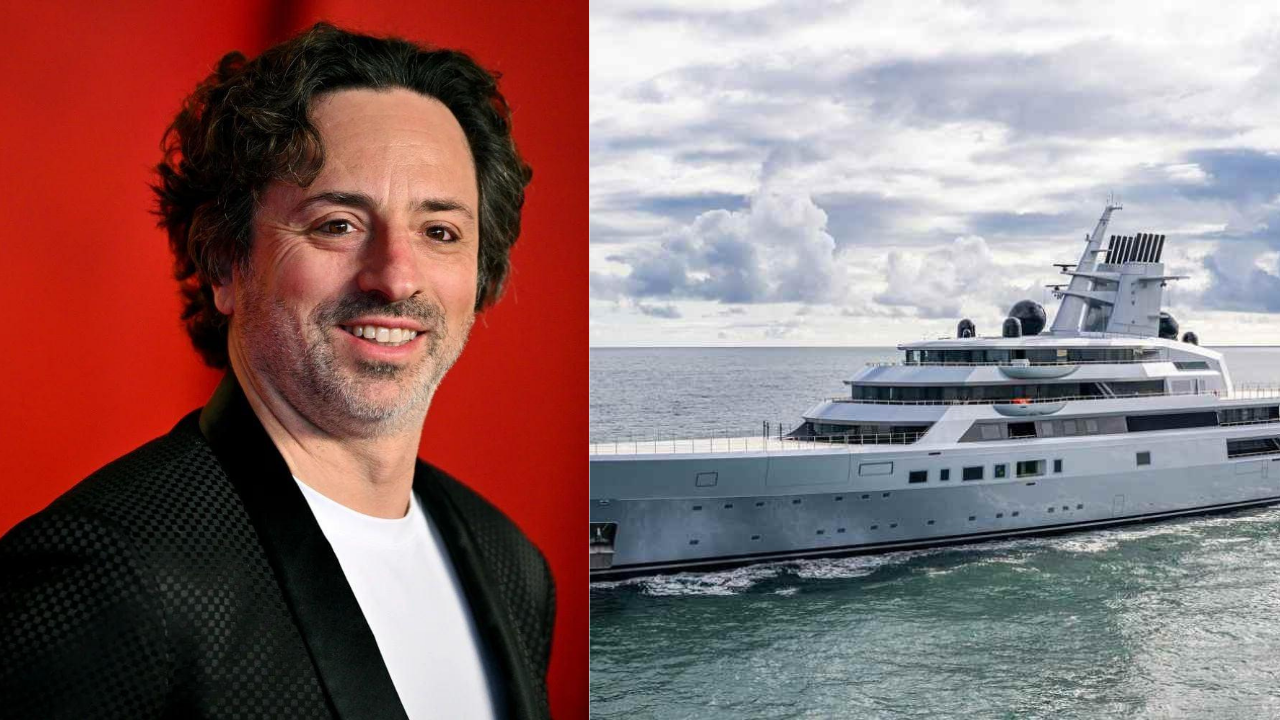
The tech media loves to gawk at billion-dollar toys disguised as productivity tools. When word spread that Google co-founder Sergey Brin retooled his $450 million floating megastructure into a high-seas corporate office—complete with a dedicated work deck, satellite uplinks, and custom workstations—the usual commentators fell inline. They called it the ultimate remote work flex. They framed it as the future of executive freedom, a masterclass in merging ultra-luxury with high-stakes decision-making.
They got it completely backward.
Brin’s oceanic command center isn't a blueprint for the future of work. It is an extraordinary, quarter-billion-dollar coping mechanism for executive isolation. It represents the logical endpoint of a deeply flawed management philosophy: the belief that if you throw enough bandwidth, physical isolation, and bespoke ergonomics at a problem, you can detach leadership from the messy, chaotic reality of human organizations without losing operational edge.
I have spent fifteen years consulting for founders who built empires only to retreat into high-walled sanctuaries, convinced they could pilot complex organizations via proxy. The result is almost always the same. Friction drops to zero, comfort climbs to infinity, and strategic alignment quietly rots from the inside out.
The Myth of the Isolated Genius Deck
The narrative surrounding Brin's vessel assumes a fundamental falsehood: that executive work is primarily about focused, uninterrupted deep-work time that benefits from complete detachment from the mainland.
It sounds romantic. You sit on a custom teak deck, three hundred miles off the coast of Baja, staring into the azure horizon while reviewing quarterly architecture docs or steering quantum computing initiatives over high-throughput satellite arrays. No line-level engineers barging into your office. No middle management noise. Just pure, unadulterated strategic thought.
This relies on a total misunderstanding of what high-level tech leadership actually requires.
Executive decision-making in multi-hundred-billion-dollar enterprise ecosystems is not an academic exercise performed in a vacuum. It relies on ambient organizational signal. It demands the uncomfortable, unscripted hallway run-ins, the body language in a tense product review, and the unfiltered subterranean panic of a team that knows a launch is failing before the dashboard metrics turn red.
When you move your office to international waters, you filter out 99% of that ambient noise. But that "noise" is precisely where truth lives. What you are left with is a sanitized stream of polished decks, curated updates, and yes-men filtering bad news through a three-layer buffer to avoid disrupting the founder's maritime flow state.
You haven't built a superior workspace. You've built a multi-million-dollar echo chamber with an engine room.
The Bandwidth Lie and Maritime Latency
Let's address the technical absurdities that tech journalists gloss over when salivating over floating headquarters.
The puff pieces point to low-Earth-orbit satellite constellations and redundant marine communications arrays as proof that a superyacht can operate with the exact same operational cadence as a terrestrial office in Mountain View or Zurich.
Anyone who has ever managed distributed infrastructure knows this is a fantasy.
- Latency is more than ping times: While LEO networks have dramatically dropped round-trip ping times, marine communications are subject to constant dynamic degradation. Vessel motion, atmospheric interference, and antenna handover cycles introduce jitter and micro-packet loss.
- Asymmetric reality: Uploading massive datasets, reviewing raw model outputs, or conducting high-fidelity async design reviews over marine links remains an exercise in frustration compared to terrestrial dark fiber.
- The cognitive tax of lag: Video calls over high-latency marine connections suffer from subtle, sub-second delays. Social neuroscientists have repeatedly shown that micro-delays in digital communication disrupt human rapport, increase cognitive fatigue, and cause participants to perceive their conversational partners as less transparent and less trustworthy.
When a founder is sitting on a boat, every digital interaction carries a micro-tax of artificial distance. Over months, that distance distorts perception. You begin to treat the company as a software simulation rather than a collection of living, breathing human systems.
The Luxury Isolation Paradox
There is an inverse relationship between physical comfort and strategic sharpness.
When you strip away all physical friction, you inadvertently strip away the exact environmental pressures that sharpen human instinct. A floating palace designed to cushion every physical need creates a state of systemic sensory deprivation.
[High Environmental Friction] -> [High Ambient Signal] -> [Sharp Tactical Adaptation]
[Zero Environmental Friction] -> [Sanitized Data Streams] -> [Strategic Drift]
Consider what happens when you attempt to run high-stakes operations from a vessel where an entire crew of forty people exists solely to anticipate your basic physical needs. Every interaction in your immediate environment is subservient, frictionless, and carefully managed.
Then, you switch tabs on your monitor to review a failing product line or an internal rebellion over corporate direction.
The dissonance is jarring. The founder's tolerance for organizational friction plunges toward zero. Problems that require deep, uncomfortable, hands-on intervention are pushed aside because they clash with the serene, frictionless reality of the floating sanctuary. The yacht does not empower the executive to solve hard problems; it gives them an ironclad excuse to ignore them.
What the Superyacht Hype Really Signifies
The glorification of the floating office is a symptom of a broader corporate pathology: the elevation of founder autonomy over organizational health.
We have entered an era where hyper-wealthy tech figures treat company oversight like a remote video game. They want the authority of a central planner with the personal exposure of a ghost. They want to issue decrees from international waters, insulated from the cultural, legal, and operational fallout of their decisions.
This is not a triumph of remote work technology. It is a failure of leadership accountability.
The true cost of this setup isn't the $450 million capital expenditure on the hull, nor is it the tens of millions in annual fuel and maintenance costs. The real cost is borne by the organization left behind on dry land—an organization led by a phantom who views their struggles through a glass-bottom floor, isolated from the very dirt that built the enterprise in the first place.
If you want to build a resilient, battle-tested organization, step off the yacht, close the executive suite, and get back into the room where the actual fires are burning.