The prevailing wisdom inside the Beltway is as dangerous as it is lazy.
For the past few years, defense intellectuals and naval strategists have championed a supposedly brilliant move to counter Beijing’s aggression in the South China Sea. The prescription? Send in the US Coast Guard.
The theory sounds elegant on paper. China uses its Coast Guard and maritime militia—the "little blue men"—to bully Philippine resupply missions and Vietnamese fishermen. Because these are civilian or paramilitary vessels, sending the US Navy to intervene looks like an overreaction that risks sparking a shooting war. Therefore, the US should deploy its own white hulls. By sending US Coast Guard National Security Cutters, the US can counter Beijing's gray-zone tactics with its own law-enforcement assets, de-escalating the friction while maintaining the rule of law.
This strategy is not clever. It is a strategic hallucination.
It misunderstands the nature of Chinese maritime power, underestimates the physical realities of naval confrontation, and actively cripples the US Coast Guard’s vital missions closer to home.
The Tonnage Delusion: White Hulls Are Not Equal
The entire "white-hull diplomacy" thesis rests on a fundamental misunderstanding of what the China Coast Guard actually is.
Western planners look at the US Coast Guard—a humanitarian, law-enforcement agency focused on search and rescue, drug interdiction, and environmental protection—and assume the China Coast Guard operates under a similar ethos. It does not. The CCG is a military branch under the direct command of the Central Military Commission.
More importantly, the CCG does not sail harmless police boats. They operate heavily armed, steel-reinforced behemoths designed specifically for naval ramming and intimidation.
Take the CCG’s Zhaotou-class cutters. At over 12,000 tons, these vessels are larger than US Navy Arleigh Burke-class guided-missile destroyers. They are specifically built to absorb and deliver physical impact.
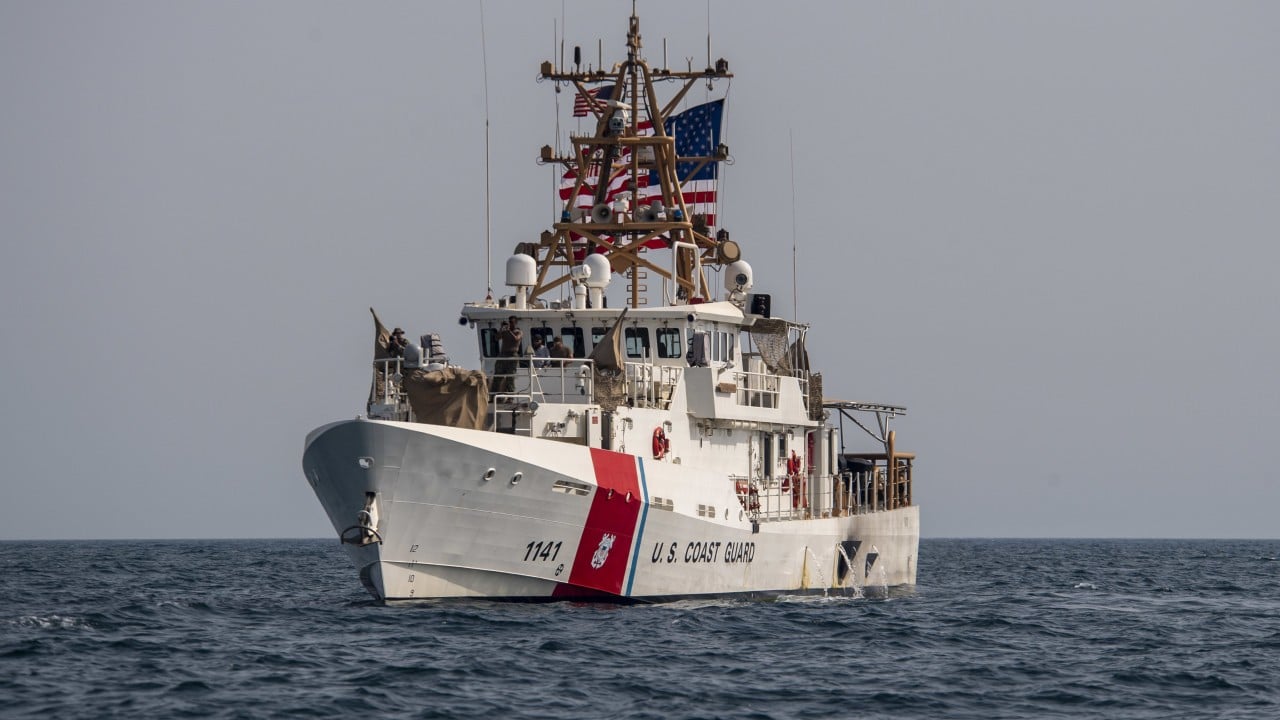
By contrast, the US Coast Guard’s premier deployment asset, the Legend-class National Security Cutter, displaces about 4,600 tons.
Vessel Comparison: Displacement & Armament
+-----------------------+------------------+-----------------------------+
| Vessel Class          | Displacement     | Primary Armament / Design   |
+-----------------------+------------------+-----------------------------+
| CCG Zhaotou-class     | ~12,000 tons     | 76mm main gun, reinforced   |
|                       |                  | hull for ramming            |
+-----------------------+------------------+-----------------------------+
| USN Arleigh Burke     | ~9,300 tons      | 5-inch gun, 96 VLS cells    |
+-----------------------+------------------+-----------------------------+
| USCG Legend-class NSC | ~4,600 tons      | 57mm gun, light armor       |
+-----------------------+------------------+-----------------------------+
When a Chinese 12,000-ton cutter decides to block or ram a US National Security Cutter, the laws of physics do not care about international maritime law. The USCG vessel will lose.
If the US vessel backs down, Beijing wins a massive propaganda victory, proving that American presence is a paper tiger. If the US vessel stays its course and suffers catastrophic structural damage, Washington is faced with a terrible choice: escalate with the US Navy, or swallow the humiliation.
By sending lightly armed Coast Guard cutters into a high-threat zone, the US is not de-escalating. It is presenting Beijing with a target that is easy to bully and incredibly difficult to defend.
The Domestic Collapse: Cannibalizing the Home Front
While strategists dream of projecting power in the Taiwan Strait, the real-world US Coast Guard is quietly suffocating from neglect at home.
The USCG is facing its worst recruiting crisis in decades. It is short thousands of active-duty personnel, forcing the service to lay up cutters and shutter stations along the US coastline. The cutters that are sailing are falling apart. The medium-endurance cutter fleet is, on average, over fifty years old. These ships are older than the crews sailing them. They suffer from frequent engine failures, asbestos issues, and structural fatigue.
The shipyard backlog is a national embarrassment. The offshore patrol cutter program is years behind schedule and billions over budget. The Polar Security Cutter program—intended to replace America’s single active heavy icebreaker, the fifty-year-old Polar Star—is a legendary disaster of design delays and ballooning costs.
In the middle of this existential domestic crisis, Washington decision-makers think it is wise to send pristine National Security Cutters on 10,000-mile deployments to the Western Pacific.
Think about the operational math. A single deployment to the South China Sea takes a cutter out of its primary operating areas in the Eastern Pacific or the Caribbean for months. It burns through precious crew hours, exhausts maintenance budgets, and subjects hulls to extreme wear and tear.
While a USCG cutter is playing chicken with Chinese fishing boats in the Spratlys, who is stopping the drug cartels in the transit zones? Who is patrolling the Bering Sea to protect American fisheries from Russian incursions? Who is conducting search and rescue in the brutal waters of the North Atlantic?
Every hour a US Coast Guard cutter spends in the South China Sea is an hour stolen from the defense of the American homeland.
The Deterrence Myth: Beijing Isn't Fooled by White Paint
The academic argument for sending the Coast Guard is that it represents a "proportional" response that reduces the risk of war. The idea is that Beijing will see a USCG cutter and think: "Ah, this is a law-enforcement action, not a military provocation. We must react with restraint."
This is pure projection.
Beijing does not distinguish between a US Coast Guard cutter and a US Navy destroyer when it comes to sovereignty disputes. To the Chinese Communist Party, any American government vessel operating within the First Island Chain is an instrument of US hegemony designed to contain China's rise.
In fact, Beijing exploits this distinction. They know that a US Coast Guard cutter lacks the air-defense capabilities, the anti-submarine warfare suites, and the offensive missile systems of a Navy surface combatant.
By sending a cutter, the US signals military weakness. It tells Beijing: "We want to show presence, but we are too afraid of escalation to send a real warship."
For an adversary that respects raw power and exploits hesitation, this is an invitation to push harder. It allows the Chinese maritime militia to employ aggressive water-cannon tactics, knowing that the US vessel lacks the organic defensive systems to retaliate without relying on a distant US Navy strike group for rescue.
The Treaty Trap: Legal Ambiguity as a Liability
The most dangerous aspect of this deployment strategy is the legal gray zone it creates under the US-Philippines Mutual Defense Treaty (MDT).
The MDT is clear: an armed attack on Philippine public vessels, aircraft, or armed forces in the Pacific or the South China Sea triggers US mutual defense obligations. But what happens if a US Coast Guard cutter is the one attacked?
If a Chinese Coast Guard vessel rams a USCG cutter, does that constitute an "armed attack"? What if they use high-powered military-grade lasers to blind the crew, or water cannons to shatter the bridge windows?
By relying on the Coast Guard, the US introduces a layer of tactical and legal ambiguity that Beijing is highly skilled at exploiting. The Chinese excel at staying just below the threshold of kinetic war. They will use non-lethal, highly destructive physical force to disable a USCG cutter, leaving Washington debating whether a water-cannon strike or a side-swipe collision qualifies as an "armed attack" under international law.
While US lawyers debate the semantics in Washington, the tactical defeat on the water becomes permanent.
Stop Trying to Cop-Op the South China Sea
If the United States wants to deter China in the Western Pacific, it must stop trying to do it on the cheap with maritime police officers.
The South China Sea is not a law-enforcement domain. It is a highly militarized, contested combat theater. Trying to resolve a territorial dispute involving the world’s largest navy with white-hulled law enforcement vessels is like bringing a megaphone to a gunfight.
If the US Navy is too busy or lacks the ship count to maintain a persistent presence in the South China Sea, the solution is to build more warships, fix the defense industrial base, and repair our drydocks. The solution is not to gut the US Coast Guard and sacrifice its domestic missions for a symbolic, ineffective deployment half a world away.
Bring the cutters home. Let them protect American waters, secure American borders, and rescue American mariners. Leave the gray-zone deterrence to the ships built to fight and win.