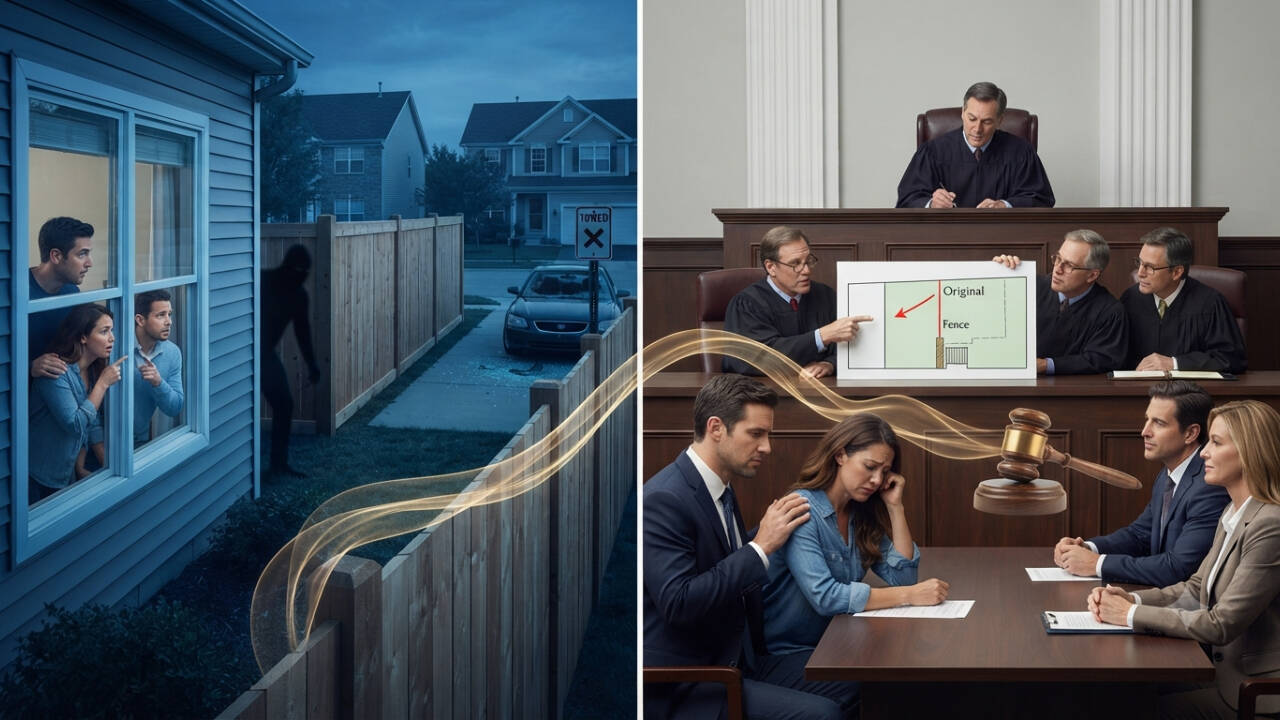
An Illinois appellate court recently ruled against homeowners who erected a perimeter fence without municipal permits following incidents of trespassing and vehicle theft on their property. The court affirmed that acute security threats and prior criminal victimization do not grant property owners an automatic exemption from local zoning ordinances, historic preservation codes, or homeowners association covenants. Even when local law enforcement fails to prevent repeated intrusions, courts routinely prioritize uniform administrative compliance over reactive, unpermitted physical fortifications.
This ruling exposes a widening fault line in American property law. Across suburban and urban municipalities, rising property crime rates are colliding head-on with rigid aesthetic and municipal zoning codes. Homeowners want physical barriers to deter opportunistic thieves. Local governments and neighborhood boards want uniform streetscapes, clear sightlines, and strict adherence to permitting bureaucracies. When those two impulses collide in a courtroom, the individual homeowner almost always loses.
The Anatomy of a Zoning Defeat
To understand why the Illinois court rejected the couple's appeal, you have to look at how appellate judges view municipal authority. Courts do not operate as neighborhood watch committees. They operate as arbiters of administrative procedure.
When a homeowner builds a fence in violation of height limits, setback requirements, or material restrictions—and does so without pulling a permit—they hand the municipality an open-and-shut case. In administrative law, the burden of proof shifts instantly to the violator. Arguing that the fence was necessary to stop car thieves or trespassers falls under the legal concept of necessity or self-help, neither of which holds weight against civil zoning enforcement.
The defense of necessity in property law is extraordinarily narrow. It generally applies to imminent, life-threatening emergencies—such as breaking down a neighbor's door to escape a spreading house fire. A past car theft, however traumatic or expensive, does not constitute an ongoing, immediate peril that justifies bypassing a city planning department. Judges view the permitting process itself as the proper remedy. If a homeowner believes standard six-foot backyard limits or front-yard prohibitions leave them vulnerable, the law requires them to apply for a zoning variance before digging a single posthole.
Why Variances Rarely Succeed on Security Grounds
On paper, the variance process looks like a reasonable safety valve. In practice, it is often a bureaucratic dead end for security-conscious residents.
Municipal zoning boards evaluate variance requests based on strict statutory criteria, primarily focusing on unique physical hardship. A classic example of physical hardship is a lot shaped like a steep triangle, or a parcel bisected by a rocky creek bed that makes standard building placement impossible. Crime is a social condition, not a topographical anomaly.
When a homeowner stands before a zoning board and argues that neighborhood car thefts justify an eight-foot wrought-iron perimeter fence, board members immediately ask a predictable question. If we grant you an exception because crime exists in this zip code, how do we deny the exact same exception to every single house on your block?
Because zoning boards cannot legally grant spot-exemptions based on generalized crime statistics, they routinely deny security-based variances. If the homeowner builds the fence anyway, hoping for forgiveness rather than permission, they enter a legal trap. Appellate courts review zoning board decisions under an abuse of discretion standard. As long as the local board followed its own rules and held a public hearing, the appellate court will uphold the denial, leaving the homeowner with court costs, daily accumulating fines, and a demolition order.
The Hidden Friction Between Municipal Codes and Crime Prevention
There is a deep irony in how local governments regulate residential fencing. Urban planners and police departments frequently promote a concept known as Crime Prevention Through Environmental Design, or CPTED. Yet standard municipal zoning codes routinely outlaw the exact physical features that security experts recommend.
Consider how standard residential zoning operates across most of the Midwest and the broader United States:
- Front Yard Restrictions: Most municipalities cap front-yard fences at three to four feet in height and require them to be at least fifty percent transparent, such as split-rail or spaced picket designs. A four-foot picket fence is a decorative boundary, not a security barrier. Any adult can step over it in less than two seconds.
- Setback Mandates: Corner lots face severe restrictions due to sight-triangle ordinances, which prohibit tall structures near intersections so drivers can see oncoming traffic. While intended for road safety, these rules leave corner-lot homes completely exposed to foot traffic and opportunistic thieves.
- Material Bans: Security-grade materials—such as high-gauge steel mesh, anti-climb finials, or solid masonry walls—are frequently banned in residential zones because planning commissions classify them as industrial or commercial in appearance.
Municipalities justify these rules through the doctrine of police power—the inherent authority of a government to regulate behavior and enforce order for the betterment of health, safety, morals, and general welfare. For over a century, following the landmark 1926 Supreme Court decision in Village of Euclid v. Ambler Realty Co., courts have ruled that preserving neighborhood aesthetics and property values falls squarely within a city's general welfare mandate.
To a city council, a fortress-like fence signals urban decay and lowers neighboring property assessments. To the homeowner whose vehicle was just stolen from their driveway, that same fence is basic self-preservation. The law sides with the tax base.
The Double Trap of Homeowners Associations
In newer subdivisions, the legal hurdles multiply. Even if a municipality has lenient fencing laws, private covenants, conditions, and restrictions (CC&Rs) enforced by a Homeowners Association operate as binding contract law.
When a buyer closes on a house in an HOA-governed community, they sign a contract surrendering significant autonomy over their exterior property. Unlike a city council, which must answer to constitutional due process and public voters, an HOA board answers primarily to its own governing documents.
If an HOA covenant bans perimeter fencing entirely to maintain an open, park-like aesthetic, a homeowner who installs a fence after a break-in is breaching a private contract. Courts enforce CC&Rs with ruthless consistency. Judges routinely rule that the homeowner voluntarily agreed to the aesthetic restrictions at the time of purchase, and a subsequent change in local crime rates does not void the contract. In many states, HOAs also possess statutory authority to place liens on properties for unpaid violation fines, turning a dispute over a backyard fence into a foreclosure threat.
What Homeowners Actually Get Wrong
After watching countless property disputes play out in state courts, a clear pattern emerges. Homeowners rarely lose these cases because their fears are irrational. They lose because their legal strategy is reactive rather than procedural.
The fatal mistake is unilateral construction. Once concrete is poured and fence panels are erected without a permit, the homeowner loses all leverage. The municipality no longer has to debate the merits of security versus aesthetics; the city attorney simply presents photographs of an unpermitted structure and asks the judge to enforce the black-letter municipal code.
Another common misstep is relying on anecdotal evidence rather than documented, localized security failures. Mentioning news reports about regional car theft rings carries zero weight in a zoning hearing. Even presenting a single police report from a stolen vehicle rarely moves the needle, because municipal attorneys argue that vehicle theft is a ubiquitous risk mitigated by locking doors, installing motion-activated lighting, or parking inside a garage.
Legally Defensible Alternatives for Perimeter Security
Property owners who face genuine threats from trespassing or theft do have viable options, provided they work within the boundaries of local codes rather than colliding with them.
1. Target the Permitting Process with Specific Hardship Data
If a variance is the only path forward, the application cannot be framed around general neighborhood crime. To survive scrutiny, the argument must tie the security vulnerability to a specific physical characteristic of the property itself. For example, if a residential lot backs directly onto an unlit commercial alley, a public transit corridor, or a municipal park with documented after-hours loitering, the homeowner can argue that the property faces a unique, site-specific boundary exposure that adjacent interior lots do not share. Submitting certified police blotter logs specific to that exact parcel—spanning months or years—builds a factual record that makes it harder for a board to dismiss the threat as speculative.
2. Utilize Biological and Landscape Barriers
Zoning codes strictly regulate structures—wood, vinyl, metal, and masonry—because they require footings and alter permanent architecture. Very few municipal codes regulate the height or density of living landscaping, provided it does not obstruct public sidewalks or intersection sight triangles. Planting dense, thorny hedging—such as barberry, pyracantha, or hardy rugosa roses—along property lines creates a painful, difficult-to-penetrate physical deterrent that requires zero building permits.
3. Layer Non-Structural Deterrents
Where physical fences are capped at four feet, security relies on detection and delay rather than absolute exclusion. High-lumen, directional LED floodlights triggered by infrared sensors remove the cover of darkness that car thieves depend on. Pairing visible, weatherproof security cameras with audible deterrent warnings—systems that emit a verbal alert when someone crosses a virtual boundary line on a driveway—frequently causes opportunistic thieves to abort an attempt before touching a vehicle door handle.
4. Petition for Ordinance Amendments Rather Than Individual Variances
When an entire neighborhood experiences a spike in property crime, individual variance requests pit neighbor against neighbor. The more effective route is collective political pressure. Organizing residents to petition the city council for a formal text amendment to the zoning code—such as increasing allowable side-yard fence heights from four feet to six feet across an entire zoning district—shifts the battle from a rigid legal hearing to a legislative process where elected officials must answer directly to voters concerned about public safety.
The Reality of Property Autonomy
The Illinois appellate ruling serves as a blunt reminder of what property ownership actually entails in modern America. A deed grants you title to the land, not sovereignty over it. Between municipal zoning boards, historic district commissions, and private HOA covenants, exterior alterations are heavily policed by administrative bodies that value uniformity above individual improvisation.
Installing an unpermitted fence after a crime feels like common sense to the person paying the insurance deductible. In the eyes of the court, however, it is simply an unauthorized structure waiting to be torn down at the owner's expense.


