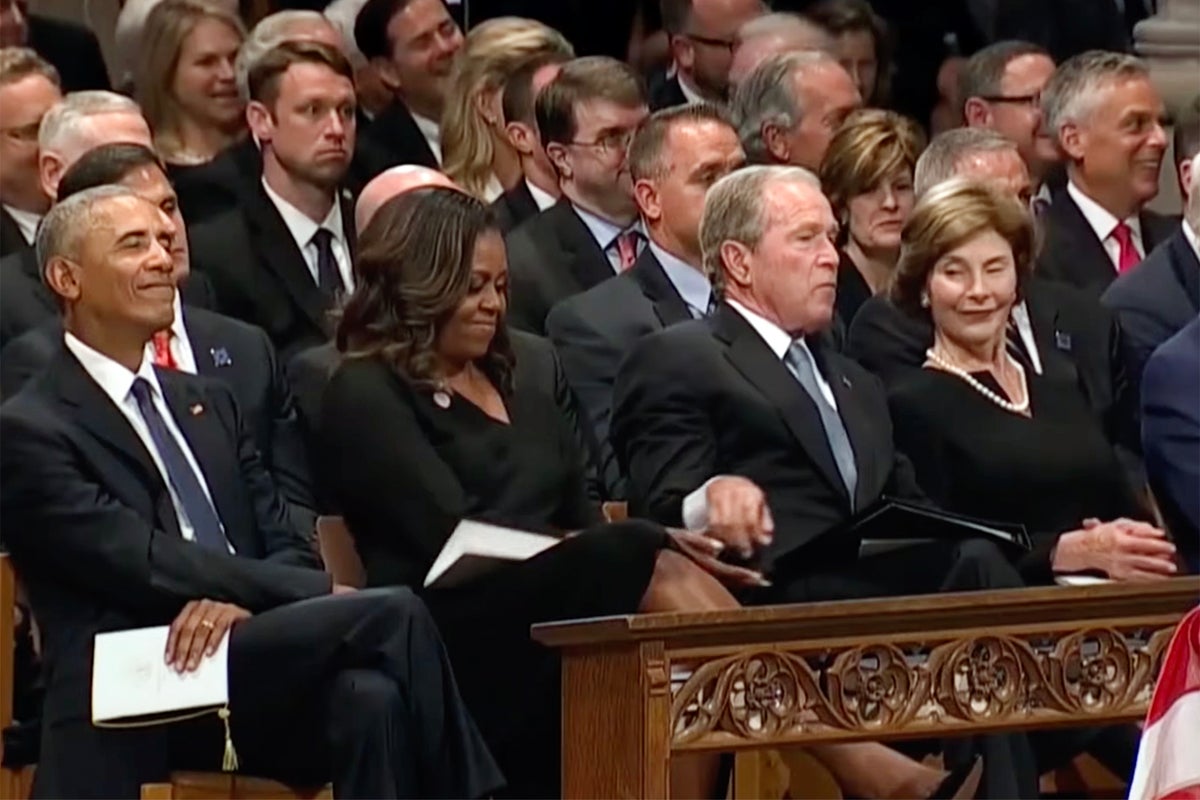
The camera sees the suit. It sees the rigid posture of the men who have held the highest office in the land, the silver hair, and the heavy weight of legacy. We watch these televised ceremonies—funerals, inaugurations, state events—as if we are observing a different species. They are icons in a museum. But if you look closer, past the Secret Service details and the historical gravity, you will see a small, rectangular tin.
It is a tin of Altoids.
In the middle of John McCain’s funeral in 2018, a small, dark object passed from the hand of George W. Bush to Michelle Obama. It was a flick of the wrist, a practiced maneuver that looked more like a schoolboy passing a note in class than a former President interacting with a former First Lady. The internet caught it. The clip went viral. We laughed because it was cute, but we missed the soul of the gesture.
That mint was not about fresh breath. It was about the invisible bridge built between two people who, by every metric of modern tribalism, should be enemies.
The Partisan Wall and the Human Crack
We live in a culture that demands blood. We are told that if you sit on the right, the person on the left is not just wrong, but a threat to your very existence. Politics has become a war of attrition where empathy is viewed as a tactical weakness. Yet, there they were.
George W. Bush and Michelle Obama occupy opposite ends of the American political spectrum. One is the architect of a neoconservative era; the other is a symbol of the progressive hope that defined the late 2000s. Their families fought bitter, grueling campaigns against each other’s interests. And yet, every time they are seated together, there is a palpable, magnetic warmth.
"She kind of likes my sense of humor," Bush later explained. "Anybody who likes my sense of humor, I immediately like."
It sounds simple. It sounds almost reductive. But in that simplicity lies a profound truth about human psychology: we cannot hate someone up close. When you are seated next to someone for four hours during a somber ceremony, the "Former President" and the "Former First Lady" fade away. What remains are two people who are bored, or tired, or grieving, or in need of a sugar-filled cinnamon disc to get through the afternoon.
The Geometry of the Seating Chart
The seating at these events is dictated by protocol. It is a rigid, mathematical arrangement based on the order of presidential terms. Because of where their respective husbands fall in the timeline, George and Michelle are perennial seatmates.
Consider the sensory reality of that position. You are surrounded by thousands of people. You are being broadcast to millions. You are expected to be a statue. In that high-pressure vacuum, a shared joke or a piece of candy becomes a lifeline. It is an act of rebellion against the performance of power.
The "Altoid Incident" wasn't a one-time fluke. It happened again at the funeral of George H.W. Bush. This time, it was intentional. It was a callback. It was a signal to the world that the previous moment wasn't a mistake—it was a tradition.
A Legacy Written in Tin
George W. Bush has often been characterized by his "gut" decision-making. In his post-presidency, he turned to painting, a solitary pursuit that forces a person to look at the world’s edges and shadows. It changed him. Or perhaps, it just allowed the public to see the version of him that his friends already knew.
When he reaches into his pocket to offer Michelle Obama a mint, he is offering a "genuine expression of affection," as she later described it.
She called him her "partner in crime."
Think about the weight of that phrase. These are individuals who have seen the most classified, terrifying data the world has to offer. They have felt the crushing loneliness of the White House. They have been burned by the same fires. That shared trauma creates a baseline of trust that transcends a ballot box.
The Myth of the Monolith
We often fall into the trap of believing that leaders are the sum of their policies. We think that if we disagree with a 2003 tax cut or a 2012 healthcare initiative, we must also fundamentally despise the human being behind it.
But the Altoid is a reminder that people are messy. They are inconsistent. They are capable of holding a friend’s hand even if they wouldn't sign their friend’s bill.
I remember watching my own grandparents—one a fierce labor union advocate, the other a staunch conservative—argue until their faces were purple over the evening news. Five minutes later, they were sharing a plate of cookies and discussing the garden. They understood something we have forgotten: the relationship is the foundation; the politics is just the weather.
The weather changes. The foundation has to hold.
The Invisible Stakes of a Small Gesture
Why does this matter to someone who isn't a world leader? Why should we care about a tiny tin of candy?
Because we are losing our ability to pass the mint.
In our offices, in our neighborhood Facebook groups, and at our Thanksgiving tables, we have replaced the human element with a digital caricature. We see a profile picture and a set of opinions, and we decide we know everything worth knowing about that person. We have stripped away the possibility of the "partner in crime" dynamic.
The stakes are higher than we think. When we lose the ability to find common ground in the small things—a joke, a mint, a shared moment of silence—we lose the ability to function as a society. If a Bush and an Obama can find a way to genuinely love one another's company, the rest of us have no excuse.
The Texture of Connection
Imagine the scene from the perspective of the mint itself.
It starts in a pocket, warmed by the body heat of a man who once led the free world. It is extracted quietly. The tin clicks—a sharp, metallic sound that is swallowed by the swell of an organ or the drone of a eulogy. The hand reaches out. It is a hand that has signed treaties and comforted grieving families.
The recipient is a woman who has carried the hopes of a generation on her shoulders. She feels the cold metal. She takes the mint. The sharp sting of cinnamon hits her tongue, and for a split second, she isn't a political figure. She is just a person sharing a treat with a friend.
That sensation—the physical reality of a shared gift—is the antidote to the cold, sterile anger of the modern age. It is tactile. It is real. It is a reminder that we are made of flesh and bone, not just ideologies.
Beyond the Cinnamon
George W. Bush’s post-presidential life has been defined by a quiet withdrawal from the spotlight, peppered with these flashes of humanity. He didn't have to tell the world about the Altoids. He didn't have to admit that he finds Michelle Obama "wonderful." He could have remained a silent, stoic figure of the past.
By opening up about this friendship, he is performing a final act of service. He is showing us that the "other side" is not a dark abyss. It is just another person, likely sitting there with a dry throat, waiting for someone to offer them a mint.
We don't need more debates. We don't need more white papers or shouting matches on cable news. We need to look at the person sitting next to us—the one we’ve decided is our enemy—and find the one small, ridiculous thing we can agree on.
Maybe it’s a brand of candy. Maybe it’s a bad joke. Maybe it’s just the shared exhaustion of being alive in a complicated world.
The tin is small. The mint is smaller. But the reach is everything. It is the only thing that has ever actually changed the world.
There is a profound, quiet power in the palm of a hand, if only we are willing to open it.