An old man sits in a park in Bristol, watching the pigeons scatter as a teenager sprays a stencil onto a brick wall. The boy doesn’t know the old man is watching. He doesn't know that the silhouette he’s painting—a girl reaching for a balloon—is a ghost of a ghost. The boy is nervous, looking over his shoulder for the police, his fingers stained with crimson paint. He thinks he is making something new. In reality, he is desperately trying to delay an appointment with the inevitable.
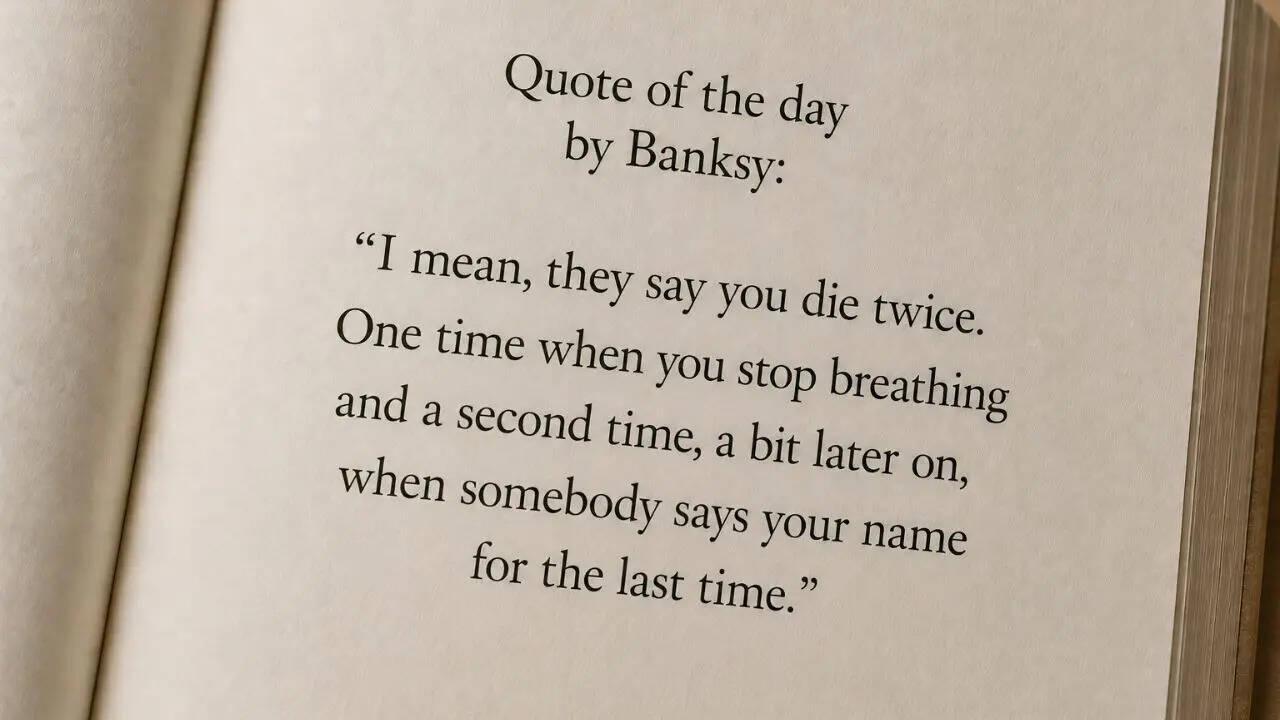
Banksy once suggested that we all have two deaths. The first is when the lungs stop their rhythmic expansion, the heart settles into a permanent stillness, and the spark behind the eyes goes dark. That is the physical expiration. But the second death is the one that actually stings. It happens years, decades, or perhaps centuries later. It occurs at the exact moment someone, somewhere, speaks your name for the very last time. After that, you are truly gone. You are erased from the collective data set of humanity. Meanwhile, you can explore related developments here: The Surprising Cultural Warfare Behind the Return of Denmark’s Mullet Championship.
The Anatomy of an Echo
Most of us spend our lives terrified of the first death while subconsciously sprinting away from the second. We build monuments. We write books. We name children after ourselves. We post photos to digital clouds, hoping the servers in Nevada or Sweden will guard our smiles against the erosion of time.
Consider a woman named Sarah. She lived in 1842. Sarah loved the smell of rain on hot pavement—well, cobblestones—and she had a specific way of laughing that made her sister feel safe. Today, Sarah is physically gone. That was her first death. But is she truly dead? If her great-great-grandson still tells the story of how she once chased a thief through the streets of London to retrieve a stolen locket, Sarah remains a ghost in the machine. She is a vibrating string in the symphony of the living. To understand the complete picture, we recommend the detailed analysis by Apartment Therapy.
The moment that grandson dies, and the story dies with him, Sarah undergoes her second death. The locket becomes just a piece of metal. The story becomes silence.
This isn't just about ego. It’s about the fundamental human desire to mean something. We are the only species that knows its own expiration date, and that knowledge creates a frantic, beautiful energy. It drives the architect to design a skyscraper that will outlive his bones. It drives the parent to instill a specific moral code in a child, a piece of software that will run long after the programmer has left the room.
The Digital Paradox of Memory
We live in an era where we assume the second death has been postponed indefinitely. We are the most recorded generation in history. Every meal, every heartbreak, and every mundane thought is etched into the silicon crust of the earth. We assume that because our names are indexed by search engines, we are immune to the second silence.
But data is not memory.
A hard drive is a cemetery of information, not a living legacy. There is a profound difference between a name existing in a database and a name being spoken with intention. Banksy’s observation cuts through the digital noise. He wasn't talking about a Wikipedia entry. He was talking about the oral tradition of humanity—the way we carry each other forward through narrative.
The risk of the modern age is that we are trading depth for durability. We have millions of "records," but fewer "stories." When we look at a photograph of a stranger from the 1920s, we feel a pang of curiosity. Who were they? Who loved them? If no one can answer, they have reached the threshold of the second death. They are a visual artifact, but the person is gone.
The Weight of a Name
Names carry a specific frequency. In many ancient cultures, to know someone's "true name" was to have power over them. To strike a name from a monument was the ultimate punishment, a "damnatio memoriae" that the Romans used to erase tyrants from history. They understood that the second death could be a weapon.
Why does it matter if someone says your name? Because names are the anchors of identity. When someone speaks your name, they are acknowledging your unique slice of the human experience. They are saying, "This specific configuration of atoms mattered."
Take the hypothetical case of an artist who never sells a painting. Let's call him Elias. Elias spends forty years in a cramped studio, breathing in turpentine and coal dust. He dies alone. His first death is unremarkable. But fifty years later, a young girl finds one of his canvases in a thrift store. She sees the way he captured the light hitting a glass of water. She looks at the signature in the corner—Elias Thorne—and she says it aloud.
In that moment, Elias is resurrected. He isn't physically there to feel it, but the impact of his soul on the world is reaffirmed. The second death is pushed back another generation.
The Strategy of the Eternal
If the second death is the true end, how do we fight it?
Some choose the path of the Great Work. They create art that is so visceral, so undeniable, that it becomes part of the cultural furniture. Banksy himself is an expert at this. By remaining anonymous, he has ensured that his work is the vessel for his name. He has decoupled his physical self from his legacy. Even if the man behind the mask stops breathing today, the name "Banksy" will be whispered in museums and on street corners for centuries. He has built a fortress against the second silence.
But for the rest of us—those who aren't painting murals or leading nations—the battle is fought in the small hours. It is fought in the way we treat the people who will survive us.
Legacy is often misunderstood as a mountain of money or a statue in a square. True legacy is a transfer of energy. It is the way you taught your daughter to look people in the eye. It is the way you helped a neighbor when their world was falling apart. Those people become the carriers of your name. They become the ones who will delay your second death by telling someone else, "I knew a person once who showed me what kindness looked like."
The Comfort of the Final Silence
There is a terrifying beauty in the idea that we will eventually be forgotten.
While the second death sounds like a tragedy, it is also a release. Imagine the weight of a world where every name ever spoken was still echoing. The air would be too thick to breathe. We need the silence to make room for the new voices. The second death is the universe’s way of cleaning the slate, of ensuring that the story of humanity keeps moving forward rather than getting stuck in a loop of its own past.
The old man in the park watches the boy finish his stencil. The boy packs his bags and runs, disappearing into the shadows of an alleyway. The old man walks over to the wall. He touches the wet paint, a small smear of red sticking to his thumb. He remembers a time when he was the one with the spray can, when he felt invincible, when he thought his name would be carved into the moon.
He smiles. He knows his first death is coming soon. He knows the second one will follow eventually, like a quiet tide coming in to smooth over the sand.
But for now, the paint is wet. The girl and the balloon are there. And someone, somewhere, is about to say a name that will keep a ghost alive for just one more day.
We are all just echoes looking for a canyon to bounce off of. We shout into the void, not because we expect an answer, but because the shouting is the only way we know we are here. The second death is the end of the echo, the moment the sound finally hits the soft moss of time and stops. It is the ultimate peace.
Until then, we keep talking. We keep naming. We keep painting.
The pigeons return to the pavement, pecking at crumbs near the wall. The red paint dries under the Bristol sun. The girl holds onto the string. The balloon stays in the air.
Nobody says a word.