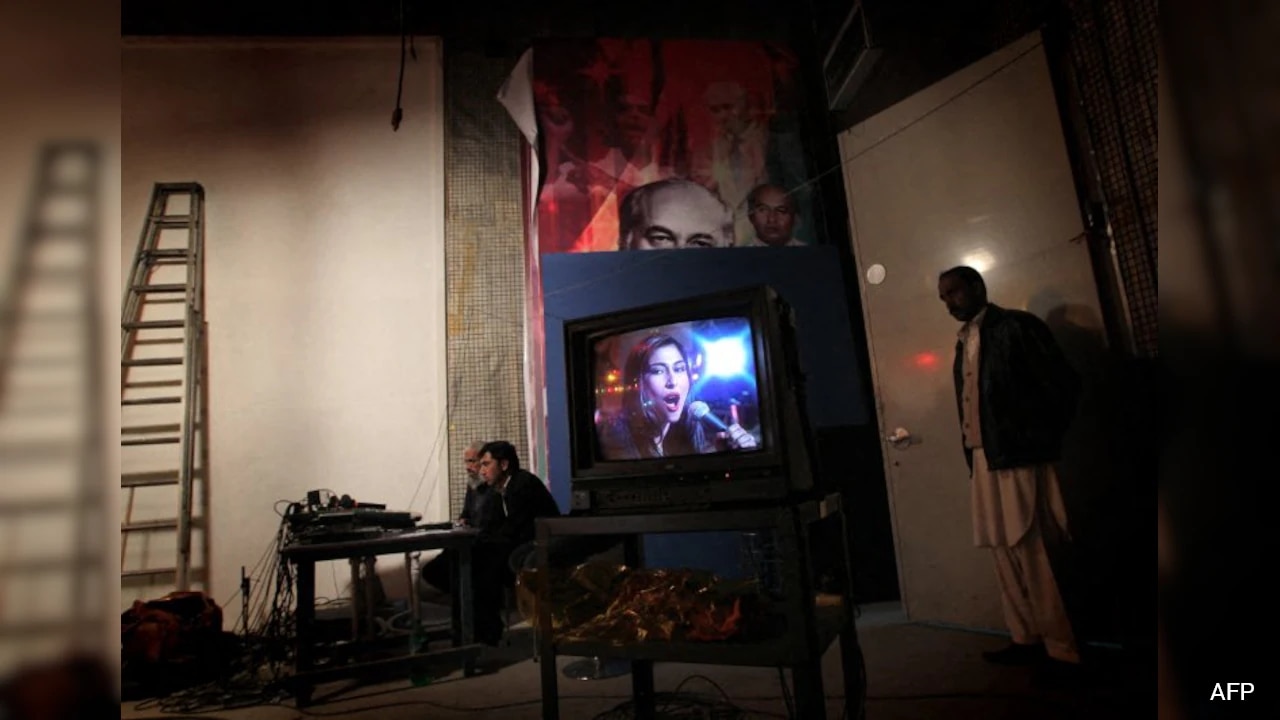
The control room of a major news network at midnight is usually an orchestra of controlled chaos. Monitors blink with live feeds from Islamabad, Lahore, and London. Phones ring off the hook. Producers scream over the static of police scanners.
Then, the screens go dark. Not because of a power outage. Not because of a technical glitch. But because a single piece of video, traveling at the speed of light through satellite transponders, collided with the invisible, hyper-sensitive tripwires of a nation's faith. Learn more on a similar subject: this related article.
This is exactly what happened when the Pakistan Electronic Media Regulatory Authority (PEMRA) pulled the plug on Geo News, slapping the media giant with a mandatory 15-day suspension. The corporate press release reads like a cold autopsy: a violation of broadcasting ordinances, a failure of internal oversight, a temporary cessation of license. But if you stand in the shoes of an ordinary producer in Karachi, or a viewer watching the static in a roadside tea stall, the story is entirely different.
It is a story about how thin the ice really is. More journalism by Reuters delves into comparable perspectives on the subject.
The Fifteen Minutes That Cost Fifteen Days
To understand how a multi-million-dollar media empire loses its voice in an instant, we have to look at the specific heat of June in Pakistan. It was the tenth day of Muharram, a period of deep, mournful significance across the Islamic world. The streets were quiet, blocked by heavy security containers to keep the peace between communities.
Geo News aired a special documentary segment titled Safar-e-Ishq. The program aimed to show how different cultures across the Middle East observe the historical tragedy of Karbala. It featured footage of local traditions from Iraq, where communal expressions of mourning sometimes involve dramatic re-enactments.
To an outside observer or an academic researcher, it was a cultural document. To a hyper-vigilant regulatory body monitoring transmissions in real time, it was a fuse lit near a powder keg.
Consider the panic that sets in when an editorial oversight occurs in a country where religious imagery carries absolute stakes. Consider a hypothetical assistant producer—let's call him Tariq—sitting at a desk, reviewing a foreign tape. He sees rituals practiced by a minority community in Baghdad. He thinks it illustrates the global scope of the holy month. He pushes "play."
He does not realize that what is acceptable in the shrines of Iraq can trigger immediate legal, social, and physical upheaval when broadcast into millions of Sunni-majority homes in Pakistan.
The regulator acted with swift, merciless precision. By the next morning, the notice was taped to the doors: Geo News was banned from satellites, cable networks, and digital distribution platforms for over two weeks.
The Apology on an Empty Screen
The corporate reaction was immediate, frantic, and desperate. Geo News stripped the documentary from every server, wiped it from YouTube, and issued an unconditional public apology before the state even concluded its formal complaints process.
The network pleaded that the footage was broadcast inadvertently. They explained that the visuals were intended only to illustrate foreign customs, not to endorse a specific sectarian interpretation. They suspended the individuals involved.
But the damage was done. The screen remained blank.
This isn't just about a corporate entity losing advertising revenue for two weeks, though the financial blow to an organization employing more than 1,500 people is immense. The real crisis is the chilling effect that settles over every other newsroom in the country. When the biggest player on the board gets knocked down for a single editorial lapse, the smaller channels don't just tighten their compliance; they freeze.
Journalism under these conditions becomes an exercise in survival rather than reporting. According to the 2026 World Press Freedom Index by Reporters Without Borders, Pakistan sits at a dismal 153rd out of 180 countries. It is a hybrid political ecosystem where journalists walk a tightrope stretched between state security directives on one side and deep-seated religious sensitivities on the other. Step an inch to the left, and you face the regulators. Step an inch to the right, and you face the street.
The Invisible Borders of the Airwaves
We often treat the media as a detached, monolithic entity. We forget that the people running the cameras and writing the chyrons are human beings operating within the psychological boundaries of their own society. They know that in Pakistan, an accusation of religious offense isn't just a matter of regulatory fines or a 15-day vacation for the channel. It can be a matter of life and death.
The regulator's defense is rooted in public safety. In a country where sectarian tensions have historically flared into street violence, authorities view strict censorship during holy months not as a restriction of freedom, but as a maintenance of the peace. They argue that an offensive broadcast can cause riots faster than any political speech.
But where does documentation end and offense begin?
When we lose the ability to look at how the rest of the world practices faith, out of fear that the mere sight of difference will shatter our own peace, our world shrinks. The screen in Karachi doesn't just go black for fifteen days; it stays dark in the minds of anyone afraid to tell a complex story.
The silence left in the wake of the Geo News suspension is loud. It reminds every writer, editor, and broadcaster that their independence is entirely conditional. You can speak, you can report, and you can analyze—until you hit the boundary line that nobody can clearly see until they have already crossed it.
A lonely television set in a Karachi market remains tuned to a channel that isn't there, broadcasting nothing but blue light and static onto the faces of passersby.