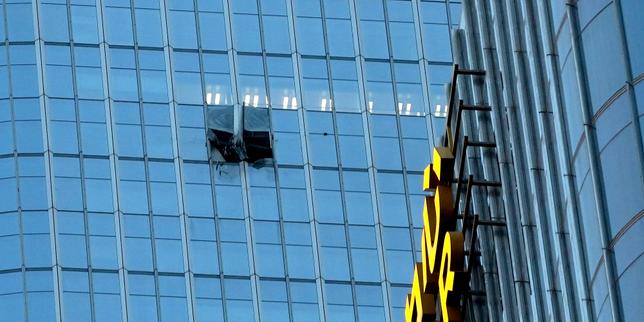
The afternoon sun over Chaoyang District was sharp enough to make you squint, the kind of dry, high-altitude brightness that characterizes Beijing in late spring. Traffic on the Third Ring Road crawled in its usual, sluggish rhythm. Pedestrians shuffled past the glass facades of the central business district, their eyes glued to the five-inch screens in their palms.
Then came the tear in the sky.
It wasn't the roar of a commercial jetliner, nor the low hum of a military transport. It was the frantic, high-pitched whine of a light, two-seater aircraft engine pushed far past its operational limits. For a handful of seconds, thousands of people looked up. They saw the silver flash of metal banking hard, a desperate, erratic trajectory that looked less like flight and more like a stumble through the air.
The impact did not sound like an explosion. It sounded like a massive, metallic fist striking an anvil.
When a two-seater plane slammed directly into the upper tiers of China Zun—the 528-meter skyscraper that anchors the capital’s skyline like a giant, tapering wine vessel—the physical shudder was felt through the concrete foundations of the surrounding blocks. Debris, fine as winter frost and jagged as broken mirrors, rained down onto the manicured plazas below.
Step into the shoes of someone standing at the base of that tower. Imagine the smell of vaporized aviation fuel cutting through the city's familiar haze. Your heart hammers against your ribs. Your instincts scream at you to find out what happened, who was inside, and whether the world you went to sleep in is still the one you are standing in now.
Naturally, you do what any modern human does. You open your phone.
You open WeChat. You open Weibo. You refresh the state media apps.
Nothing.
The sky had just screamed, but the screens were completely mute.
The Architecture of Absolute Stillness
For three hours, the digital universe of the world’s most populous internet ecosystem behaved as though the laws of physics had simply paused over Beijing. If you searched for the name of the tower, the results returned restaurant reviews and real estate listings from last week. If you uploaded a five-second clip of the smoke plume drifting off the top of the skyscraper, the video vanished into a black hole of permanent rendering.
This is the invisible friction of modern information control. It is not a clumsy wall; it is a highly responsive, automated suffocator.
To understand how a major aviation disaster in the heart of a mega-city can be rendered non-existent in real-time, you have to look past the software. You have to look at the human labor driving it. In low-slung office parks on the outskirts of cities like Tianjin and Xi'an, thousands of content moderators sit in shifts that never end. They are the digital street sweepers, armed with keyword lists that update by the minute.
When the plane struck the tower, an alarm didn't just sound in the cockpit; an algorithmic tripwire snapped across the entire Chinese internet.
Consider the psychological weight of that silence. For the citizens walking the streets of Beijing, the lack of information becomes far more terrifying than the event itself. Rumor is a gas; it expands to fill any vacuum. Within ninety minutes of the crash, the offline whisper networks were buzzing with dark theories. Was it a political assassination? A targeted terror attack on the financial heart of the regime? A defection gone wrong?
When authority refuses to speak, it inadvertently invites the imagination to construct monsters.
The Cost of the Unsaid
The standard wire reports from international agencies eventual covered the bare mechanics of the afternoon. They listed the aircraft model, the approximate time of departure, and the grim reality of the two casualties inside the cockpit. They treated the subsequent media blackout as a predictable quirk of an authoritarian system—a standard operating procedure.
But treating it as routine misses the deep, human tragedy of enforced amnesia.
Information is not just data; it is the currency of safety. When a plane hits a building in any major global metropolis, the immediate flow of information saves lives. It tells people which streets to avoid, which hospitals are overwhelmed, and whether their loved ones inside the structure are out of harm's way. To cut those lines of communication for the sake of maintaining a pristine image of social stability is to trade physical safety for psychological theater.
The true stakes are found in the families of those affected. Imagine being the parent, the spouse, or the child of someone who worked on the top floors of China Zun. You know where their desk is. You saw the smoke on your walk to the subway. Yet, every digital avenue you possess tells you that your eyes are lying to you. The state-run television channels continue broadcasting a documentary on rural agricultural reforms. The news tickers focus on a trade delegation in Europe.
You are forced to navigate your terror in absolute isolation, gaslit by the very infrastructure meant to keep you connected.
The Filter and the Fracture
There is a profound irony in the modern landscape of technology. We were promised that the internet would make censorship impossible, that information would always find a way to break through the cracks like water through concrete.
The reality is that concrete has gotten much better at sealing its cracks.
The system relies on a concept known as "preventative harmony." It is the architectural belief that an event did not truly happen if it cannot be debated, shared, or memorialized. By the time the first official, heavily sanitized statement dropped from a minor municipal bureau four hours after the impact, the digital landscape had already been scrubbed clean. The statement was brief, attributing the crash to a mechanical failure during a low-altitude survey flight, noting dryly that the fire had been extinguished with minimal structural damage to the tower.
No comments were allowed underneath the post. The "share" button was greyed out.
The story was dead before the wreckage had even cooled.
This method of governance creates a strange, bifurcated reality for those who live within it. On the outside, there is the physical world of broken glass, emergency sirens, and the unmistakable smell of burning oil. On the inside, there is a digital world of perfect serenity, rising stock indices, and choreographed optimism. To survive there, a person must learn to hold both of these worlds in their head at the same time, knowing full well they contradict each other.
The plane that struck the highest tower in Beijing left a physical scar on the building's crown, a black smudge against the silver and glass that engineers will patch over within a matter of weeks. The glass will be replaced. The steel will be reinforced. The physical debris will be hauled away to a landfill outside the city limits, hidden from view.
But the deeper fracture remains unpatched. It is the quiet, creeping realization among millions of onlookers that if the sky can fall in broad daylight and leave no trace on the record, then anything can disappear. The true danger isn't the sudden, violent intrusion of reality from above. It is the terrifying ease with which that reality can be erased from the collective memory, leaving nothing behind but the steady, rhythmic scrolling of a screen that tells you everything is perfectly fine.